







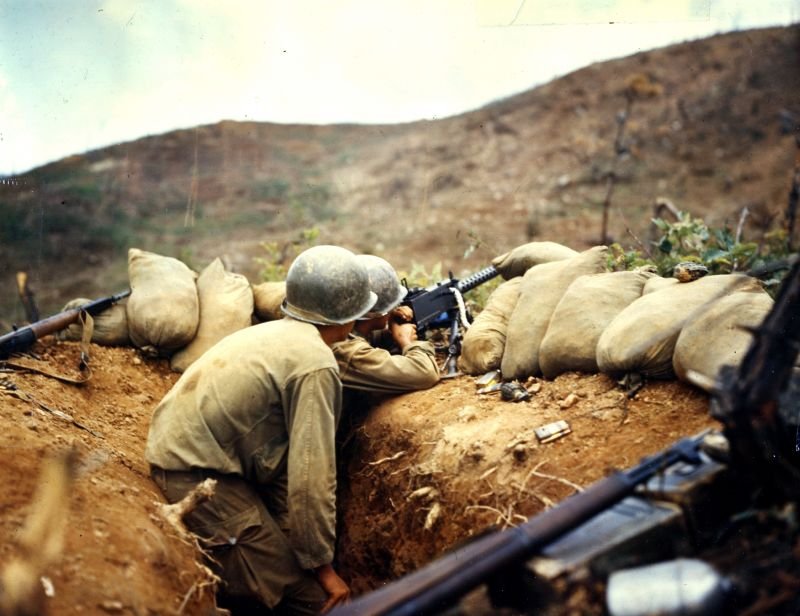


Seventy-five years ago, one of the most devastating and consequential wars in modern history began. On June 25, 1950, over 135,000 North Korean soldiers stormed across the 38th parallel into South Korea, launching a conflict that would claim millions of lives and leave a lasting impact on global geopolitics. Known as the Korean War, it remains one of the most overlooked events of the 20th century—eclipsed by World War II and often dubbed “The Forgotten War,” despite its enormous cost and enduring legacy.

I. The Start of a Divided Conflict
1. The North Invades the South
The Korean War began when North Korea, led by Kim Il Sung, invaded South Korea with the backing of the Soviet Union and later, China. This military action was aimed at unifying the Korean Peninsula under communist control. The South, supported by the United Nations and spearheaded by the United States, mounted a defense that would quickly escalate into a full-blown international war.
2. A War Without an Official End
While the fighting officially ceased with an armistice on July 27, 1953, the war never technically ended. No peace treaty was signed, and the Korean Peninsula remains divided, with North and South Korea still technically at war. This lingering conflict continues to shape international relations, especially between the U.S., China, and North Korea.
II. Overlooked But Not Forgotten: Six Critical Insights About the Korean War
1. The U.S. Once Controlled Pyongyang
Though it’s nearly impossible for Americans to enter Pyongyang today, in 1950, U.S. and South Korean forces captured the North Korean capital. On October 19, the 1st Cavalry Division entered Pyongyang, and by October 22, the U.S. Eighth Army had established its headquarters in Kim Il Sung’s former office. A symbolic photo from the time even shows a U.S. intelligence officer seated at Kim’s desk, with Stalin’s portrait hanging behind him. However, the occupation was short-lived—Chinese troops entered the war in late November and expelled U.S. forces by December 5.
2. North Korea Faced Unprecedented Bombing
The Korean War saw an enormous air campaign by the U.S., which dropped over 635,000 tons of explosives on North Korea—surpassing the total used in the Pacific Theater during World War II. This campaign destroyed nearly every major structure in the country, forcing citizens to live in holes and shelters. Historian Charles Armstrong and others noted that the psychological and physical damage caused by this bombing campaign remains deeply embedded in North Korea’s defense strategy, including its development of nuclear weapons and fortified underground facilities.
3. Stalin and Mao Approved the Invasion
After World War II, Korea was divided between Soviet and American zones. Kim Il Sung sought Stalin’s permission to unify Korea under communist rule. Initially hesitant, Stalin agreed in 1950 on the condition that Kim also secure China’s support. Mao Zedong, emboldened by his recent victory in the Chinese Civil War and America’s lack of intervention, agreed. This tri-party backing gave Kim the green light to proceed with the invasion, triggering the war.
4. The War Altered Taiwan’s Fate
In 1949, the newly formed People’s Republic of China was preparing to invade Taiwan, home to Chiang Kai-shek’s Nationalist government. But the outbreak of the Korean War changed U.S. priorities. President Truman dispatched the Seventh Fleet to the Taiwan Strait, effectively preventing a communist invasion. Troops initially stationed to attack Taiwan were redirected to Korea. While this move saved Taiwan, it also drew China directly into the Korean conflict, where it suffered over 180,000 troop fatalities.
5. The First Jet-on-Jet Dogfight Occurred Over Korea
The Korean War was the setting for the first dogfight between jet fighters. On November 8, 1950, U.S. F-80 jets engaged Soviet-made MiG-15s near the Yalu River. U.S. Air Force Lt. Russell Brown claimed the first kill, though Soviet sources dispute this. However, a confirmed kill was made the following day by U.S. Navy Lt. Cmdr. William Amen, flying an F9F Panther from the USS Philippine Sea. These dogfights later intensified in “MiG Alley,” where better-trained American pilots achieved an estimated 8:1 kill ratio.
6. A War Without Congressional Declaration
The Korean War set a precedent for U.S. military involvement without a formal declaration of war. Under the U.S. Constitution, only Congress can declare war, a power last exercised during World War II. When the Korean War broke out, President Truman sent troops under a United Nations mandate without Congressional approval, framing it as a “police action.” This approach became the template for future U.S. conflicts in Vietnam, Iraq, Afghanistan, and Kosovo, reflecting a significant shift in how the United States engages militarily.
III. The Korean War’s Lingering Legacy
1. Modern-Day Tensions on the Korean Peninsula
Though hostilities stopped in 1953, the Korean Peninsula remains divided and militarized. Occasional skirmishes, nuclear testing by North Korea, and diplomatic standoffs keep the memory of the war alive. The demilitarized zone (DMZ) is among the most heavily guarded borders in the world, symbolizing a war that never truly ended.
2. U.S.-North Korea Relations and Historical Trauma
The immense destruction caused by the U.S. bombing campaign continues to influence North Korean foreign policy. According to Armstrong, North Korea’s obsession with nuclear weapons stems from its fear of future U.S. airstrikes. Despite fluctuating diplomatic relations, the wounds of war and its psychological impacts remain significant obstacles to peace.
Conclusion: A War That Shaped the Modern World
The Korean War is often called “The Forgotten War,” yet its influence is anything but forgotten. From reshaping U.S. military policy to altering the course of Taiwan’s history, and from establishing Cold War battle lines to influencing North Korea’s modern strategy, the war’s impact is enduring. Though overshadowed by World War II and Vietnam, the Korean War laid the foundation for many of the geopolitical tensions we still navigate today. As we mark 75 years since its outbreak, it’s time to remember the sacrifices made and the lessons left behind by this unfinished chapter in world history.








