





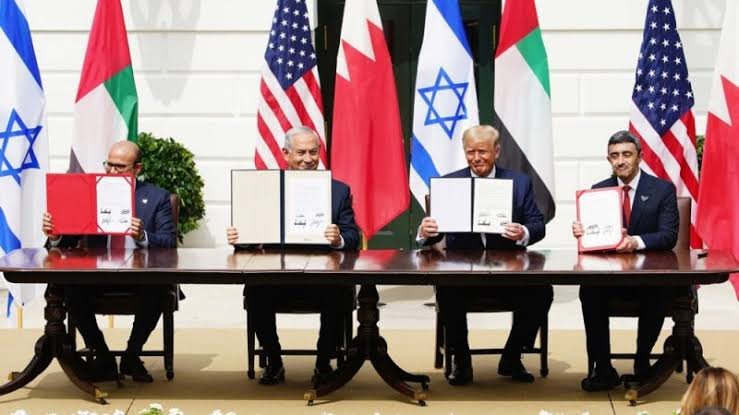


The signing of the Abraham Accords in 2020 marked a turning point in Middle Eastern diplomacy, ushering in a new era of normalization between Israel and several Arab states. Initiated under U.S. mediation, the Accords saw the United Arab Emirates (UAE) and Bahrain formally recognize and establish diplomatic relations with Israel, soon followed by Sudan and Morocco. While these agreements were historic, their broader regional implications continue to unfold.

More than four years later, the geopolitical landscape of the Middle East and North Africa (MENA) has evolved significantly. Regional powers — including Saudi Arabia, Iran, Turkey, Egypt, and Qatar — have been reassessing their foreign policy priorities, realigning strategic interests, and redefining bilateral and multilateral relationships in light of the Accords and their aftermath.
This article explores how the Abraham Accords have reshaped diplomatic equations, trade relations, defense strategies, and regional alignments — while also examining the challenges and contradictions that remain in the region’s complex geopolitical fabric.
The Abraham Accords: A Diplomatic Game-Changer
The Abraham Accords represented a paradigm shift in Arab-Israeli relations. For decades, most Arab states withheld diplomatic recognition of Israel, citing the unresolved Palestinian issue as the main impediment. The Accords broke this convention, normalizing relations in the absence of a comprehensive peace deal between Israel and the Palestinians.

Beyond symbolism, the agreements opened avenues for:
-
Bilateral trade and economic cooperation
-
Technology and defense partnerships
-
Tourism and cultural exchange
-
Joint innovation in cybersecurity, water, and energy
Crucially, the Accords reflected a convergence of strategic interests — especially mutual concerns about Iran’s regional influence, the need for economic diversification, and a shared interest in stability.
UAE and Bahrain: From Diplomacy to Deep Integration
The UAE has been the most enthusiastic architect of post-Accords diplomacy. Abu Dhabi quickly moved from symbolic gestures to substantial bilateral cooperation with Israel. In just a few years:
-
Trade between the UAE and Israel has surpassed $3 billion, with expectations of continued growth.
-
Both countries signed comprehensive economic partnership agreements (CEPA).
-
Defense ties, including the exchange of intelligence and military technologies, have deepened.
-
Collaborative ventures in agriculture, health, clean energy, and AI are expanding.
Bahrain, while more cautious, has followed suit — welcoming Israeli officials and integrating Israel into regional security discussions. However, domestic public sentiment remains more reserved, prompting a more low-key diplomatic rollout compared to the UAE.
Morocco and Sudan: Normalization With Nuances
Morocco’s normalization came with a significant diplomatic gain: U.S. recognition of Moroccan sovereignty over Western Sahara. In return, Rabat expanded ties with Israel in areas such as trade, tourism, and military cooperation. Still, the relationship is carefully managed, with attention to both domestic sensitivities and regional optics.
Sudan’s normalization remains less advanced. Despite removing Sudan from the U.S. state sponsors of terrorism list as part of the deal, internal instability and the country’s fragile transition have delayed the establishment of formal diplomatic mechanisms with Israel.
Saudi Arabia: Watching, Waiting, and Signaling
Saudi Arabia — arguably the most influential regional power in the Gulf — did not formally join the Abraham Accords but has signaled openness to normalization under specific conditions.
Under Crown Prince Mohammed bin Salman (MBS), Riyadh has:
-
Allowed Israeli overflights through Saudi airspace
-
Facilitated discreet diplomatic engagements
-
Expressed conditional support for normalization, often tying it to progress on the Palestinian statehood issue
The Kingdom’s current position reflects a careful balancing act:
-
Strategic Interest: Saudi Arabia shares with Israel concerns about Iranian influence, the need for regional stability, and technological modernization.
-
Domestic and Religious Sensitivities: As the custodian of Islam’s two holiest sites, Saudi Arabia is cautious about alienating domestic and wider Muslim opinion.
-
Negotiation Leverage: Riyadh seeks to extract maximum geopolitical benefit — including U.S. security guarantees, advanced weapons systems, and progress in the Palestinian-Israeli peace process.
Recent reports suggest that while formal normalization is not imminent, gradual confidence-building measures are underway, indicating that Saudi-Israeli relations may further evolve in the coming years.
Egypt and Jordan: Old Allies, New Dynamics
Egypt and Jordan were the first two Arab states to sign peace treaties with Israel — in 1979 and 1994, respectively. However, their “cold peace” with Israel was characterized by limited public engagement and tepid economic interaction.
The Abraham Accords have revitalized this dynamic:
-
Egypt has expanded trilateral cooperation with Israel and the UAE, particularly in energy and gas exports to Europe.
-
Jordan remains a key security partner and an intermediary in Israeli-Palestinian issues.
-
Both countries are exploring economic corridors, water-sharing agreements, and regional connectivity projects involving Israel and Gulf states.
Nonetheless, both Egypt and Jordan continue to emphasize the centrality of the Palestinian issue, warning against bypassing or sidelining Palestinian aspirations.
Iran: A Catalyst and Adversary
The Abraham Accords have intensified Iran’s perception of regional encirclement. Tehran views normalization as a U.S.-led strategic alliance aimed at isolating Iran politically and militarily.
In response, Iran has:
-
Increased rhetorical attacks on Gulf countries normalizing with Israel.
-
Strengthened its own regional alliances — notably with Hezbollah, the Syrian regime, and various Iraqi and Yemeni militias.
-
Accelerated military drills and drone development to signal deterrence.
-
Exploited anti-normalization sentiment through media, cyber operations, and proxy networks.
Paradoxically, the Abraham Accords have driven Iran to deepen its economic and security ties with non-Arab allies, including Russia and China, in an attempt to offset regional isolation.
Turkey: Realigning for Relevance
Turkey initially criticized the Abraham Accords, positioning itself as a defender of Palestinian rights. However, faced with diplomatic isolation and economic challenges, Ankara has since softened its stance and recalibrated relations across the region.
Key developments include:
-
Restoration of full diplomatic ties with Israel in 2022, following years of strained relations.
-
Pursuit of energy cooperation, particularly involving Eastern Mediterranean gas resources.
-
Engagement with UAE, Saudi Arabia, and Egypt to normalize ties and boost trade.
Turkey’s pragmatic shift illustrates how even critics of the Accords are now realigning to protect national interests, especially in a region increasingly defined by economic pragmatism and multipolar diplomacy.
Qatar: Walking a Fine Line
Qatar did not join the Abraham Accords and maintains a nuanced foreign policy:
-
It hosts Hamas’ political office and advocates for Palestinian rights.
-
At the same time, it permits discreet security coordination with Israel, particularly concerning Gaza.
-
Qatar’s media influence (e.g., Al Jazeera) continues to critique normalization efforts, reflecting both ideological and strategic priorities.
Doha positions itself as a mediator and humanitarian actor, often engaging in backchannel diplomacy with multiple sides, including Israel, Iran, and the U.S.
The Palestinians: Marginalized but Not Forgotten
The Abraham Accords were signed without direct Palestinian involvement, triggering accusations of betrayal from Palestinian leaders. While some normalization advocates argue that engagement with Israel can eventually benefit the Palestinian cause through economic integration and dialogue, most Palestinians view the agreements as a circumvention of their rights.
The Accords have:
-
Undermined the Arab Peace Initiative (2002), which made normalization conditional on Palestinian statehood.
-
Reduced leverage for Palestinian negotiators.
-
Sparked internal divisions between factions over strategy and foreign alliances.
Nonetheless, the resilience of the Palestinian issue remains evident. Global protests during recent Israeli-Palestinian escalations, continued support from non-Arab Muslim countries, and rising youth activism in the West indicate that Palestinian aspirations have not faded — even as regional dynamics shift.
New Multilateralism: Regional Blocs and Cooperation
Post-Abraham Accords, new multilateral initiatives are gaining traction. These include:
-
I2U2 Group (India, Israel, UAE, USA): A quadrilateral partnership focusing on food security, technology, and investment.
-
Negev Forum: A platform for cooperation between Israel and several Arab states on regional integration and development.
-
Eastern Mediterranean Gas Forum (EMGF): Involving Egypt, Israel, Cyprus, and others — emphasizing energy diplomacy.
These groupings reflect a new regional architecture, less bound by ideological divisions and more focused on geoeconomic collaboration and technological synergy.
Challenges Ahead: Fragility, Backlash, and Escalation
Despite significant progress, the post-Abraham Accords environment is not without risks:
-
Backlash from Non-State Actors: Groups like Hezbollah, Houthis, and Hamas oppose normalization and can disrupt diplomatic and security progress.
-
Public Opinion Divergence: Many Arab citizens remain skeptical or hostile toward normalization, creating a disconnect between governments and their populations.
-
Escalation of Israeli-Palestinian Tensions: Any major conflict could derail normalization efforts or strain new alliances.
-
Geopolitical Polarization: Competition between the U.S., China, and Russia may complicate or exploit regional alignments.
-
Unrealized Expectations: Failure to deliver economic benefits or tangible development from normalization could fuel disillusionment.
Conclusion: A Region in Transformation
The Abraham Accords were not just diplomatic agreements; they were a catalyst for regional transformation. They have redefined the Middle East’s political and economic map, encouraging new alliances, softening old rivalries, and catalyzing pragmatic engagement.
Regional powers — from Saudi Arabia to Turkey, and from Egypt to Iran — are responding in diverse ways, each recalibrating their foreign policy to navigate the post-Accords reality. While the trajectory remains uncertain and riddled with complexities, the region is unmistakably moving toward a more open, multipolar, and interconnected future.
The true legacy of the Abraham Accords will depend not only on the resilience of these new ties but also on whether they can be leveraged to advance peace, prosperity, and justice for all — including the long-sidelined Palestinian people.








