





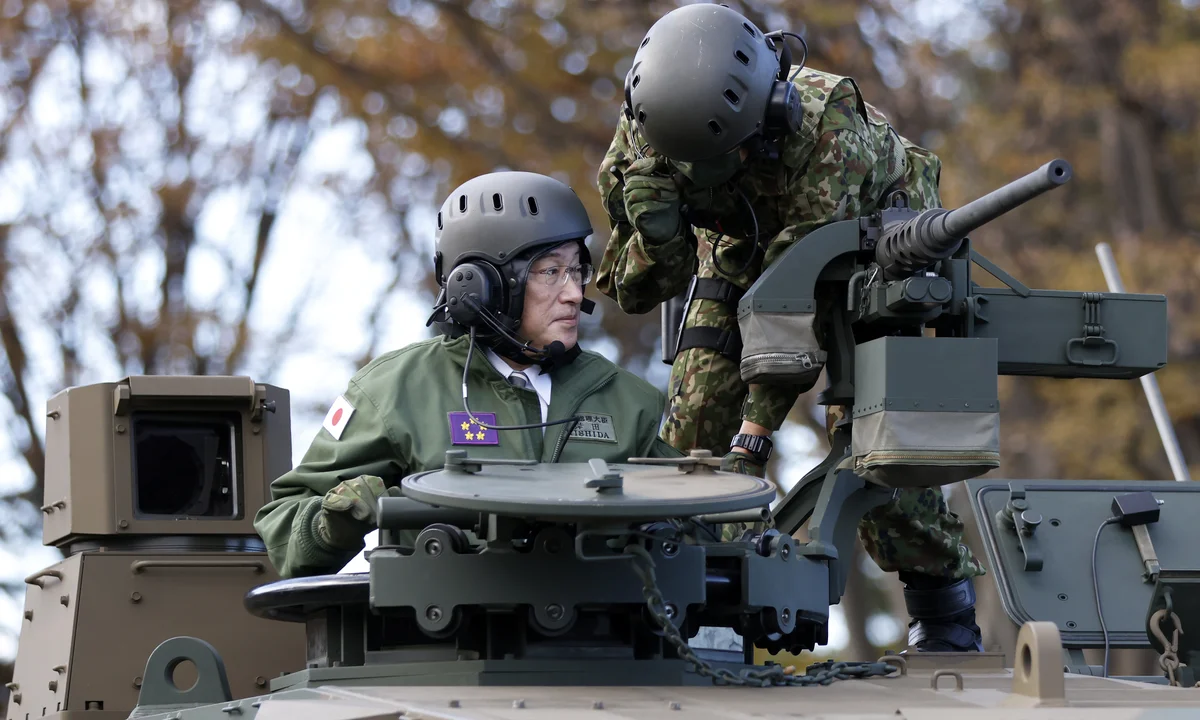

For decades, Japan maintained a pacifist stance enshrined in its post-World War II constitution, particularly Article 9, which renounces the right to wage war. However, the shifting security dynamics in East Asia have prompted Tokyo to reconsider its long-held position. From rising tensions with China over territorial disputes in the East China Sea to the persistent threat of North Korean missile tests, Japan finds itself in a region fraught with geopolitical volatility.


In response, Tokyo has gradually—but steadily—moved toward a more assertive military posture. This transition, while controversial domestically and abroad, reflects the country’s reassessment of its national defense priorities in the face of evolving threats. Under the leadership of Prime Minister Fumio Kishida and influenced by regional developments, Japan is now investing in offensive capabilities, expanding its defense budget, and bolstering security alliances, particularly with the United States and like-minded democracies.

This article delves into the drivers of Japan’s military shift, the domestic and international implications, and the potential outcomes for regional and global security.
Historical Background: Japan’s Postwar Pacifism
After its defeat in World War II, Japan adopted a pacifist constitution in 1947 under the influence of the United States. Article 9 famously states that “the Japanese people forever renounce war as a sovereign right of the nation,” and that land, sea, and air forces “will never be maintained.” Despite this, the Japan Self-Defense Forces (JSDF) were established in 1954, under the interpretation that Japan could maintain military forces strictly for self-defense.

For decades, Japan operated under a policy of minimal defensive capability, limiting military spending to about 1% of GDP, refraining from developing offensive weapons, and relying heavily on the U.S.-Japan Security Treaty for extended deterrence.
However, by the 21st century, this stance began to evolve. Japan’s strategic environment changed drastically, prompting a reconsideration of its military doctrine.
Strategic Drivers of Japan’s Military Shift
Several factors have driven Tokyo’s shift toward a more assertive defense posture:
1. The Rise of China
China’s rapid military modernization and increasingly assertive behavior in the East and South China Seas have alarmed Japanese policymakers. The Senkaku Islands (known as Diaoyu in China), administered by Japan but claimed by Beijing, have become a flashpoint for tension. Chinese coast guard and naval vessels frequently patrol the area, leading to confrontations.
China’s growing naval capabilities, missile programs, and overall regional influence have heightened Japanese fears of strategic encirclement and potential coercion.
2. North Korea’s Missile and Nuclear Threat
North Korea’s ongoing development of nuclear weapons and long-range ballistic missiles directly threatens Japan. Pyongyang has repeatedly launched missiles that fly over Japanese territory, triggering emergency alerts and public fear.
The unpredictability of the North Korean regime has added urgency to Japan’s efforts to enhance its missile defense systems and potentially acquire counterstrike capabilities.
3. Uncertain U.S. Commitment
Although the U.S.-Japan alliance remains strong, concerns about the reliability of American extended deterrence, especially during the Trump administration, led to a growing realization in Tokyo that Japan must do more for its own defense.
Even under the Biden administration, the shifting focus of U.S. foreign policy and global commitments have underscored the need for strategic autonomy, albeit within the framework of alliance cooperation.
4. Russia’s Invasion of Ukraine
Russia’s 2022 invasion of Ukraine sent shockwaves around the world, including Japan. The conflict illustrated how quickly a military invasion could reshape borders and global norms, and it raised alarms that similar aggression could occur in Asia, particularly over Taiwan or disputed islands.
Japan responded by taking a harder stance against Moscow, sanctioning Russian officials and increasing its own defense urgency. The war in Ukraine is often cited by Japanese officials as a “wake-up call.”
Key Elements of Japan’s New Defense Strategy
In late 2022, Japan released a new National Security Strategy (NSS), National Defense Strategy, and Defense Buildup Program, marking the most significant transformation in its postwar defense posture.
1. Doubling the Defense Budget
Japan announced plans to double its defense spending to 2% of GDP by 2027, aligning with NATO standards. This would make Japan’s defense budget the third-largest in the world, behind the U.S. and China.
The budget increase will fund:
-
Long-range missiles
-
Cybersecurity enhancements
-
Unmanned systems
-
Space and satellite technology
-
Improved missile defense
2. Acquisition of Counterstrike Capabilities
Perhaps the most controversial move is Japan’s decision to acquire counterstrike capabilities, allowing it to hit enemy bases preemptively in the event of an imminent attack.
This includes:
-
The purchase and development of Tomahawk cruise missiles from the U.S.
-
Deployment of indigenous missiles like the Type-12 surface-to-ship missile with extended range
-
Upgrades to Japan’s F-35 fighter jets to carry long-range munitions
This marks a dramatic shift from purely defensive to proactive deterrence, challenging longstanding interpretations of Article 9.
3. Strengthening the U.S.-Japan Alliance
Tokyo continues to view the U.S.-Japan alliance as the cornerstone of its security. Joint military drills, intelligence sharing, and interoperability have increased.
In 2023, Japan and the U.S. agreed to:
-
Station U.S. Marine Littoral Regiments in Okinawa
-
Establish new command structures for rapid response
-
Coordinate on emerging technologies like hypersonics and AI
These moves aim to enhance integrated deterrence, particularly with regard to a Taiwan contingency.
4. Deepening Security Partnerships
Beyond the U.S., Japan is building ties with other like-minded countries:
-
The Quad (Japan, India, Australia, U.S.) has become a key regional framework.
-
Japan signed defense cooperation agreements with the U.K., France, and Australia.
-
Tokyo launched joint military exercises with ASEAN and supported capacity-building in Southeast Asia.
These efforts are part of a broader strategy to deter unilateral changes to the status quo in the Indo-Pacific.
Domestic Challenges and Public Debate
While Japan’s security shift has elite and strategic support, it also faces domestic hurdles:
1. Constitutional Constraints
Article 9 remains intact. Although reinterpretations and legal loopholes have allowed incremental changes, amending the constitution would require a two-thirds majority in both houses of the Diet and a national referendum—a difficult political hurdle.
2. Public Opinion
Japanese society remains cautious about militarization, shaped by its postwar pacifist identity. Polls show support for self-defense but ambivalence about offensive capabilities or constitutional revision.
Efforts by leaders to sell the new defense posture often rely on framing it as a necessity, not a choice, in light of growing threats.
3. Fiscal and Social Trade-Offs
Critics argue that increased defense spending could divert funds from social welfare, healthcare, and education, particularly in a rapidly aging society.
The challenge for Kishida’s government is balancing strategic urgency with economic sustainability and public consent.
Regional and Global Reactions
1. China
Beijing views Japan’s military expansion with deep suspicion, accusing Tokyo of militarism and revanchism. Chinese state media frequently frame Japan’s moves as a threat to regional peace.
In response to Japan’s security strategy, China has increased naval patrols near disputed waters and held live-fire exercises.
2. South Korea
Relations between Japan and South Korea have historically been fraught, but shared concerns about North Korea and China have recently led to improved military cooperation.
Still, segments of the Korean population remain wary of Japan’s defense build-up due to historical grievances.
3. United States
Washington strongly supports Japan’s strategic shift, seeing Tokyo as a more active partner in deterring Chinese aggression.
The U.S. views Japan’s military transformation as a model of burden-sharing in the Indo-Pacific, and has promised further coordination.
The Taiwan Factor
One of the most sensitive aspects of Japan’s military posture is the potential conflict over Taiwan. Japanese leaders, including former Prime Minister Shinzo Abe, have stated that “a Taiwan emergency is a Japan emergency.”
Japanese territory in Okinawa and the Nansei Islands lies close to Taiwan. In a conflict scenario, Japan could:
-
Provide logistical and intelligence support to U.S. forces
-
Face missile strikes on its own bases
-
Be forced to invoke collective self-defense
This possibility has driven defense upgrades in Japan’s southwestern islands, including the deployment of missile units and radar installations.
Conclusion: A New Era for Japanese Defense
Japan is undergoing a historic transformation in its approach to national security. Spurred by external threats and internal reassessment, Tokyo is adopting a more proactive and assertive military posture, one that reflects the realities of a volatile Indo-Pacific region.
While remaining committed to peace and multilateralism, Japan is no longer content to be a passive actor in its own defense. It seeks to become a “normal country”—one that can deter threats, defend its interests, and contribute to regional stability.
The road ahead will require careful diplomacy, domestic consensus-building, and clear articulation of strategic goals. But one thing is clear: the era of Japan’s quiet pacifism is giving way to a new paradigm—strategic realism anchored in constitutional caution.








