




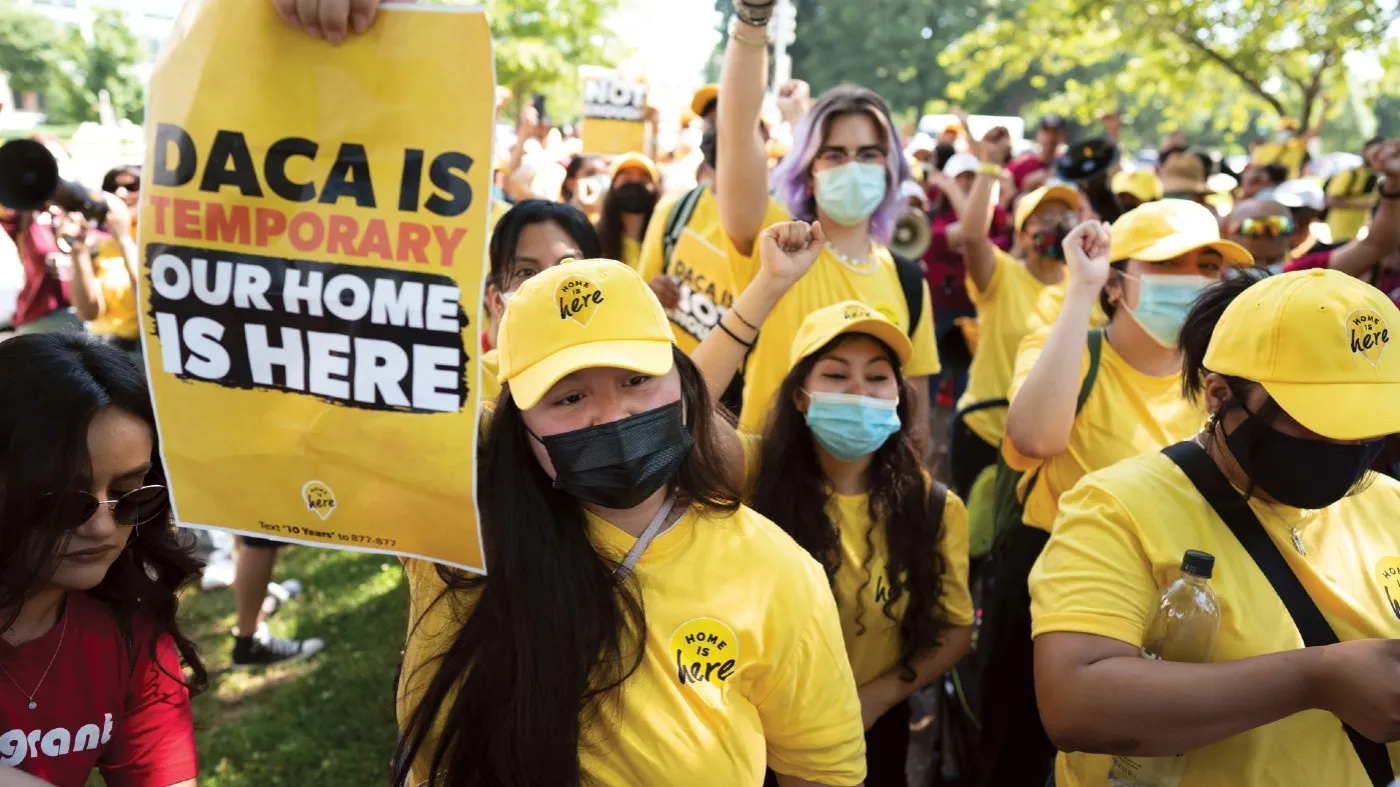

In the United States, immigration has long been one of the most contentious and politically sensitive issues. Over the years, lawmakers have struggled to strike a balance between securing the nation’s borders, offering humane pathways for migrants and refugees, and establishing long-term immigration reform. Today, that balance remains elusive. Three core pillars of American immigration policy—border control, the Deferred Action for Childhood Arrivals (DACA) program, and asylum rules—are all entangled in a complex web of political stalemate, legal challenges, and ideological divisions.


This essay explores the current state of these key components, the policy debates surrounding them, and how deep partisan gridlock continues to obstruct meaningful reform, leaving millions of lives in legal and emotional limbo.

I. The U.S.-Mexico Border: A Flashpoint of National Politics
The southern border of the United States, particularly the U.S.-Mexico boundary, has become a potent symbol of national sovereignty, law enforcement, and humanitarian concern. The debate over how best to manage this border is central to the broader immigration discussion.
1. Rising Migrant Numbers and Humanitarian Pressures
In recent years, the number of migrants crossing or attempting to cross the southern border has surged. Migrants from Central America, South America, and more recently Africa and Asia, often flee violence, poverty, political instability, and climate-related disasters.

U.S. Customs and Border Protection (CBP) has consistently reported high levels of encounters at the border, including families, unaccompanied minors, and asylum seekers. This influx has overwhelmed detention facilities and processing centers, prompting concerns over inhumane conditions, especially for children.
2. Enforcement vs. Compassion
The debate around border control often pits two competing philosophies:
-
Enforcement-first advocates call for increased funding for Border Patrol, expansion of physical barriers, surveillance technologies, and expedited removals.
-
Humanitarian advocates emphasize the need for due process, international asylum obligations, and protection of vulnerable populations.
This tension has produced inconsistent policies across different administrations—President Trump focused on deterrence and hardline enforcement, while President Biden initially signaled a more compassionate approach, though his administration has also adopted restrictive policies under pressure.
3. Title 42 and the End of Pandemic-Era Policies
Under Title 42, a public health authority enacted during the COVID-19 pandemic, the U.S. expelled millions of migrants without allowing them to seek asylum. Though controversial, it became a de facto border control mechanism.
When Title 42 was lifted in 2023, the Biden administration introduced new asylum rules, such as requiring migrants to first seek protection in transit countries and mandating online appointment scheduling through a CBP app. These changes were criticized by human rights organizations and praised by centrists seeking order.
Yet, legal challenges continue, and Congress remains divided on whether to codify or repeal these evolving policies.
II. DACA: Dreams Deferred
The Deferred Action for Childhood Arrivals (DACA) program, introduced by President Barack Obama in 2012, was designed to protect undocumented immigrants who were brought to the U.S. as children—often called “Dreamers.” While it does not provide permanent legal status, DACA grants work authorization and protection from deportation, subject to renewal every two years.
1. Legal Vulnerability and Uncertain Future
DACA has been under relentless legal assault. Critics argue that the program was an overreach of executive authority, bypassing Congress. In 2021, a federal judge in Texas ruled that DACA was unlawful, barring new applications while allowing renewals to continue temporarily. In 2023, the Fifth Circuit Court upheld the ruling, leaving the program in a fragile state.
With no legislative solution in place, DACA recipients face a precarious existence. Many of the 600,000+ Dreamers contribute to the economy, serve in the military, and pursue higher education. Yet, they remain stuck in a legal limbo with no clear path to citizenship.
2. Congressional Inaction
Despite broad public support for protecting Dreamers, Congress has repeatedly failed to pass the DREAM Act or any comparable legislation. Efforts at bipartisan compromise—including proposals to trade DACA protections for increased border security—have stalled amid political polarization.
Democrats have pushed for a permanent solution, often as part of broader immigration reform. Republicans, while occasionally expressing support for Dreamers, often tie DACA relief to stricter enforcement measures—creating deadlock.
The result: a generation of young immigrants continues to live in fear that the protections they’ve relied on for over a decade could vanish with a court ruling or change in administration.
III. The Asylum System: Overburdened and Under Siege
The U.S. asylum system was created to offer protection to individuals fleeing persecution due to race, religion, nationality, political opinion, or membership in a particular social group. But the system is now at a breaking point.
1. Backlogs and Bureaucracy
The asylum application backlog has grown to over 1.5 million cases, with average wait times exceeding four years. Immigration courts are under-resourced and overwhelmed, making it nearly impossible for legitimate claims to be processed swiftly.
Asylum seekers, in the meantime, may wait years before their cases are heard, often with limited access to legal representation and inconsistent rulings based on jurisdiction or judge.
2. Shifting Rules and Restrictions
Each administration has sought to reshape asylum rules through executive orders and regulatory changes:
-
Under the Trump administration, “Remain in Mexico” (Migrant Protection Protocols) forced asylum seekers to wait outside the U.S. during their proceedings.
-
Biden initially ended the program but later reinstated aspects of it under court order.
-
New rules under Biden impose eligibility restrictions, including denials for those who fail to apply for asylum in transit countries or who do not use official ports of entry.
These measures have prompted lawsuits and drawn criticism for undermining international asylum norms. Advocates argue that deterrent policies violate the U.S.’s obligations under the 1951 Refugee Convention.
3. Political Stalemate in Reforming the System
Immigration courts, under the Department of Justice, are not independent judicial bodies. This structure has made them susceptible to political interference and changes in administration policy.
Proposals to establish an independent immigration court system or streamline asylum claims through humanitarian parole and community-based alternatives to detention have garnered support from legal experts and human rights organizations—but have not gained traction in Congress.
IV. The Politics of Gridlock
Immigration is a wedge issue that consistently fuels political division in the U.S. Rather than serving as a unifying policy area, it has become a tool for partisan messaging, campaign rhetoric, and identity politics.
1. Polarized Narratives
-
Republican politicians often frame immigration in terms of national security, crime, and economic burden. They call for walls, deportations, and strict enforcement.
-
Democratic leaders emphasize inclusion, humanitarian responsibility, and the benefits of immigration to American society.
These competing narratives leave little room for middle ground, even as polls show that many Americans support both border security and compassionate immigration reform.
2. Legislative Failures
Over the last two decades, multiple attempts at comprehensive immigration reform have failed:
-
The 2007 McCain-Kennedy bill
-
The 2013 “Gang of Eight” Senate proposal
-
Multiple standalone bills on DACA, visa reform, and asylum changes
In each case, disagreements over enforcement, legalization pathways, and guest worker programs have doomed efforts, even when there was bipartisan support in theory.
3. State-Level Actions
In the absence of federal action, states have taken matters into their own hands. Republican-led states like Texas and Florida have passed laws empowering local law enforcement to detain undocumented migrants and have organized controversial migrant transports to Democratic cities.
Meanwhile, Democratic-led states and cities have declared themselves “sanctuary jurisdictions”, refusing to cooperate with federal immigration enforcement.
These actions have added further confusion and inconsistency to the national immigration landscape.
V. Human Impact: Lives in Limbo
Amid the policy debates and legislative deadlock are real human stories—of migrants fleeing gang violence in El Salvador, of Dreamers excelling in American universities, and of asylum seekers seeking safety for their families.
-
Children separated from their parents at the border under zero-tolerance policies still await reunification.
-
DACA recipients worry that a future administration may end the program.
-
Asylum seekers face uncertainty, prolonged detention, and complex legal hurdles.
The absence of comprehensive reform leaves families vulnerable, communities divided, and the nation’s moral authority in question.
VI. The Road Ahead: Is Reform Still Possible?
While the current outlook for immigration reform appears bleak, several factors could create openings for future change:
1. Public Opinion
Surveys consistently show that Americans support both secure borders and humane immigration policies. Majorities support pathways to citizenship for Dreamers and favor legal immigration reform.
Mobilizing this moderate center could help break the political impasse if leaders are willing to compromise.
2. Judicial Pressure
Ongoing court cases—particularly those concerning DACA and asylum policy—could force Congress to act. If the Supreme Court invalidates DACA, the urgency to legislate a replacement may rise dramatically.
3. Economic Needs
As the U.S. faces labor shortages in agriculture, healthcare, and construction, immigration may be increasingly seen as an economic necessity. This could shift the policy conversation toward practical solutions rather than ideological grandstanding.
4. International Cooperation
Solving the root causes of migration—violence, corruption, poverty—will require deeper cooperation with Latin American nations. Initiatives to improve regional stability, expand refugee processing, and offer legal migration channels could reduce border pressures and foster goodwill.
Conclusion: A System Stuck in Crisis
America’s immigration system—especially regarding border control, DACA, and asylum—remains mired in dysfunction. While each issue presents unique challenges, they are united by a common thread: a failure of political will. Until Congress can rise above partisan divides to enact durable solutions, millions will remain in a state of uncertainty.
The stakes are high—not only for migrants and asylum seekers but for the soul of the nation itself. How the U.S. chooses to address immigration will reflect its values, define its identity, and shape its future in a world of increasing displacement and mobility.
Now, more than ever, leadership, empathy, and compromise are needed to move beyond gridlock and toward a just, effective, and humane immigration policy.