





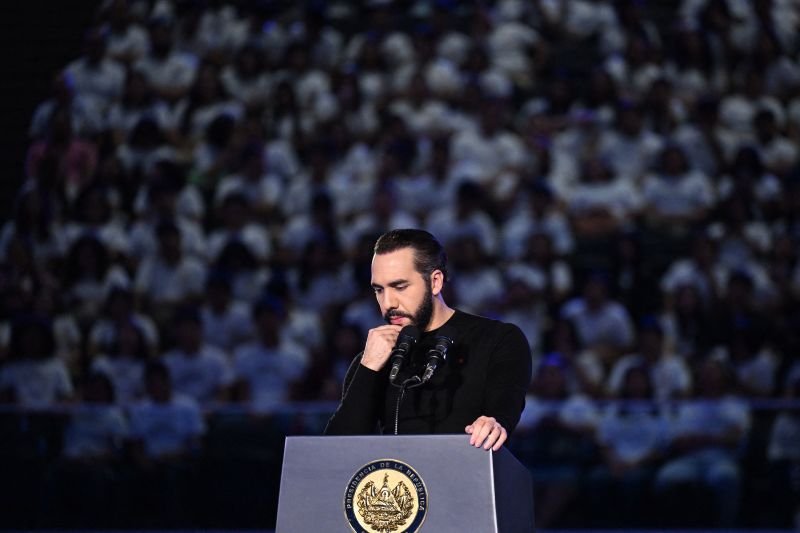

As Nayib Bukele marks six years in office as President of El Salvador, his tenure is a study in contrasts: unprecedented drops in violent crime set against concerns of authoritarianism, weakened democratic institutions, and potential collusion with criminal gangs. Self-styled as the “world’s coolest dictator,” Bukele has forged his leadership on tough-on-crime rhetoric and bold reforms. But while many Salvadorans credit him with restoring public safety, human rights advocates warn that his methods have undermined the rule of law.


This article explores Bukele’s anti-gang campaign, the sweeping legal changes, the growing suppression of dissent, and accusations of illicit pacts with gangs. We delve into how the balance between security and civil liberty has been altered—raising urgent questions about the future of democracy in El Salvador.
I. Bukele’s Crime Crackdown: Order Through Mass Arrests
1. Transforming a Crime-Ridden Nation
When Bukele assumed the presidency in June 2019, El Salvador held the unfortunate title of “most violent country in the hemisphere.” He responded with a zero-tolerance policy: mass arrests, heightened militarization, and declarations of a permanent “state of exception.”
Since then, approximately 87,000 people have been detained, often with minimal due process—according to government figures. Bukele credits this campaign for dramatic reductions in gang violence: once ubiquitous daily killings and extortion are now rare in many urban areas. Residents of San Salvador report feeling safer walking streets that were once considered no-go zones.
2. The Price of Security: Mass Incarceration
However, critics highlight that these arrests extend far beyond hardened criminals. Lawyers and activists representing families say thousands have been swept up based merely on suspicion or error. Samuel Ramírez, from the Movement of Victims of the Regime (MOVIR), calls it “a war against the people,” describing citizens enduring indefinite detentions with little chance of defense or judicial review.
Bukele has conceded that some wrongful arrests occurred, promising the release of “several thousand” detainees. But activists argue most remain behind bars, and many fear speaking out under threats of the harsh security posture and seemingly stacked legal system.
II. Erosion of Democratic Norms and Civic Space
1. The State of Exception: A Permanent Reality
Since March 2022, El Salvador has been governed under a rolling “state of exception.” This extraordinary legal framework has suspended multiple constitutional rights—such as protection from arbitrary detention and freedom of expression—in the name of public order. Soldiers and armored vehicles in city streets have become regular sights.
Critics say the state of exception has morphed into a permanent tool of crowd control rather than emergency response. Its prolonged use has stifled dissent, weakened the separation of powers, and empowered the president to act unilaterally.
2. Targeting Opposition, Civil Society, and Journalists
Bukele’s administration has faced mounting accusations of intimidation aimed at critics. The arrest of Ruth López—a lawyer and vocal anti-corruption advocate—on May 19 for alleged state fund theft is emblematic. Despite being detained for weeks, López has still not been formally charged, raising doubts about the political motivations behind her arrest.
Months earlier, Bukele’s government enacted a law taxing foreign NGO donations at 30%, seen by many as a direct blow to charitable organizations and human rights defenders. Human Rights Watch’s Latin America deputy director, Juan Pappier, said: “What we have seen is a massive concentration of power in Bukele’s hands… demolition of the checks and balances of democracy and increasing efforts to silence and intimidate critics.”
Several independent outlets, including El Faro, have fled the country to escape arrest. Seven of its journalists reportedly face arrest warrants after revealing claims of alleged gang pacts with Bukele—making press freedom increasingly precarious.
III. Allegations of Shadow Pacts with Gangs
1. Controversial Claims of Truce-for-Power Deals
Despite framing himself as combatant to gang rule, Bukele has repeatedly faced charges of clandestine negotiations with criminal organizations. U.S. officials accused his government in 2021 of paying off MS-13 and Barrio 18 gang leaders to reduce violence—alleging cash, contraband, and perks in exchange for peace, especially during Bukele’s mayoral campaigns.
El Faro later published an interview with two Barrio 18 leaders who claimed Bukele paid them to intimidate voters in his favor. They allege the tactic continued after 2019, ensuring gangs would refrain from widespread killings and extortion to “make him look good.”
Bukele dismissed these as “obvious lies,” but did not publicly denounce El Faro’s account. Instead, he responded sarcastically, saying the only pact he made was the one putting them behind bars.
2. Journalism Under Threat
The reprisals against El Faro journalists highlight growing intolerance for independent journalism. They fled to Costa Rica and claim they face politically motivated arrest warrants. Oscar Martínez, El Faro’s editor-in-chief, told CNN: “I think Bukele will try to put us in jail… after what he did to Ruth López… he’s decided to raise the bar and persecute those he considers the most visible critics.”
Cristosal, the NGO López worked for, warns the 30% foreign donation tax poses an existential threat, effectively limiting their operations within three months—a shift they describe as signal of a dictatorship masquerading as reform.
IV. Public Opinion and Ongoing Divide
1. Popularity Despite Rights Concerns
Public sentiment remains divided. Many Salvadorans credit Bukele with transforming the country from chaos to calm. With daily homicides dramatically reduced, the sense of security in once-hostile neighborhoods is palpable. His reelection last year in a historic landslide—even after a constitutional ban on consecutive terms—attests to this popularity.
Bukele’s allies in Congress capitalized on this mandate, orchestrating the removal of the Supreme Court’s chief justices to engineer legal grounds for his reelection—raising fresh concerns about democratic erosion.
2. A Laboratory for Authoritarianism
Critics warn that Bukele’s strategy could serve as a blueprint for leaders around the world. Gracia Grande, from the Netherlands Institute for Multiparty Democracy’s Salvadoran branch, calls the tactics “an existential threat.” She says, “Right now… we are under a dictatorship.”
Even in the U.S., comparisons have been drawn. Bukele told former President Trump that mass incarceration is a model the United States should consider: “You have to imprison some… that’s the way it works.”
V. Future Implications: Model or Menace?
1. Is Bukele’s Model Exportable?
Bukele’s harsh methods against gangs may hold lessons for leaders struggling with cartel violence, especially in Central America. Yet critics argue his tactics—en masse arrests, rights suspension, media suppression—are incompatible with democratic governance.
The mega-prison known as Cecot, now the largest in the Americas, exemplifies the regime: overcrowded, austere, and emblematic of harsh justice. Its image is that of a laboratory for authoritarian solutions, raising ethical questions as well as logistical ones.
2. What Lies Ahead for El Salvador
Nagging doubts remain about the long-term viability of Bukele’s approach. Does public security justify sweeping rights curtailment? How far can institutions erode before democracy is unrecoverable? Will the detained, dismissed, or harassed ever find redress?
Upcoming challenges include:
- Transitioning away from the state of exception
- Rebuilding judicial and legislative independence
- Ensuring civil society and press regain autonomy
- Investigating past abuses, wrongful arrests, and possible collusion
The struggle ahead is not just legal—it’s cultural. Whether El Salvador evolves toward pluralistic democracy or becomes permanently tethered to authoritarian rule will test the country’s resilience.
Conclusion
Over six years in power, Nayib Bukele has dramatically shifted El Salvador from chaos to relative public order, raising hopes in communities once ruled by gangs. Yet the methods employed—mass incarceration, aggressive constitutional changes, and suppression of dissent—have ignited a struggle over the nation’s democratic soul.
The alleged secret pacts with gangs, targeting of civic actors, and rejection of legal safeguards suggest a model of governance that favors control over rights. As Salvadorans cautiously enjoy safer streets, they also face a future where freedoms are uncertain.
El Salvador now stands at a critical crossroads: the security gains under Bukele come at a steep institutional cost. Whether future leaders will maintain his grip, or reverse course to restore democratic norms, remains one of the great questions of a region where upheaval and reform are all too familiar.








