





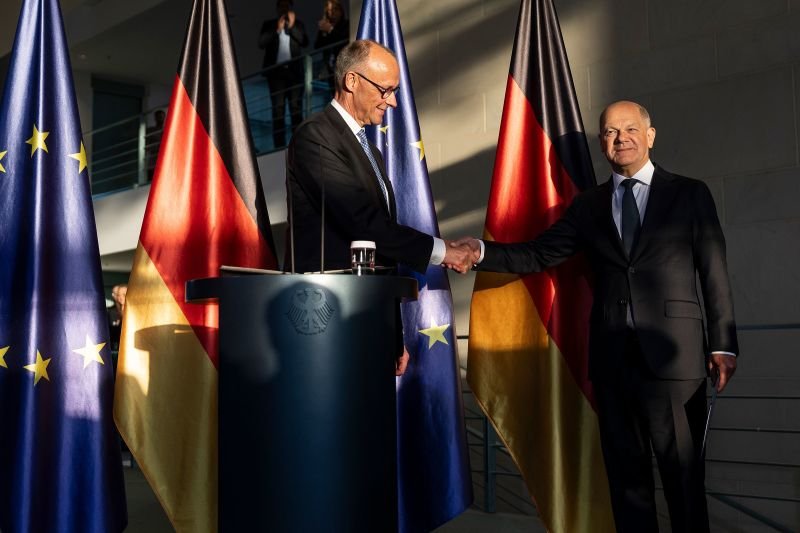


Friedrich Merz officially became Germany’s chancellor on May 6, 2025, marking a significant shift in the country’s political direction. A longtime member of the Christian Democratic Union (CDU), Merz has spent decades in and out of politics, known for his conservative economic views, tough stance on migration, and criticism of welfare dependency. With a legal background, experience in the private sector, and a strong voice in European politics, Merz brings a mix of traditionalism and assertiveness to the chancellorship.

His appointment follows a victory by the CDU and its sister party in the February 2025 federal elections, after which he formed a coalition with the center-left Social Democrats (SPD). Though it took an extra vote in parliament, Merz was finally approved as chancellor, ending a suspenseful political moment for the nation.
I. Personal Background of Friedrich Merz
1. Early Life and Education
Friedrich Merz was born on November 11, 1955, in Brilon, Germany, under the full name Joachim-Friedrich Martin Josef Merz. Raised in a Catholic family, his father Joachim Merz was a judge, and his mother Paula Sauvigny provided a stable family environment rooted in values of discipline and service.
Merz studied law at the University of Bonn and the University of Marburg, completing his education in 1985. Prior to his legal studies, he served in the German military from 1975 to 1976, a common path for many public servants of his generation.
2. Family Life
Merz has been married to Charlotte Gass since 1981, and together they have three children. Outside of politics, he enjoys flying as an amateur pilot, showcasing a personal side not often highlighted in the media.
II. Friedrich Merz’s Political Timeline
1. Early Career and Rise in the CDU
- 1972 – Merz joins the Christian Democratic Union (CDU), beginning his lifelong commitment to center-right politics.
- 1985–1986 – Serves as a judge at the Saarbrücken District Court.
- 1986–1989 – Works as a lawyer for the German Chemical Industry Association, gaining insight into the business world.
- 1989 – Elected to the European Parliament, initiating his influence in EU matters.
- 1994 – Wins a seat in the Bundestag, Germany’s federal parliament.
2. Leadership Challenges and Return to Power
- 2000 – Competes for CDU leadership but loses to Angela Merkel.
- 2009 – Leaves the Bundestag to work in the private sector as a lawyer.
- 2021 – Returns to parliament and regains political momentum.
- January 2022 – After two unsuccessful attempts, Merz is elected as CDU party leader, signaling a shift to the right for the party.
- February 23, 2025 – Under Merz’s leadership, the CDU wins the federal election.
- April 9, 2025 – Announces a coalition with the SPD to form a governing majority.
- May 6, 2025 – Officially approved as Chancellor of Germany.
III. Merz’s Political Ideology and Public Positions
1. Migration Policy: A Firm Approach
Merz has long held a strict view on immigration, particularly calling for asylum seekers from other EU nations to be turned away at Germany’s borders. His stance resonates with voters who favor tighter controls and more structured migration policies, especially in light of past refugee influxes.
2. Welfare and Economic Reform
Known for his critique of generous welfare systems, Merz has promised to cut government assistance for those unwilling to work. In a recent interview with The Economist, he argued for leaner welfare policies that incentivize employment, reinforcing his image as a fiscally conservative reformer.
3. Simpler Tax Systems
Back in 2003, Merz gained attention by proposing that German tax laws should be so simple they could be written on a beer coaster—a metaphor for his advocacy of streamlined bureaucracy and pro-business policies.
IV. Chancellorship and Coalition Building
1. A Surprising Partnership with the SPD
Despite their ideological differences, Merz’s CDU formed a coalition with the center-left SPD, illustrating his pragmatic leadership style. This political marriage seeks to create a balanced agenda, mixing Merz’s conservative economics with the SPD’s focus on social equity.
The coalition is expected to address key national priorities, including:
- Economic competitiveness
- Energy security
- Immigration reform
- Defense spending and EU engagement
2. Narrow Approval in Parliament
Merz’s path to the chancellorship wasn’t entirely smooth. On May 6, 2025, he initially fell short by six votes in parliament. However, a second round of voting secured his approval, solidifying his position and beginning a new chapter in German politics.
V. Impact on Germany and Europe
1. Shifting Germany’s Global Role
With Merz in office, Germany is expected to adopt a more assertive stance on global issues. This includes enhanced defense commitments, support for European integration, and a tougher line on foreign policy matters such as China, Russia, and NATO cooperation.
2. Business-Friendly Domestic Agenda
Merz is poised to introduce pro-market reforms, including tax simplification, deregulation, and support for small businesses. These measures aim to revive economic growth and modernize Germany’s industry, especially in technology and energy sectors.
Conclusion: Friedrich Merz Ushers in a New Political Era
Friedrich Merz’s ascent to the chancellorship is a significant moment in German politics. His blend of conservatism, economic reform, and political experience sets the stage for a government that aims to tighten immigration controls, streamline welfare, and boost economic productivity.
Though some of his policies are controversial, especially among progressive circles, Merz’s leadership reflects a growing appetite for fiscal discipline and national resilience in Germany’s post-Merkel landscape. His ability to forge a coalition with the SPD shows political flexibility, and his background in both law and business gives him a multifaceted perspective on governance.
As Germany navigates complex global challenges, from energy crises to defense obligations, Chancellor Friedrich Merz will play a central role in shaping not only the nation’s future but also its place on the world stage.








