




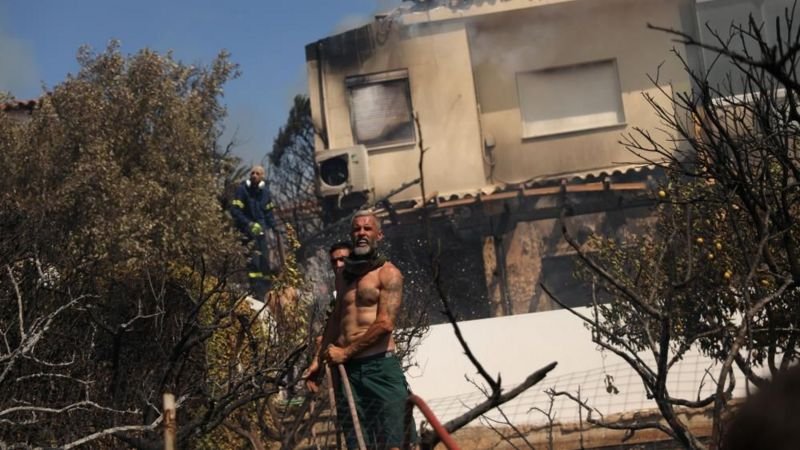


A major wildfire broke out this week in the coastal villages of Palaia Fokaia and Thymari, approximately 40 km (25 miles) southeast of Athens, as Greece endured its first intense summer heatwave. Fed by temperatures nearing 40 °C and strong winds, the blaze swiftly tore through low-lying brush before devastating residential areas and threatening beachside communities. At least 20 homes were destroyed, with additional properties damaged, prompting widespread evacuations and emergency responses.

I. Wildfire Emergency in Eastern Attica
1. Fast-Moving Flames
The fire ignited in grassy terrain and raced toward neighborhoods with alarming speed. Local fire service spokesman Col. Vassilis Vathrakogiannis confirmed that 130 firefighters, supported by 12 planes, 12 helicopters, and coast guard vessels, were deployed to battle the flames. The blaze advanced across multiple fronts under gusty conditions, causing smoke to drift up to 180 km away, reaching as far as the island of Kythira.
2. Evacuations and Rescue Operations
Authorities issued urgent alerts via Greece’s 112 emergency system, calling for evacuations in villages including Thymari, Tourkolimano, Katafygi, Harakas, Triantafyllia, and the seaside area of Agia Fotini. Over 40 residents, including children and seniors, were evacuated by police, while 11 tourists were rescued after being trapped by advancing flames . Despite assistance, some residents chose to resist evacuation and attempted to extinguish flames using garden hoses—a decision officials warned was dangerous and hindered emergency efforts .
II. Widespread Property Damage and Community Impact
At least 20 residences were completely destroyed, with many more suffering structural compromise. One local woman shared her poignant story of returning home to find it burned to the ground, while others narrowly saved their homes amid the chaos. The fire even crossed the coastal roadway toward Cape Sounion, forcing its closure. Authorities reported that both municipal shelter facilities and emergency medical stations were activated to support displaced residents .
III. Slashing Through Heat and Wind
1. First Heatwave of Summer
This wildfire coincided with Greece’s first heatwave, bringing sweltering temperatures around 40 °C, which exacerbated fire conditions. The region, including Attica, Evia, the Peloponnese, and northern Aegean, was placed at a Level 4 fire risk out of 5. The extreme heat melted vegetation and heightened flammability, while strong winds fanned the fast-moving blaze.
2. National Response and Capability
This year has seen an unprecedented fire-fighting effort. Greece deployed a total of 18,000 firefighters, supported by volunteers and international specialists, to respond throughout the season . Additional EU support, bringing nearly 294 firefighters, is expected through mid-September. Regional authorities have increased oversight of vegetation fires as part of a beefed-up wildfire prevention strategy led by a new arson investigation force.
IV. Arson Under Investigation
Officials dispatched a special arson unit to determine if the Palaia Fokaia blaze was deliberately set. This follows similar determinations on Chios, where multiple simultaneous fires led authorities to arrest a Georgian woman for unintentional arson after she allegedly discarded a cigarette. That blaze scorched as much as 40,000 hectares, prompting a state of emergency. The government has now toughened arson penalties, with sentences possibly reaching 20 years in prison .
V. Community and Government Response
1. Unified Effort
Local firefighters, volunteers, forest service personnel, and coast guard units worked alongside aerial operations to control the blaze . One deputy mayor stated that all municipal buildings were open to those in dire need . A regional emergency meeting was convened to coordinate response and ensure the distribution of water tanks, heavy equipment, and support services.
2. Tourist Safety Measures
Authorities maintained a coastguard presence with boats ready to evacuate seaside areas if conditions worsened. While no fatalities have been reported, at least 40 people—children and elderly among them—were rescued from danger zones .
VI. Lessons and Long-Term Preparedness
1. Climate Change and Wildfire Trends
Greece is on the frontlines of climate change, facing increasingly intense heatwaves and prolonged dry seasons that fuel wildfires. Recent years have seen devastating events, including the 2021 Euboea fires, the deadly 2018 Mati inferno, and the vast 2023 blazes—each reinforcing the urgent need for resilience.
2. Bolstering Firefighting and Prevention
In response, Greece has significantly ramped up its wildfire infrastructure. This year’s mobilization of 18,000 firefighters, supported by international forces, marks a historic commitment to combating forest fires. Seasonal collaboration under the EU Civil Protection Mechanism is also expanding, with aircraft, personnel, and financial investments allocated toward detection, response, and post-fire reforestation.
Conclusion: A Nation on High Alert
Greece’s first major wildfire of the summer, set against record-breaking heat and fierce winds, underscores the climate crisis facing the Mediterranean region. The inferno in Palaia Fokaia and Thymari destroyed homes, uprooted families, and demanded swift emergency action. While the blaze highlights vulnerabilities, it also demonstrates Greece’s growing preparedness and coordinated response, from deploying vast firefighting resources to initiating arson investigations and reinforcing evacuation protocols.
Yet, what remains abundantly clear is the need for continued vigilance, stronger preventative strategies, and sustained investment. As heatwaves become the norm, Greece must adapt—building on lessons learned this summer to better shield its people, landscapes, and cultural landmarks from future infernos.