





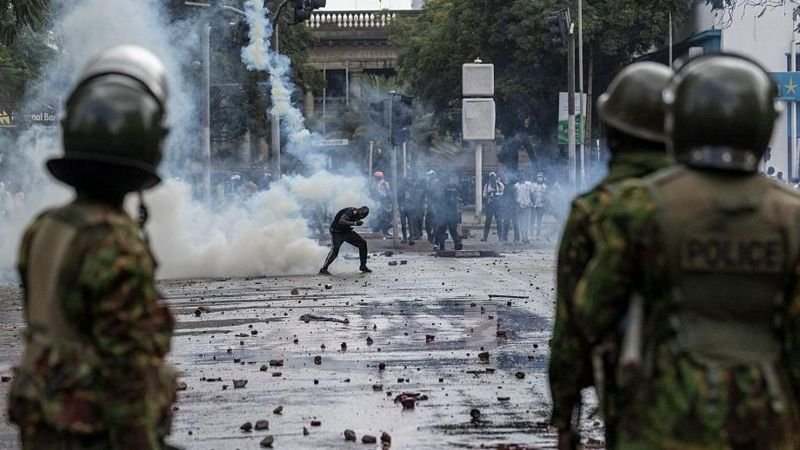


In a week marked by nationwide grief, political unrest, and rising anger, Kenya finds itself at the center of international concern following Wednesday’s deadly protests. The demonstrations, held to mark the anniversary of previous anti-government uprisings, resulted in the deaths of at least 10 civilians, with some rights groups placing the toll higher.

Amid mounting accusations of excessive use of force, Kenya’s Interior Minister Kipchumba Murkomen has defended law enforcement actions, labeling the unrest as an “unconstitutional attempt to change government” and “terrorism disguised as dissent.”
I. Government Denies Police Brutality Claims
In a press briefing following the protests, Interior Minister Kipchumba Murkomen firmly denied allegations of police brutality. Instead, he praised security forces for showing what he described as “remarkable restraint” despite being under extreme provocation. “We condemn the criminal anarchists who, under the guise of peaceful demonstrations, engaged in looting, sexual assault, violence, and destruction,” said Murkomen.
He accused demonstrators of targeting vital government facilities, including nine police stations, five of which were set on fire. Additionally, he claimed that five firearms were stolen and dozens of vehicles—including those belonging to civilians, government institutions, and the police—were destroyed.
Murkomen went on to describe the unrest as a “foiled coup attempt,” blaming what he termed criminal elements for exploiting the right to peaceful protest.
II. Human Rights Groups Paint a Different Picture
Contrasting sharply with the government’s narrative, Amnesty International reported that 16 people died in the protests, all due to gunshot injuries. The organization emphasized that live rounds were used indiscriminately and called for immediate independent investigations into police conduct.
The Law Society of Kenya also condemned the crackdown, citing “unnecessary aggression and brute force” by law enforcement. In a statement, the organization blamed state security for the “senseless loss of life.” “The Constitution guarantees the right to peaceful assembly. What we witnessed was an abuse of that right,” their statement read.
III. Victims of Violence: Stories from the Ground
1. The Tragic Death of David Mwangi
Among the deceased was 19-year-old David Mwangi, a resident of Nairobi’s Mukuru informal settlement. According to his mother, Rachael Nyambura Mwangi, David was not participating in the protests but had gone to pick up his younger brother from tuition classes when he was struck by a bullet. “A bullet went straight through his head. He was just a bystander,” she told the BBC in a tearful interview.
David had dreams of becoming a mechanic. As the family’s eldest son, he often helped his mother, who sells sweet potatoes to support the household.
2. Student Dennis Njuguna Killed in Molo
In another tragic incident, 17-year-old Dennis Njuguna was shot and killed in Molo, about 170 kilometers northwest of Nairobi. His mother, Jecinta Gathoni, expressed disbelief and devastation. “He was my hope. He had dreams. I haven’t even had the strength to go to the morgue,” she said.
Dennis had just finished school for the day and, according to local reports, may have been caught in the chaos either accidentally or as part of the crowd. The exact details of his death remain unclear.
IV. Mass Protests and Public Backlash
1. Demonstrators Demand Accountability
The protests, which took place in several cities across Kenya, were largely peaceful at the outset. Protesters marched with tree branches—a long-standing symbol of non-violent resistance—while chanting slogans such as “Ruto must go.”
The movement was intended not only to mark the anniversary of past demonstrations but also to express anger at President William Ruto’s government, rising living costs, and persistent police brutality.
2. Media Blackout and Legal Reversal
In an unexpected move, the Kenyan government banned live TV and radio coverage of the protests, citing national security concerns. However, the Nairobi High Court overturned the ban, ruling that it violated press freedom and the public’s right to information.
The court’s decision marked a rare win for transparency in a country increasingly criticized for shrinking civic space and heavy-handed governance.
V. Widespread Injuries and Damages Reported
1. Hundreds Wounded, Including Police Officers
According to Interior Minister Murkomen, the unrest left more than 400 individuals injured, including nearly 300 police officers. He argued this statistic proved that the security forces were also under attack and had responded appropriately.
However, human rights groups argue that many injuries were preventable and that law enforcement had escalated the violence instead of managing it responsibly.
2. Damage to Infrastructure
The minister outlined widespread property damage, listing the destruction of public vehicles, government offices, and even private property. Photos circulated on social media showed burned-out cars, smashed windows, and vandalized buildings across multiple cities.
Murkomen has ordered an inquiry into the true extent of the damage, promising that all perpetrators would be held accountable—though critics fear this will be used as a tool to suppress dissent.
VI. Political and International Ramifications
1. President Ruto Faces Mounting Criticism
President William Ruto, who came into power with promises of economic transformation and youth empowerment, now finds his leadership under serious scrutiny. With inflation surging and job opportunities shrinking, public dissatisfaction continues to grow.
The president has yet to directly comment on the police response but has been criticized for allowing a climate where police violence goes unpunished.
2. Calls for International Oversight
As images of bloodied protesters and grieving families circulate globally, international watchdogs and foreign governments are beginning to call for transparency. Amnesty International and Human Rights Watch have urged the Kenyan government to allow independent investigations into the killings and injuries.
Conclusion: A Nation at a Crossroads
Kenya now stands at a critical juncture, facing difficult questions about governance, civil rights, and the rule of law. While the government insists that the protests were an attempted insurrection, rights groups argue they were a justified cry for change.
The deaths of young citizens like David Mwangi and Dennis Njuguna have transformed this political conflict into a deeply personal national tragedy.
With elections still years away, and frustrations mounting, the path forward requires more than just rhetoric or repression. It demands transparency, accountability, and a renewed commitment to democratic values.
As Kenya’s leadership and civil society move forward, one thing is clear: the cost of ignoring the people’s voice is far greater than the risk of listening to it.








