





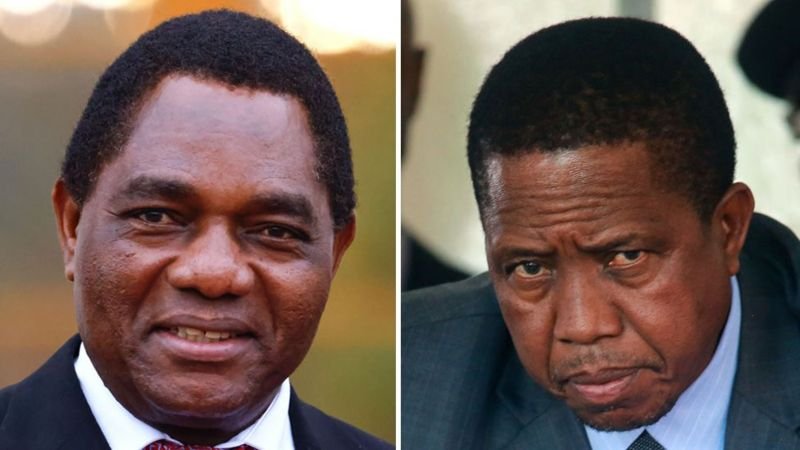


The recent passing of former Zambian President Edgar Lungu has ignited a nationwide debate—one not just about mourning a head of state, but about the entanglement of personal animosity and political tension at the highest level of government. Instead of uniting the nation in remembrance, Lungu’s funeral has exposed the sharp and deeply rooted rift between him and his successor, President Hakainde Hichilema.

Lungu’s death was initially confirmed not by the state, but by his daughter via Facebook, creating confusion and setting the tone for what would become a politically charged mourning period. With accusations, emotional family statements, and broken funeral arrangements, Zambia’s aspiration for unity under the national motto “One Zambia, One Nation” has been painfully tested.
I. A Longstanding Political Feud: Hichilema vs. Lungu
The fraught relationship between Edgar Lungu and Hakainde Hichilema began well before the 2021 elections that brought Hichilema to power. Their rivalry intensified in 2017 when Hichilema, then opposition leader, was arrested and detained for over 100 days under treason charges. The incident, triggered by a motorcade altercation, left Hichilema blaming Lungu directly for his inhumane treatment and solitary confinement.
Even after winning the presidency in a landslide, Hichilema’s tenure has been marked by lingering resentment. Many Zambians hoped that the victory would symbolize a new chapter of reconciliation. However, as political and economic pressures mounted, Lungu re-entered the political arena, accusing the government of targeting him and his family under the guise of an anti-corruption campaign.
II. Death and Division: The Breakdown of Funeral Diplomacy
1. Lungu’s Final Wish: Exclusion of the Sitting President
Lungu’s animosity toward Hichilema remained until his last breath. According to his family, one of his final wishes was that Hichilema should not attend his funeral. The message was clear: he did not want what he perceived as political hypocrisy overshadowing his death. This wish sparked a conflict between the family and the state regarding who should control funeral proceedings.
The government initially planned a full state funeral to honor Lungu’s years of leadership. A venue in Lusaka was prepared, and national mourning was declared. But tensions reignited when the funeral programme revealed a level of government involvement the family had not agreed to.
2. A Sudden Collapse of Funeral Plans
What was supposed to be a dignified national farewell turned into a political stalemate. The government, citing failed negotiations with the family, called off the state funeral and ended the mourning period prematurely. Meanwhile, the family announced that the burial would take place in South Africa, with no expectation of President Hichilema’s attendance.
III. Accusations of Political Harassment and Retaliation
1. Retirement Benefits Revoked
After re-entering politics in 2023, Lungu was stripped of his retirement privileges—an act the government justified as per constitutional obligations. However, critics and supporters of the former president viewed it as a politically motivated decision meant to weaken his influence.
2. Restricted Movements and Medical Travel
Throughout 2023 and early 2024, Lungu complained about being under surveillance and facing restrictions on travel, especially for medical purposes. He described being blocked from jogging in public and even from traveling overseas for treatment. Though the government denied any such bans, his family and legal representatives insisted that delays in medical attention contributed to the decline in his health.
IV. Legal Troubles for Lungu’s Family
Lungu’s widow and children have not escaped scrutiny under the current administration’s anti-corruption drive. Properties have been seized, court cases filed, and financial investigations initiated. While the government claims impartial justice, the former president’s camp argues that the investigations are politically charged and vindictive.
These events only deepened the distrust and hostility between the two political camps—casting doubt on whether true national unity could ever be achieved under current conditions.
V. Public Reaction: A Nation Caught in the Middle
The delay in the official announcement of Lungu’s death further fueled speculation of internal government conflict or lack of preparedness. While international leaders such as Kenya’s president expressed condolences swiftly, the state broadcaster ZNBC remained silent until Hichilema made a Facebook post hours later.
Zambians across the country expressed disappointment—not just in the inability of the political elite to reconcile, but in being denied the chance to mourn a former president with the dignity and respect such a role commands.
VI. Historical Context: When Mourning Becomes Political
Zambia has long prided itself on peaceful transitions of power and political stability compared to other African nations. The rivalry between Lungu and Hichilema, however, has threatened that legacy. It has taken the personal and made it national—turning grief into another battleground for political supremacy.
Lungu’s own words, relayed through his lawyer, emphasized a refusal to allow “pretend love” at his death. In his view, a funeral with full state honors led by someone he considered his persecutor would be an insult rather than a tribute.
Conclusion: What Lungu’s Death Means for Zambia’s Future
The events surrounding Edgar Lungu’s passing are not just about a funeral; they are a mirror reflecting Zambia’s current political climate. The nation hoped for a moment of healing—a symbolic burying of the hatchet between two of its most influential leaders. Instead, it received further polarization.
This funeral saga should serve as a wake-up call for Zambia’s leadership. Healing national divisions requires more than rhetoric—it requires action, humility, and respect, especially in moments of shared grief. With the former president now to be buried abroad and many citizens left without closure, the road to reconciliation in Zambia appears longer than ever.
Yet hope remains. If lessons are learned from this painful episode, Zambia can still reclaim the spirit of “One Zambia, One Nation”—not just as a slogan, but as a lived national reality.








