





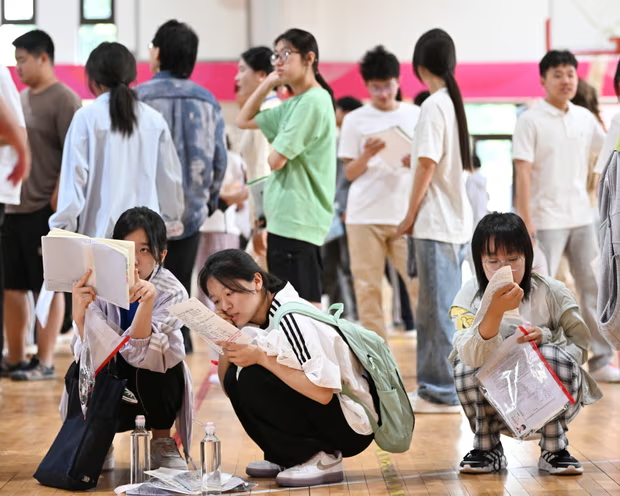


In an unprecedented move to uphold the integrity of China’s most critical academic assessment—the gaokao—several major Chinese tech firms have restricted access to certain artificial intelligence (AI) tools during the exam period. With more than 13.3 million students competing in this year’s high-stakes college entrance exams, authorities and corporations alike are going to extraordinary lengths to ensure fairness. The disabling of AI features marks a significant shift in how technology companies are responding to the ethical challenges posed by rapidly advancing AI systems.


I. AI Restrictions Implemented During Gaokao
1. ByteDance and Doubao’s Suspension of Q&A Services
As students across China sat for the four-day gaokao exams, tech companies acted swiftly to curb any misuse of AI platforms for academic dishonesty. Among the first to respond was ByteDance, the parent company of TikTok, which disabled its Doubao app’s question-answering functionality.

Screenshots shared online show that users attempting to submit exam questions to Doubao received a message reading: “During the college entrance examination, according to relevant requirements, the question answering service will be suspended.” When a user tried to bypass the system by stating it wasn’t an exam question, the app reiterated the same message, signaling a system-wide lockdown of its features during exam time.
2. DeepSeek and Other Platforms Follow Suit
DeepSeek, a generative AI platform recently introduced to the Chinese market, also implemented usage restrictions. The app reportedly suspended services during specified time slots, explicitly stating it was to “ensure fairness in the college entrance examination.”

Other tech giants, including Tencent’s Yuanbao, Alibaba’s Qwen, and Kimi by Moonshot, disabled their image recognition and AI functionalities during exam hours, according to Bloomberg. These measures prevented users from uploading and analyzing exam-related content in real-time—a tactic that could otherwise give students an unfair advantage.
II. Reactions from Users and Broader Community
1. Frustration Among Non-Exam Users
While the intention behind these restrictions was to deter academic cheating, not all users welcomed the move. University students and other users expressed their irritation online, especially those using AI tools for legitimate purposes like studying or completing assignments.
One sarcastic comment circulating on Weibo read: “College entrance exam candidates, you are all shit. I can’t use DeepSeek to upload pictures, I have to download ChatGPT again. I hope you all go to community college.” This type of reaction highlights a growing tension between enforcing security protocols and maintaining public access to valuable technological tools.
2. Lack of Public Statements from Tech Firms
Despite the widespread impact of the restrictions, none of the involved companies have released official statements explaining the temporary suspensions. Public awareness of the policy shift appears to have spread primarily through word-of-mouth, particularly from frustrated university students encountering unexpected service outages.
III. Broader Anti-Cheating Measures in Gaokao
1. AI Surveillance and Behavioral Monitoring
Beyond disabling AI tools, Chinese authorities have implemented a range of other advanced strategies to maintain the integrity of the gaokao. Many provinces are deploying AI-powered surveillance systems to monitor testing environments for suspicious behaviors. These systems can detect whispering, frequent glances, or other signs of potential cheating.
In Jiangxi province, for instance, authorities announced that video footage from exam rooms would be reviewed after the tests, and any misconduct would be “dealt with strictly in accordance with relevant regulations,” according to the state-owned Global Times.
2. Heightened Security Protocols and Entry Checks
In addition to digital surveillance, China has introduced enhanced screening at test centers. Candidates are subject to biometric identity verification, rigorous inspections for digital devices, and even the deployment of radio signal jammers to prevent unauthorized communications. These steps are intended to block any attempt to smuggle in or transmit exam content, particularly through smart gadgets.
3. National-Level Support and Social Adjustments
The gaokao’s significance in Chinese society cannot be overstated. It is widely regarded as a life-defining examination that determines not only university placement but future career prospects. In acknowledgment of this, cities across the country have adjusted their daily routines to support test-takers.
Measures include postponing public events, delaying office opening hours, and designating special traffic lanes to ensure students arrive at exam centers without delay. These actions reflect the national effort to create a secure, focused environment for academic assessment.
IV. Technology and Ethics in High-Stakes Testing
1. Balancing AI Access and Academic Integrity
The decision by China’s tech giants to disable AI features during gaokao raises important questions about how technology should be governed in high-stakes environments. While AI tools can provide valuable educational support, their misuse during exams presents a serious threat to fairness.
By proactively suspending services, companies are acknowledging their role in ethical AI usage and demonstrating a willingness to comply with national priorities. However, the blanket suspension also risks alienating legitimate users, calling for more nuanced solutions in the future.
2. A Model for Other Countries?
As AI becomes more integrated into education systems worldwide, other nations may look to China’s approach as a potential framework for managing technology during critical assessments. From biometric checks to temporarily disabling specific app features, the measures taken this year set a new precedent in balancing innovation with academic honesty.
Nonetheless, global implementation would require thoughtful consideration of privacy, access rights, and the broader implications of AI restrictions on education.
Conclusion
China’s proactive efforts to maintain the integrity of the gaokao exams reflect the country’s deep-rooted emphasis on academic merit and social mobility. By disabling AI functionalities and employing sophisticated surveillance technologies, both the government and private tech firms are demonstrating a unified front against academic dishonesty.
However, the situation also highlights the growing complexity of managing AI in everyday life. As technology continues to evolve, striking a balance between innovation and responsibility will be key—not just in China, but across the globe. The lessons learned from this year’s gaokao may help shape future policies on ethical AI usage in education and beyond.








