




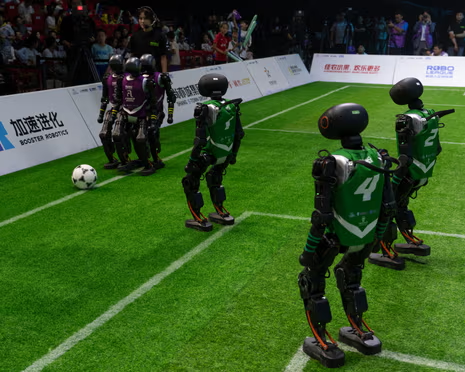

In a unique and futuristic twist to the beautiful game, humanoid robots recently took center stage in Beijing for a three-a-side football tournament driven entirely by artificial intelligence. While the event showcased how far robotic engineering has come, it also made clear that human athletes like Kylian Mbappé aren’t about to be replaced anytime soon. Despite impressive innovation, the robots’ on-field antics ranged from clumsy kicks to unexpected tumbles, drawing attention to both the promise and the limits of current AI and robotics in sports.


I. A Glimpse into the Future of Sports
1. The Rise of AI-Powered Athletes
The recent robot football match brought together four AI-enhanced humanoid teams, each built and programmed by university teams competing in the event. This wasn’t just a demonstration—it was a testbed for what could eventually become a new genre of athletic competition. With companies like Booster Robotics supplying the technology, the focus is now shifting toward refining both the physical and cognitive capabilities of these machines to better emulate—and perhaps one day compete with—human players.


2. A Rough Start on the Pitch
While the robots were equipped with impressive programming, their performance on the field proved that mastering football is no easy task—even for intelligent machines. Video clips of the match showed the humanoids awkwardly attempting to kick the ball, stumbling over their own legs, and collapsing in comical fashion. At least two robots were “stretchered” off the field after failing to recover from a fall, highlighting the delicate balance between hardware resilience and AI coordination.

II. The Competition Behind the Metal
1. University Teams in the Spotlight
The tournament featured teams from top Chinese universities, including Tsinghua University and China Agricultural University. Each group was responsible for customizing their robot squad with proprietary algorithms, showcasing not only technical knowledge but strategic acumen. These student-led teams are helping to push the boundaries of what is possible in robotics, particularly in dynamic environments like sports.
2. The Final Showdown: THU vs. Mountain Sea
In the championship match, Tsinghua University’s THU Robotics faced off against the Mountain Sea team from China Agricultural University. The game ended in a 5–3 victory for THU, earning them the tournament title. The match, although filled with technical fumbles and occasional robot misfires, captivated audiences and revealed just how much potential lies in the fusion of sports and AI development.

3. Supporters Show Enthusiasm
Spectators, including student supporters, cheered on the robots with the same passion seen at human football matches. One Tsinghua fan praised both teams, saying, “They [THU] did really well. But the Mountain Sea team was also impressive. They brought a lot of surprises.” This enthusiasm underscores how robotics competitions are beginning to capture public imagination, much like traditional sports.
III. The Broader Implications of Robot Sports
1. Robotics as a Testing Ground
According to Cheng Hao, CEO of Booster Robotics, sports offer an ideal environment to evaluate and improve humanoid robot performance. The unpredictable, fast-paced nature of football challenges robots to demonstrate agility, decision-making, and real-time response—all crucial capabilities that extend beyond entertainment into real-world applications such as disaster response or eldercare.
2. Human-Robot Matches on the Horizon?
Cheng also hinted at a possible future where robots might one day play alongside or against humans. While the idea is exciting, ensuring player safety—especially when human bodies are involved—will be a key concern. Robots would need to operate with precision and control to avoid accidents, making safety engineering just as important as performance.
3. Blurring the Line Between Technology and Entertainment
As AI and robotics advance, so too does their role in leisure and entertainment. While the current level of robot football might not rival the drama of the World Cup, it reflects a cultural shift where machines aren’t just tools but performers in their own right. This blend of engineering and spectacle could pave the way for new sports leagues centered entirely around robotic competitors.
IV. Challenges Still to Be Overcome
1. Physical Coordination and Stability
Despite sophisticated programming, one of the biggest hurdles is ensuring that robots can maintain balance and execute movements with fluidity. Saturday’s matches demonstrated how even simple tasks like kicking a ball or turning quickly can be difficult to achieve consistently in humanoid form.
2. Real-Time AI Decision Making
Another obstacle is the speed and reliability of decision-making in a game setting. Unlike controlled environments, football requires split-second reactions based on constantly changing variables. Training robots to respond appropriately, even when things don’t go as planned, remains a complex challenge in AI development.
3. The Human Element
While the excitement surrounding robot sports is growing, many argue that part of what makes traditional sports compelling is the emotion, unpredictability, and humanity of the players. Whether or not robots can ever replicate that is still up for debate.
Conclusion
The robot football matches in Beijing offered a glimpse into a future where sports and AI coexist in fascinating ways. While humanoid robots are still far from replacing professional athletes, their presence on the pitch marks an important step in the evolution of intelligent machines. With continued research and development, these events could become a staple of both technological innovation and public entertainment. For now, the message is clear: the game is just beginning—for robots and humans alike.








