



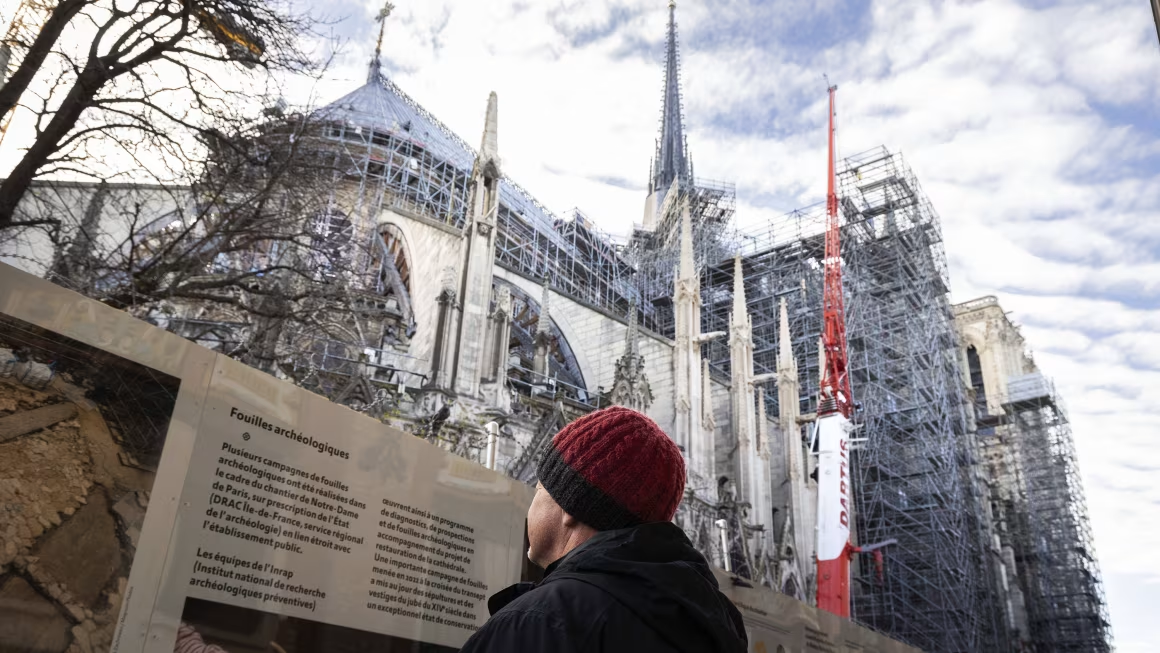

After a devastating blaze five years ago, Paris’s Notre Dame Cathedral has reopened, remarkably resembling its original 1163 form. This ambitious restoration became possible not through guesswork, but via a blend of traditional craftsmanship and next-generation technology. From drones and lasers to detailed 3D models, these tools provided a digital blueprint, guiding the rebuilding process and allowing France to meet President Macron’s goal of reopening within half a decade.

I. Laying the Digital Foundation
1. Pre-Fire Laser Mapping
In 2015, art historian Andrew Tallon conducted an extraordinary laser survey of Notre Dame, scanning every nook and cranny. Using 12 lasers and a team of seven engineers, he captured 46,000 images and compiled over a billion data points. His work uncovered curious architectural anomalies—such as misaligned columns—and created an invaluable record just before the 2019 fire destroyed much of the structure.

2. Post-Fire Scanning and Modeling
Following the fire, Autodesk and the French laser service firm AGP stepped in. They installed advanced scanners around the damaged cathedral to capture even more point data and layered it over Tallon’s original records. Working with Rebâtir Notre Dame, they created a digital model over the course of a year. Thanks to ongoing scans and drone footage, reconstruction could proceed with exceptional precision—even as the fragile structure was propped up with temporary supports.

II. Bringing History Back to Life
1. Merging Past and Present
The reconstruction effort layered old scans with fresh data, uniting Tallon’s pre-fire model with new laser and drone captures. This fusion provided a comprehensive blueprint, enabling craftsmen to faithfully recreate the cathedral’s complex Gothic details—archways, buttresses, and the iconic spire—without relying on memory or incomplete records.
2. Blending Tradition with Modernity
Though the cathedral appears nearly unchanged, the rebuild incorporates contemporary upgrades: discreet fire suppression systems, optimized LED lighting, and soot-free facades achieved by cleaning centuries of residue. These subtle enhancements prioritize safety and aesthetics while honoring the original design.

III. Tech Beyond the Cathedral Walls
1. Revamping the Esplanade
Autodesk lent its expertise to redesign Notre Dame’s plaza, inviting four design teams to create 3D visualizations of their concepts. Public input helped select the final proposal, ensuring the new landscape resonates with both heritage and modern communal needs.
2. A Legacy of Digital Preservation
Autodesk’s scanning methods have proven crucial globally. After the 2011 earthquake in Christchurch, New Zealand, the firm deployed drones and robot dogs to scan damaged cathedral areas. Similar efforts recorded the Michigan State Capitol and historic Brownsville, Pennsylvania. This Notre Dame project illustrates how these techniques not only guide restorations but preserve digital blueprints for future reference.
IV. A Model for Cultural Conservation
1. Preparing for the Unthinkable
Experts say Notre Dame’s restoration offers a valuable lesson: cultural icons worldwide should be digitally scanned before disaster strikes. Wladek Fuchs, an architecture professor, is using this principle in reconstructing the ancient Italian city of Volterra. Such digital archives function as insurance policies for heritage sites.
2. Future-Proofing a Landmark
Beyond restoration, Notre Dame’s 3D model will serve as an ongoing resource. Facility managers can monitor structural integrity, perform simulations, and plan future conservations with unprecedented foresight. Amy Bunszel from Autodesk says this digital twin will play a key role in maintenance and conservation strategies for years to come.
Conclusion
Notre Dame’s resurrection is more than an architectural victory—it’s a showcase of how technology can safeguard cultural heritage. By combining meticulous laser scans, airborne drones, and expert craftsmanship, France not only restored a cathedral but created a digital legacy for generations. The success of this project signals a future where landmarks worldwide can be preserved virtually, ensuring their endurance long after calamity strikes.