




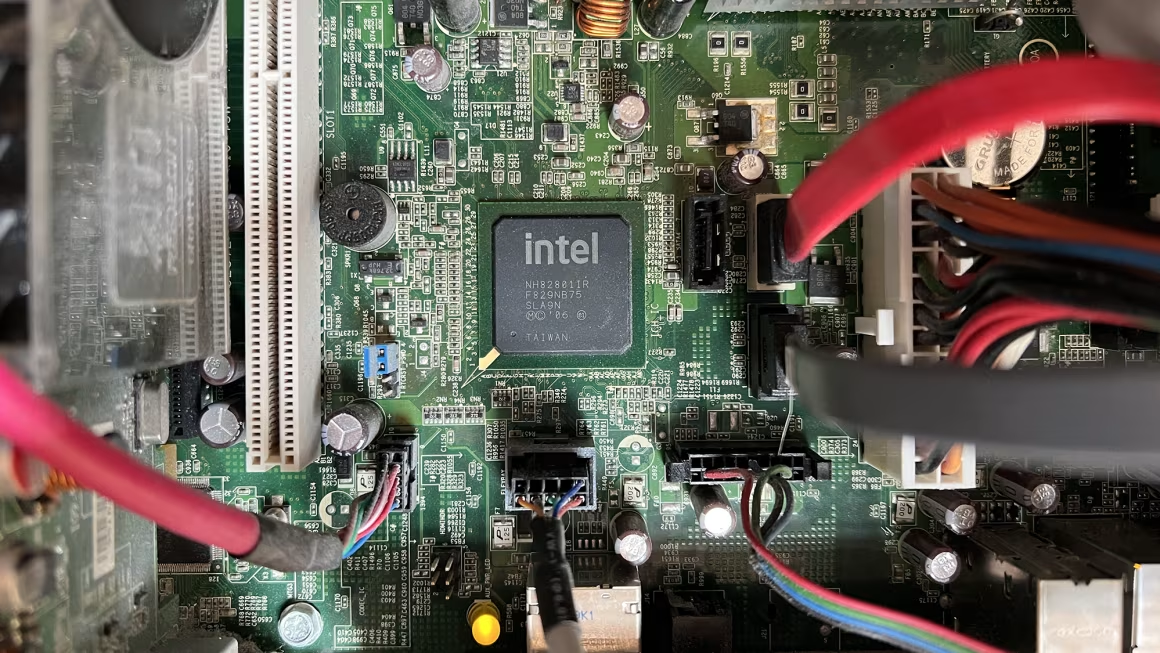

Intel, once the undisputed leader in computer chips, has watched its dominance slip as the world pivoted toward mobile devices and artificial intelligence—waves it failed to ride. What began as a hypothetical warning in Andy Grove’s 1996 classic Only the Paranoid Survive has become a real crisis. Now, after nearly 25 years since its stock peaked in 2000, Intel faces sweeping layoffs, leadership changes, and a struggle for relevance in an industry transformed by NVIDIA, AMD, and ARM.

I. The Fall from Grace
1. Highs in the Dot‑Com Era, Lows Since
Intel hit its all-time high share price of about $42.58 on August 31, 2000—during the height of the dot-com boom. Yet today, with shares trading near $22, the company has lost nearly 50% of its market value. Its stock hasn’t reclaimed early peaks as rivals surged ahead.


2. Workforce Cuts and Dow Jones Drop
In August 2024, Intel announced it would trim approximately 15,000 positions—15% of its workforce—aiming to save $10 billion. By mid-2025, under new CEO Lip-Bu Tan, layoffs expanded to over 20%, shuttering key divisions like automotive chips. Gone too is Intel’s spot on the Dow Jones, replaced by NVIDIA in late 2024.

II. PC Powerhouse Missed Mobile
1. ARM Takes the Wheel
Intel’s first major misstep emerged around 2010 when Apple chose British chip designer ARM to power the iPhone. ARM’s efficiency and adaptability vaulted it to dominance in mobile chips. As a result, not only did ARM eclipse Intel in phones, but it later replaced Intel chips in some PCs.
2. AMD Eats Market Share
Meanwhile, AMD capitalized on Intel’s stagnation, reclaiming CPU market share by outpacing Intel on both desktop and server performance. Intel’s failure to advance along Moore’s Law—doubling transistors every two years—led to delays and product setbacks that harmed its competitiveness.

III. The AI Disruption
1. NVIDIA’s Meteoric Rise
While Intel tinkered with CPUs, NVIDIA transformed its gaming GPUs into AI workhorses. Its chips became essential for training generative AI models, exploding its market cap to $3.4 trillion—a staggering 33× that of Intel at about $104 billion. Intel’s own AI chip, the Gaudi, failed to make significant inroads this year.
2. Change Driven by Deep Learning
NVIDIA’s Jensen Huang noted CPU-focused firms like Intel were blindsided as AI workloads shifted from sequential CPU instructions to massively parallel GPUs. What took Intel by surprise was the “incredible pace” of deep-learning innovation—unfolding over just ten years.
IV. Attempted Comeback: Foundry Bet and AI Chips
1. Foundry Gambit
In response, Intel bet big on its chip factories, aiming to rival leaders like TSMC. With federal funding—$7.9 billion from CHIPS Act—the company expanded U.S. fabrication efforts. But these mega-factories have been burdened by delays and demand concerns.
2. Energy‑Efficient AI Chips
Under interim co-CEOs like David Zinsner and MJ Holthaus, Intel is emphasizing cost-effective, energy-efficient AI products tailored for smaller players who can’t afford NVIDIA-scale power. Whether this strategy gains traction remains unclear.
V. What Lies Ahead for Intel
1. A Leaner, Focused Organization
Intel is streamlining aggressively. It’s eliminating middle management layers, consolidating overlapping roles, and focusing R&D toward strategic, core areas. But investors remain skeptical of its ability to regain lost territory.
2. Strategic Paths: Acquisition or Break-Up?
Analysts suggest potential mergers, spin-offs (especially of its foundry arm), or an Intel legacy sale. But splitting off segments could jeopardize CHIPS Act funding, which requires Illinois to maintain majority ownership of the foundry business.
3. Geopolitics in Play
Should U.S.–China tensions trigger semiconductor reshoring, Intel could benefit from heightened demand at home. However, rivals already dominate global chipmaking infrastructure.
Conclusion
Intel’s journey from silicon powerhouse to struggling incumbent underscores Grove’s insight: even tech giants must reinvent or risk collapse. They misread the signals in mobile and AI, and are now racing to recover. Whether their bet on American-made chips, cost discipline, and energy-efficient AI processors pays off remains uncertain. In a tech world that’s profoundly changed, Intel must once more predict the next big wave—or risk being left behind.








