





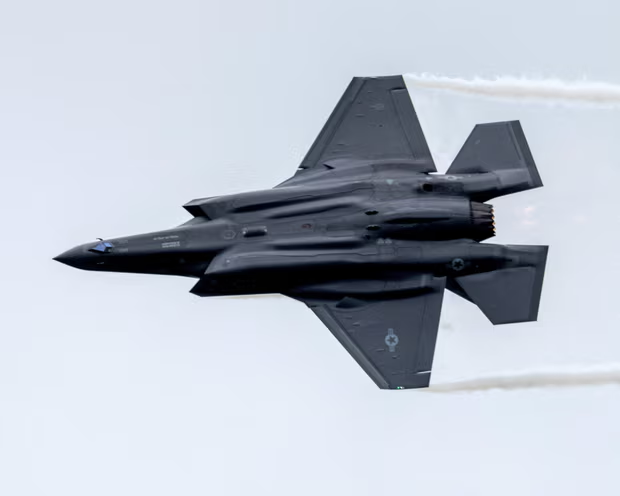


Britain’s decision to continue supplying F-35 fighter jet components to Israel, despite acknowledging that the equipment might be used in violation of international humanitarian law (IHL) in Gaza, has been declared lawful by the UK’s high court. This verdict follows nearly two years of litigation and is seen as a major relief for government officials who feared the decision might jeopardize the UK’s role in the F-35 global supply chain led by Lockheed Martin. The ruling has stirred controversy, with critics arguing that it exposes flaws in the UK’s arms export oversight and avoids responsibility for potential complicity in war crimes.


I. UK Court Ruling on F-35 Exports to Israel
1. Legal Decision and Its Justification
In a detailed 72-page judgment, Lord Justice Males and Mrs Justice Steyn dismissed all 13 legal challenges presented against the UK government’s continued sale of F-35 parts to Israel. The case stemmed from a Labour government decision made in September 2023, which involved halting 30 other arms export licenses to Israel but preserving the F-35 supply arrangement. The judges emphasized that decisions involving complex foreign policy and defense matters fall under the domain of the executive branch, which is accountable to Parliament and the public, not the judiciary.

2. Role of the UK in the F-35 Program
Britain supplies roughly 16% of all components for the F-35 stealth fighter, a key weapon used by various NATO allies. The UK’s contribution is part of a multinational supply pool, and the court acknowledged that the system does not permit the UK to exclude its components from reaching Israeli aircraft. Government officials warned that disrupting this global chain could damage Western security interests at a critical time, particularly for NATO.
II. Human Rights Groups and the Legal Challenge
1. Al-Haq and Legal Action Supporters
The legal challenge was initiated by Palestinian human rights organization Al-Haq and the Global Legal Action Network (GLAN), with backing from Human Rights Watch, Amnesty International, and Oxfam. These groups claimed that continuing to supply parts for F-35 jets enabled potential violations of IHL by the Israeli military in Gaza. Despite their efforts, the court dismissed all their claims, asserting that the UK government’s actions were within its legal bounds.

2. Judicial Deference and Executive Power
The court’s decision reflects a reluctance to override decisions made by the government on complex geopolitical matters. The judges argued that assessing whether the UK should withdraw from a major defense alliance over speculative future breaches of IHL was not appropriate for judicial review. According to GLAN’s senior lawyer, Dearbhla Minogue, this approach should not be viewed as approval of the government’s stance but rather a cautious respect for the separation of powers.
3. Reaction from Humanitarian Advocates
The judgment was met with strong criticism from advocacy groups. Campaign Against Arms Trade (CAAT) labeled the verdict as cowardly, highlighting that the court declined to assess whether the UK had fulfilled its international law obligations, since such laws are not directly enforceable in UK domestic legislation. Yasmine Ahmed of Human Rights Watch stated that the ruling leaves Palestinians in Gaza without access to the protection of international law and underscores the dangerous precedent of governments avoiding accountability for the use of exported weapons.
III. Flaws in the Government’s Justification
1. Genocide Assessment Discrepancies
One of the most contentious aspects of the case was the government’s internal analysis regarding potential genocide in Gaza. While in Parliament officials maintained that determining genocide was a task for international courts, court documents revealed that by July 2024, the UK government had concluded there was no serious risk of genocide occurring. Furthermore, it claimed to have found no evidence that women and children were intentionally targeted during Israeli strikes.
2. Limited Investigation Into Civilian Casualties
Despite reports from Gaza’s health authorities citing over 40,000 Palestinian deaths and tens of thousands of Israeli airstrikes, by September 2024 the UK government had reviewed only 413 incidents. Out of these, it found just one potential breach of international law: the bombing that killed seven World Central Kitchen aid workers on April 1, 2024. None of the incidents involving exclusively Palestinian casualties were flagged for further concern, leading critics to accuse the government of setting unrealistically high evidentiary thresholds.
3. Narrow Interpretation of Proportionality
Al-Haq contended that the UK government wrongly evaluated each airstrike individually instead of analyzing the broader pattern of Israeli military actions. They argued that this fragmented approach ignored the scale and frequency of civilian deaths, thereby failing to measure proportionality—an essential component of IHL compliance.
IV. Political Responsibility and Public Accountability
1. Court Defers to Parliament
As the judiciary declined to interfere with government policy, responsibility for any potential misuse of UK-exported arms now rests firmly with Parliament and the electorate. The court’s decision shifts the debate back into the political arena, urging lawmakers and voters to hold officials accountable for arms export practices.
2. Calls for Stricter Oversight
Human rights groups are now calling for reforms in how arms export licenses are granted and monitored. They argue that the current system is too lenient and fails to ensure that UK-made equipment is not used in ways that violate international norms. The F-35 case has exposed systemic issues within the UK’s arms trade regulation and has reignited calls for stronger ethical standards in defense contracts.
Conclusion
While the UK high court’s ruling upholds the legality of exporting F-35 components to Israel, it does not absolve the government of moral and political accountability. The decision underscores the judiciary’s limited role in matters of international law unless such laws are incorporated into domestic statutes. Meanwhile, the controversy highlights the urgent need for transparent and enforceable mechanisms to ensure that British-made weapons are not used in violations of humanitarian principles. As pressure mounts from rights groups and global watchdogs, the future of the UK’s arms export policy will likely face greater scrutiny both at home and abroad.








