




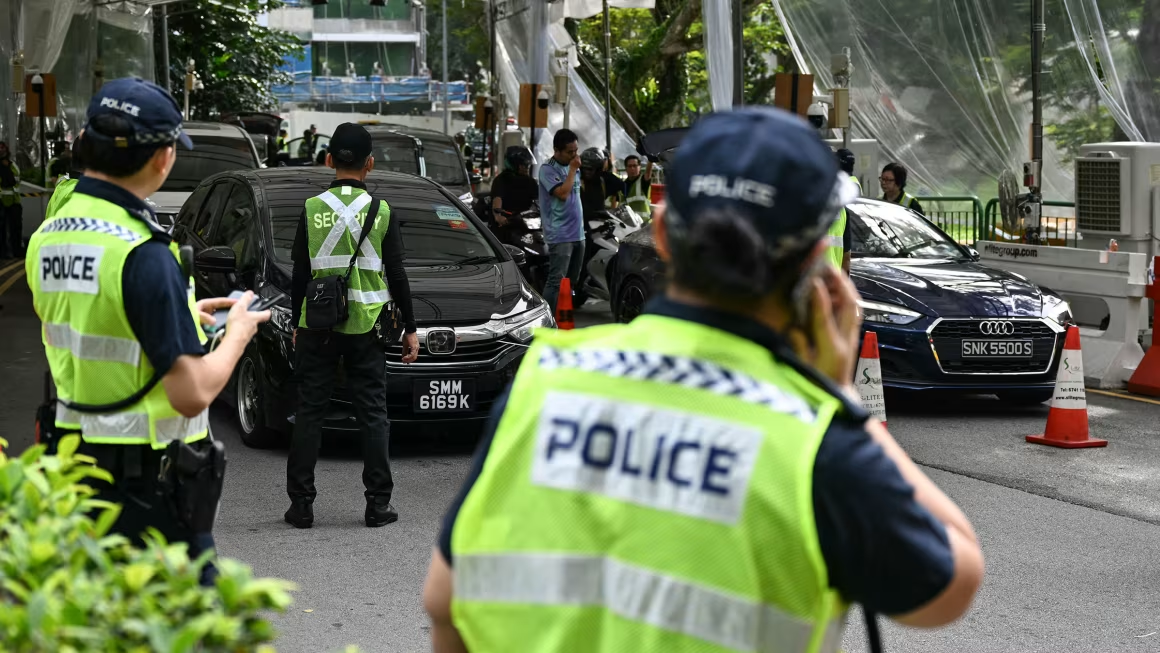

Tensions between the United States and China continue to escalate as Beijing decides to forgo sending its defense minister to the annual Shangri-La Dialogue, Asia’s premier defense summit. Instead, China will be represented by a lower-level delegation, signaling growing discontent with Washington amid deepening geopolitical and economic rifts. This absence not only reflects strained military relations but also raises questions about Beijing’s broader strategic priorities and the future of U.S.-China defense diplomacy in the Indo-Pacific.


I. China’s Surprising Absence at Shangri-La
1. A Break from Tradition
For the first time in five years, China has chosen not to send a senior official to the Shangri-La Dialogue. Instead, the People’s Liberation Army National Defense University will represent Beijing, a noticeable downgrade from previous high-level delegations. This move stands in stark contrast to past engagements where Chinese defense ministers engaged directly with their U.S. and Asian counterparts, even amid periods of heightened friction.

2. Missed Opportunity for Dialogue
The absence of Minister of National Defense Adm. Dong Jun means the possibility of direct talks between U.S. and Chinese defense leaders is effectively off the table this year. Just last year, Dong met then-U.S. Defense Secretary Lloyd Austin at the event, where both sides agreed to maintain military communication despite disagreements over Taiwan and the South China Sea. Without such sideline diplomacy, critical channels for reducing misunderstandings are now more limited.

II. Rising Tensions and Escalating Trade Frictions
1. From Tariff Wars to Tech Sanctions
While both nations recently declared a temporary truce on tariffs, fresh U.S. actions targeting Chinese tech firms and student visas have reignited hostilities. Just days before the Shangri-La Dialogue, Washington delivered new sanctions aimed at curbing software exports to Chinese technology companies and tightening restrictions on educational exchanges. These moves threaten to unravel fragile economic diplomacy and further strain military ties.
2. China’s Silent Protest
Chinese officials have avoided directly addressing why no senior leader will attend the forum. However, U.S. defense insiders interpret the decision as a signal of Beijing’s dissatisfaction. It reflects Beijing’s unease with U.S. engagement in Asia and suggests an intentional effort to withhold legitimacy from a platform where it has often faced tough, unscripted questions from regional leaders and academics.

3. Beijing’s Aversion to Uncontrolled Narratives
Analysts note that the Shangri-La Dialogue offers little control over discourse—something the Chinese government typically values. Facing criticism, like last year’s pointed remarks by Philippine President Ferdinand Marcos Jr. condemning coercive tactics in the South China Sea, may be a scenario Beijing now prefers to avoid. This aversion points to a broader discomfort with open, multilateral forums where China’s actions are scrutinized.
III. Shifting Focus to Economics and Internal Politics
1. Economic Prioritization Over Military Engagement
Observers suggest China’s current foreign policy may be more focused on stabilizing its economy amid ongoing trade tensions rather than investing in high-level military diplomacy. With significant domestic challenges and a sweeping anti-corruption purge reshaping its military ranks since 2023, Beijing may be choosing to refocus on economic resilience over international security dialogue.
2. Corruption Woes in the PLA
The Chinese military has faced internal upheaval in recent years, with numerous high-ranking officials ousted due to corruption scandals. This internal instability might partially explain the absence of top defense leaders at international events like Shangri-La, as the PLA navigates a period of transition and rebuilding.
IV. The United States Deepens Its Indo-Pacific Strategy
1. Clear Messaging Through Presence
U.S. Defense Secretary Pete Hegseth’s appearance at the Dialogue sends a clear signal that the United States remains firmly committed to maintaining its presence in the Indo-Pacific. His visit began in the Philippines, where he emphasized the U.S. strategy of “reestablishing deterrence” against Chinese assertiveness in the region. During a morale-boosting session aboard a U.S. Navy ship, Hegseth reiterated Washington’s dedication to allies and partners across Asia.
2. Ongoing Military Exercises
In 2025, the U.S. Pacific Command has scheduled around 120 joint exercises with key allies including Japan, South Korea, Australia, and the Philippines. These drills reflect a growing military presence and serve to counterbalance China’s expanding influence. Analysts agree that these activities reinforce Washington’s security commitments, though some caution they must be carefully managed to avoid inflaming regional tensions.
3. A Balancing Act for Regional Security
While regional allies welcome America’s proactive role, experts warn that too aggressive a posture could provoke further hostility from Beijing. As most Southeast Asian countries are not formal treaty allies of the U.S., any escalation might place them in precarious positions. Thoughtful engagement is required to ensure that deepened ties with the U.S. don’t inadvertently increase instability.
V. Europe’s Role and China’s Diplomatic Discomfort
1. Macron’s Blunt Remarks
This year’s keynote address was delivered by French President Emmanuel Macron, whose comments openly challenged China’s stance on global security. Macron accused Beijing of applying double standards—condemning NATO’s presence in Asia while failing to denounce North Korea’s support for Russia in Ukraine. His critique highlights growing European frustration with China’s perceived duplicity.
2. China’s Waning European Support
China’s support for Russia amid the Ukraine conflict has strained its relationships with European nations. With European leaders increasingly unwilling to overlook China’s alignment with Moscow, the Shangri-La Dialogue risked becoming an arena for public criticism. Avoiding direct engagement may have been a strategic retreat to avoid further diplomatic damage.
Conclusion
China’s decision to downgrade its participation at the Shangri-La Dialogue is a revealing signal of its current geopolitical stance. While the U.S. strengthens its defense alliances and reaffirms its presence in the Indo-Pacific, Beijing appears more inclined to step back from contentious diplomatic arenas—at least temporarily. This withdrawal highlights the fragile state of U.S.-China relations and the broader uncertainty facing regional security. As global power dynamics shift, strategic communication and careful diplomacy will be essential to prevent conflict and foster mutual understanding in a deeply polarized world.








