





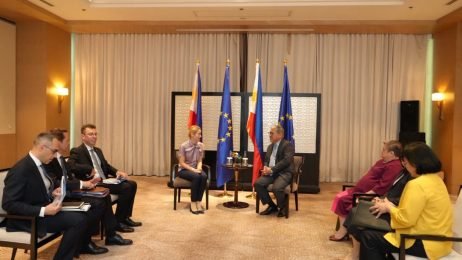
Amid escalating global uncertainties and intensifying regional disputes, the Philippines and the European Union (EU) have agreed to establish a formal security and defense dialogue. This strategic collaboration is aimed at strengthening bilateral ties and enhancing joint responses to evolving security challenges, including cyber threats, foreign disinformation, and maritime disputes. The decision marks a significant move in deepening cooperation under the broader EU-Philippines Partnership and Cooperation Agreement.


I. Reinforcing Bilateral Relations Through Security Dialogue
1. An Evolving Partnership for a Complex World
Following a meeting in Taguig City, Philippine Foreign Minister Enrique Manalo announced the forthcoming establishment of a security and defense dialogue with the EU. This initiative, he said, is designed to ensure both sides remain aligned and proactive in countering cross-border threats such as cyberattacks, foreign interference, and misinformation campaigns. Manalo emphasized the need for cooperation in a climate of growing international instability.

2. A Platform for Deeper Collaboration
EU foreign policy chief Kaja Kallas described the dialogue as a dedicated mechanism for bolstering security-related engagement between the Philippines and Europe. She noted that the forum would facilitate expertise sharing and the launch of collaborative initiatives. The agenda will include key areas such as maritime security, crisis response, counterterrorism, cyber defense, and combating information manipulation.

II. Responding to Global Shifts in Power Dynamics
1. From Economic Pact to Strategic Engagement
The security dialogue is being developed within the framework of the EU-Philippines Partnership and Cooperation Agreement (EPCA), which was originally signed in 2012 and took effect in 2018. While EPCA initially focused on issues like terrorism, illegal arms and drugs, corruption, and organized crime, the new dialogue mechanism represents a timely expansion of its scope. This adjustment reflects the evolving geopolitical landscape and the necessity for strategic responses to emerging risks.
2. Adapting to a Changing Global Environment
Geopolitical tensions have intensified significantly in recent years. China’s increasingly assertive foreign policy, both regionally and internationally, has complicated relationships throughout the Indo-Pacific. Meanwhile, Europe has experienced renewed instability, especially following Russia’s annexation of Crimea in 2014 and the full-scale invasion of Ukraine in 2022. These developments underscore the urgent need for international coalitions capable of addressing multifaceted security issues.

III. Regional Security Challenges and the Philippine Perspective
1. Rising Tensions in the South China Sea
A key motivator for the Philippines’ push to strengthen its security posture is the persistent maritime friction with China. In recent years, numerous confrontations have taken place near contested shoals and reefs within Manila’s exclusive economic zone. These incidents have included aggressive maneuvers, such as the ramming of Philippine vessels and the use of high-pressure water cannons by Chinese coast guard ships.
2. Trust Deficit in Manila-Beijing Relations
Philippine Defense Secretary Gilberto Teodoro, Jr. recently addressed the strained relations between China and the Philippines at the Shangri-La Dialogue in Singapore. He highlighted a “trust deficit” that impedes meaningful progress in bilateral dispute resolution. According to Teodoro, without restoring confidence and transparency, China remains an unreliable partner in negotiations over territorial issues. His remarks point to the broader strategic rationale behind the Philippines’ efforts to deepen security alliances with like-minded nations, including the EU.
IV. The Future of EU-Philippine Security Cooperation
1. First Security Dialogue Set for Late 2025
Both parties have announced that the inaugural session of the EU-Philippines security dialogue is expected to take place in the final quarter of 2025. The event is anticipated to establish the foundation for ongoing coordination on defense and security matters, with the possibility of creating new joint initiatives tailored to shared concerns.
2. A Comprehensive Agenda for Security Engagement
Topics on the agenda will likely range from traditional military cooperation to more contemporary concerns such as cybersecurity, counter-disinformation, and counterterrorism. This wide-ranging focus reflects the understanding that modern security threats are no longer confined to conventional battlefields but extend into the digital and information domains.
3. Strengthening Political and Strategic Alignment
Through this dialogue, the EU and the Philippines aim to go beyond diplomatic gestures to build genuine strategic alignment. It is a continuation of Europe’s growing interest in Southeast Asia and an opportunity for Manila to diversify its partnerships, particularly in light of its challenging maritime relationship with Beijing.
Conclusion
The creation of a formal security and defense dialogue between the Philippines and the European Union represents a pivotal shift in their bilateral relationship. Against the backdrop of escalating regional disputes and broader global instability, this mechanism serves as both a symbol and a tool—demonstrating mutual commitment to collective security and providing a practical platform for action. As the geopolitical landscape becomes increasingly complex, such alliances will be essential in ensuring stability, resilience, and peace in both Europe and the Indo-Pacific.








