





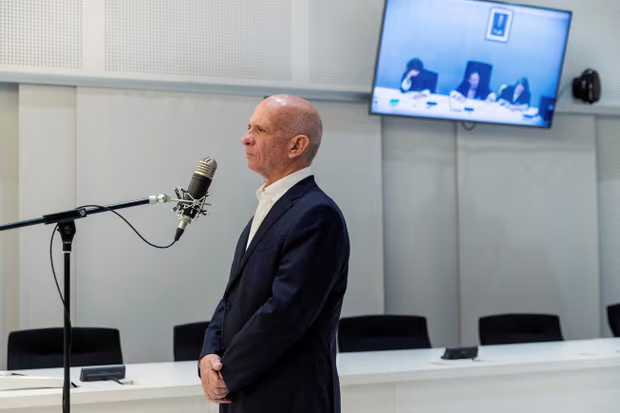

In a significant development in U.S. efforts to combat international drug trafficking, Hugo Armando Carvajal Barrios, a former high-ranking Venezuelan military intelligence official, has pleaded guilty in a New York federal court. Known by the nickname “El Pollo” (The Chicken), Carvajal admitted to participating in a narco-terrorism conspiracy, drug trafficking, and weapons offenses. His guilty plea, entered just days before his scheduled trial, increases the legal pressure on Venezuela’s government under President Nicolás Maduro.


I. Carvajal’s Rise and Fall
1. Powerful Figure Turned Defendant
Hugo Carvajal once wielded immense influence in Venezuela. He led the country’s military intelligence agency under both Hugo Chávez and Nicolás Maduro. Over the years, Carvajal was accused of facilitating a drug trafficking operation embedded within the Venezuelan state itself. According to U.S. prosecutors, he played a central role in a criminal network that used cocaine shipments as a means to undermine American society by flooding cities like New York with illicit drugs.
2. Breaking Ties with Maduro
Carvajal publicly split from Maduro in 2019 when he supported opposition leader Juan Guaidó during a failed coup attempt. While the Trump administration recognized Guaidó as Venezuela’s legitimate leader, Maduro retained control of the government. Despite turning on Maduro, Carvajal remained a subject of U.S. scrutiny, having been previously indicted in 2020 for his alleged role in narcotics-related crimes alongside other top Venezuelan officials.
II. The Cartel of the Suns and International Drug Trafficking
1. An Alleged State-Backed Drug Cartel
The charges against Carvajal are part of a broader U.S. investigation into the so-called Cartel of the Suns, a term used by American authorities to describe a drug trafficking network allegedly supported by elements of the Venezuelan government. The U.S. Department of Justice alleges that Carvajal and other senior leaders—including Maduro—collaborated with Colombia’s former guerrilla group, the Revolutionary Armed Forces of Colombia (FARC), to move cocaine into the United States.
2. A Network, Not a Hierarchy
While U.S. prosecutors portray the Cartel of the Suns as a structured, state-run organization, other analysts suggest it functions more as a decentralized “network of networks.” In this interpretation, various trafficking groups operate under the protection of Venezuelan authorities, making it difficult to dismantle the system entirely due to its fragmented and informal nature.
III. U.S. Legal Strategy and Political Implications
1. Extradition and Legal Proceedings
Carvajal was arrested in Spain and extradited to the United States in 2023 after a lengthy legal battle. Now facing life imprisonment on each of the four charges he admitted to, Carvajal’s sentencing is scheduled for October. It is during this hearing that further information may emerge, especially if he is cooperating with U.S. authorities in exchange for leniency.
2. Cooperation with U.S. Investigators
Reports from the Miami Herald suggest that Carvajal may be aiding U.S. efforts to uncover more details about the Maduro regime’s involvement in drug trafficking. He may also provide intelligence on the Tren de Aragua, a powerful Venezuelan criminal organization, and on Venezuela’s international connections, including alleged ties to Iran.
3. Heightened Rewards for Maduro’s Capture
Earlier this year, the U.S. government raised the bounty for Nicolás Maduro and his interior minister to $25 million. This move underscores Washington’s continued commitment to holding Venezuelan officials accountable for drug-related crimes, even as diplomatic relations remain tense.
IV. Other Figures and Connections
1. Co-Defendants and Sentences
Carvajal is not the only high-profile individual facing consequences under this investigation. His co-defendants include Maduro himself, the country’s interior minister, and two former FARC commanders—one of whom was reportedly killed during a Colombian military operation. Another co-defendant, Cliver Alcalá, a former general who also opposed Maduro, pleaded guilty in 2023 and received a sentence exceeding 21 years for aiding the FARC.
2. U.S.-Backed Coup Allegations
The case may also shed light on covert U.S. operations in Venezuela. In a letter submitted to the court, attorneys for Alcalá claimed that the CIA, the Drug Enforcement Administration (DEA), and the National Security Council were aware of a failed 2020 plan to overthrow Maduro. That botched mission, known informally as the Bay of Piglets, ended with the capture of dissidents and two American ex-Green Berets working as contractors for the U.S.-based firm Silvercorp.
V. Geopolitical and Security Ramifications
1. Pressure on the Maduro Government
The legal actions taken against Carvajal and others serve as a key component of the United States’ strategy to isolate and delegitimize the Maduro administration. By exposing the alleged criminal underpinnings of the Venezuelan leadership, Washington hopes to increase international support for sanctions and potential regime change.
2. Risks and Opportunities of Carvajal’s Testimony
Should Carvajal offer detailed testimony implicating Maduro or exposing state-sponsored drug trafficking activities, it could significantly escalate diplomatic tensions. At the same time, it might bolster international legal efforts to pursue sanctions or further criminal charges against members of Venezuela’s ruling elite.
3. Insights into Criminal Networks
Beyond Venezuela, this case offers valuable insight into how state actors can facilitate or shield transnational criminal organizations. Understanding the structure and operations of the Cartel of the Suns could help law enforcement agencies dismantle similar networks operating elsewhere in Latin America.
Conclusion
The guilty plea of Hugo Carvajal marks a major milestone in the U.S. government’s campaign against drug trafficking tied to state actors. Once a key figure in Venezuela’s military apparatus, Carvajal now faces life behind bars, accused of turning his position of power into a channel for narcotics and violence. His potential cooperation with American authorities could expose deeper layers of criminal governance and possibly influence future actions against the Maduro regime. As the case moves toward sentencing, the international community watches closely for revelations that may reshape how governments approach both diplomacy and the global drug trade.








