





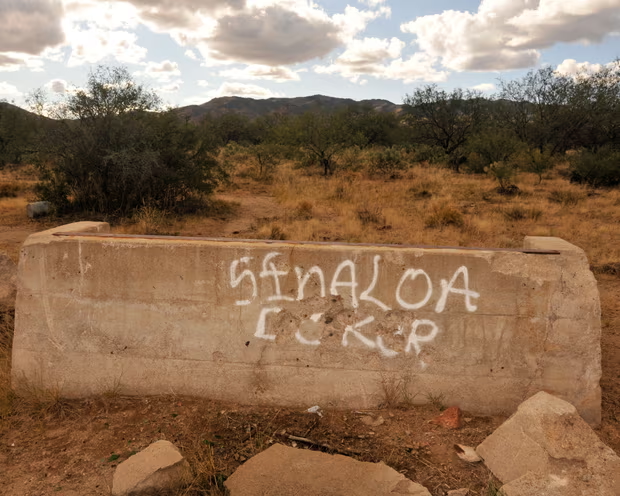


In a troubling revelation, a hacker associated with the notorious Sinaloa drug cartel successfully accessed an FBI official’s phone records and exploited Mexico City’s surveillance infrastructure to locate and eliminate informants working with U.S. law enforcement. The incident, outlined in a newly released audit by the U.S. Department of Justice’s inspector general, underscores the growing risks posed by pervasive surveillance technologies in the hands of organized crime groups.


I. The Incident and Its Implications
1. Breach of FBI Communications
The Justice Department’s report details how a hacker, working on behalf of the Sinaloa cartel, managed to compromise the communications of an FBI assistant legal attaché stationed at the U.S. embassy in Mexico City. By gaining access to the official’s phone number, the hacker was able to retrieve call records and geolocation data. This breach enabled the cartel to monitor the agent’s movements throughout the city.

2. Exploitation of Mexico City’s Surveillance Network
The hacker reportedly went further by tapping into Mexico City’s extensive network of surveillance cameras. Through this system, they tracked the FBI official’s physical movements and observed meetings with various individuals. The gathered intelligence was then used to identify informants or potential witnesses who were later intimidated or, in some cases, killed.
II. Vulnerabilities in the Surveillance Age
1. The Threat of Ubiquitous Surveillance
The audit refers to the growing phenomenon of “ubiquitous technical surveillance,” describing the global expansion of camera systems and the commercial trade in communication and location data. These advancements, while useful to law enforcement, have also become tools for hostile entities—including criminal organizations—seeking to undermine investigations and eliminate threats to their operations.

2. Global Security Risks for Intelligence Agencies
The ability of criminal enterprises to harness relatively accessible technology to breach government data systems presents a significant national security concern. The report stresses that even less technologically advanced actors now possess the capability to exploit weaknesses in both public and private surveillance infrastructures. The FBI, according to the report, recognizes these vulnerabilities and is actively developing a strategic framework to address them.
III. The Role of Commercial Data and Surveillance Expansion
1. Easy Access to Sensitive Data
A major point of concern raised in the report is the ease with which granular location and communication data can be obtained from mobile devices. Various commercial and governmental entities routinely collect this information, creating vast datasets that, if compromised, can expose sensitive operations or individual identities.
2. The Dual-Use Dilemma
While surveillance tools and location tracking are essential for law enforcement and national security purposes, their dual-use potential poses a complex challenge. Technologies originally intended for public safety or commercial use can be repurposed by bad actors, including drug cartels and hostile foreign intelligence services, to carry out targeted attacks.
IV. Institutional Response and Recommendations
1. Strategic Response Underway
The inspector general’s audit acknowledges that the FBI is aware of the pressing need to mitigate these surveillance-related threats. In response, the bureau is working on a comprehensive strategic plan aimed at reducing its exposure to such attacks, particularly those that exploit digital communication and geolocation tracking.
2. Training and Preparedness Measures
Among the recommendations put forth in the report is the enhancement of training programs for FBI personnel. These would aim to raise awareness of surveillance-related vulnerabilities and provide agents with the tools to better safeguard themselves and their contacts against potential exploitation.
V. Legal and Diplomatic Silence
1. Limited Public Disclosure
The report does not name the hacker, the FBI attaché involved, or any of the affected informants. Moreover, the U.S. embassy in Mexico declined to comment on the incident, directing inquiries to the Departments of State and Justice, both of which have remained silent thus far. The FBI and Joaquín “El Chapo” Guzmán’s legal team also did not provide any responses when approached.
2. Broader Implications for U.S.-Mexico Cooperation
This incident could further strain collaborative security efforts between the U.S. and Mexico, particularly in the realm of intelligence sharing and counter-narcotics operations. It highlights the pressing need for stronger cybersecurity protocols and more secure communication channels between allied agencies operating across international borders.
VI. The Sinaloa Cartel’s Evolving Tactics
1. Technological Sophistication
The Sinaloa cartel’s successful use of digital surveillance to target law enforcement informants suggests a significant evolution in its operational capabilities. Traditionally known for violence and drug trafficking, the cartel is now demonstrating an increasing proficiency in cyber tactics, marking a concerning shift in the methods of organized crime.
2. Persistent Threat to Informants
The use of surveillance technology to target individuals cooperating with authorities represents a serious threat to law enforcement efforts. By weaponizing public surveillance systems, cartels can effectively neutralize threats to their operations, undermining trust in security institutions and discouraging potential informants from stepping forward.
Conclusion
The Justice Department’s recent audit brings to light a chilling reality: organized crime groups like the Sinaloa cartel are now leveraging modern surveillance and data access technologies to strike directly at the heart of law enforcement operations. As these threats evolve, intelligence agencies must adapt with enhanced training, tighter cybersecurity, and proactive strategies to protect both their personnel and their sources. The digital age has created new battlegrounds in the fight against transnational crime, and staying ahead will require both innovation and vigilance.








