





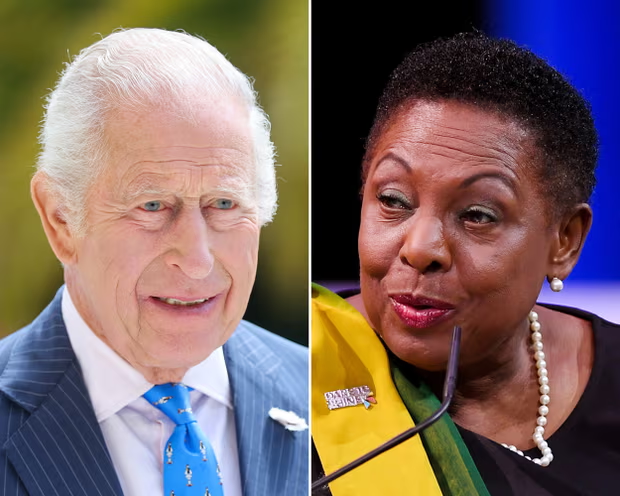


Jamaica has taken a bold legal step in its long-standing pursuit of justice for the descendants of enslaved Africans by formally requesting King Charles III to seek legal advice from the Judicial Committee of the Privy Council. This move seeks to explore whether Britain bears legal responsibility for its historical role in the transatlantic slave trade and whether it is obliged to provide reparations. The initiative brings renewed attention to the enduring legacy of slavery and intensifies the ongoing global debate on historical accountability and justice.


I. A Historic Legal Appeal to the Privy Council
1. Leveraging the Judicial Committee Act of 1833
Jamaica’s government has invoked the rarely used provision under the Judicial Committee Act of 1833, which allows the British monarch to refer legal questions to the Privy Council. Although Jamaica became an independent nation in 1962, King Charles III remains its official head of state. Using his constitutional role, the Jamaican government is requesting that the monarch submit a legal petition to the council concerning Britain’s responsibility for slavery and its long-term consequences.

2. The Role of the Privy Council
The Judicial Committee of the Privy Council serves as the final court of appeal for various Commonwealth nations and UK overseas territories. According to legal expert Nicola Diggle of the London-based firm Blake Morgan, the monarch has the discretion to refer any matter to the council, although it may determine some issues to be inappropriate for its review. If accepted, the council’s opinion could carry significant legal or symbolic weight, depending on whether it is issued as a binding judgment or a non-binding advisory opinion.
II. Jamaica’s Legal and Moral Claims
1. Assessing the Legality of Enslavement
Jamaica is asking the Privy Council to examine whether the forced transportation of enslaved Africans to the island and their subsequent exploitation constituted crimes against humanity and violated legal principles of the time. The legal review seeks clarity on whether these historical acts can be categorized as unlawful under existing legal frameworks or if they require new interpretation based on modern human rights standards.
2. Reparation for Historical and Present Harms
Beyond acknowledging historical wrongs, the Jamaican government wants the Privy Council to determine whether Britain has a continuing legal obligation to provide reparative justice. This includes not only compensation for the atrocities of slavery itself but also for the socioeconomic disparities that many argue have roots in colonial exploitation and persist today.
3. Reinforcing Calls for Justice
Culture Minister Olivia Grange presented the petition to the Jamaican parliament, outlining the government’s formal appeal to King Charles. “We will be submitting a petition to His Majesty King Charles III to refer to the Privy Council a set of questions that we want answered within his current position as head of state of Jamaica,” Grange declared. Her announcement signifies Jamaica’s commitment to addressing slavery not just through rhetoric, but through structured legal processes.
III. Global Context and Political Resistance
1. The Pushback Against Reparations Discourse
While Jamaica’s appeal has reignited discussions around reparations, there remains considerable resistance, particularly in Europe. Many European governments have opposed initiating reparations talks, fearing the political and financial implications. This backlash, however, has not deterred Caribbean nations and activists from pushing the conversation forward on international platforms.
2. Britain’s Historical Position
Despite King Charles expressing “deep sorrow” for the horrors of slavery in a 2022 address to Commonwealth leaders, the British government has consistently resisted calls to provide formal reparations. Instead, it has offered symbolic gestures of remorse without acknowledging legal liability or proposing material remedies. This hesitancy reflects a broader reluctance among former colonial powers to accept responsibility for the long-term impacts of slavery.
3. A Moment of Transition
Jamaica’s legal move comes at a time when the nation is reconsidering its constitutional ties to the British monarchy. In December, Jamaica’s government introduced legislation that would remove King Charles as head of state and transition the country into a republic. The reparation petition adds momentum to the broader movement advocating for post-colonial autonomy and justice.
IV. Legal Challenges and Opportunities
1. The Scope of the Privy Council’s Authority
Legal scholars have pointed out that while the Privy Council has the power to hear referred matters, it may decline if it considers the questions unsuitable for adjudication. Even if the council issues an opinion, it might be non-binding and thus carry limited enforceability. Nonetheless, a favorable ruling could have strong persuasive value and set a precedent for similar legal efforts worldwide.
2. Strategic Use of International Law
Jamaica’s approach reflects a strategic use of international legal mechanisms to pursue historical justice. Rather than relying solely on diplomatic appeals, the country is taking formal legal action that could lead to a reevaluation of Britain’s obligations under modern human rights standards. If successful, this legal strategy could be emulated by other former colonies seeking redress for colonial-era injustices.
3. Raising Global Awareness
The case is not only a legal maneuver but also a public statement. By involving the British monarch and the Privy Council, Jamaica is ensuring the issue receives international attention. This helps maintain pressure on the UK government while educating the global community about the ongoing consequences of slavery.
Conclusion
Jamaica’s request for a legal opinion from the Privy Council, facilitated through King Charles III, represents a significant step in the global push for reparative justice. By framing the legacy of slavery within a legal context, Jamaica is challenging Britain to confront its colonial past not only with regret, but with accountability. Though the path ahead may be fraught with political and legal hurdles, the petition underscores a broader demand for justice, restitution, and a reckoning with history that many nations and communities have long awaited.








