





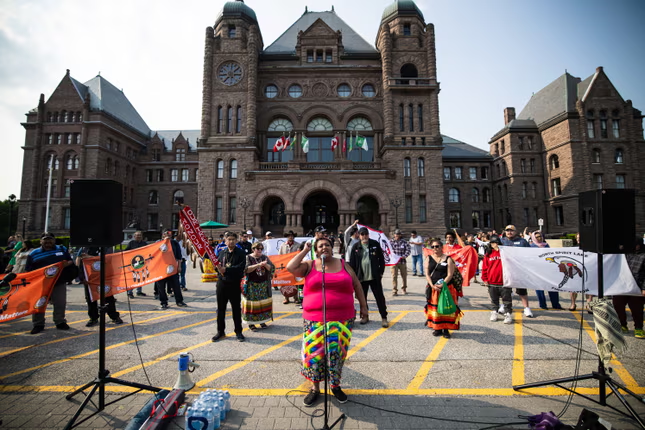


As Canada’s parliament prepares to conclude its final session before the summer break, the Liberal government is moving ahead with Bill C-5, a sweeping piece of legislation that aims to fast-track “nation-building” infrastructure projects. Prime Minister Mark Carney has championed the bill as a vital tool to strengthen the national economy in the midst of escalating trade tensions with the United States. However, Indigenous communities across the country have voiced serious concerns, arguing that the bill undermines their constitutionally protected rights and could push forward major development projects without proper consultation.


I. BILL C-5 AND ITS ECONOMIC OBJECTIVES
1. A Legislative Push for Infrastructure and Trade Expansion
Bill C-5 is designed to eliminate interprovincial trade restrictions and prioritize infrastructure projects such as energy pipelines and mining developments considered vital to national interests. Framed as part of Carney’s broader economic recovery strategy, the bill seeks to modernize Canada’s internal trade systems and accelerate approval processes for strategic development initiatives.

The legislation emerges amid a tense global economic climate, particularly due to protectionist measures and a trade war led by U.S. President Donald Trump. Carney has promoted Bill C-5 as necessary for ensuring Canada’s long-term competitiveness and self-reliance by unlocking stalled infrastructure and resource projects.
2. Federal Powers to Override Local Resistance
While the bill stipulates that Indigenous communities must be consulted on projects that affect their rights, it also empowers the federal cabinet to bypass certain legal protections to expedite permits and construction. This sweeping authority has sparked alarm among Indigenous leaders who argue that such measures could be used to override objections to controversial projects in their territories.

Critics worry that this expedited process could repeat historical patterns of exclusion, where development occurred without meaningful input or consent from Indigenous populations directly impacted by the projects.
II. INDIGENOUS OPPOSITION AND CALLS FOR ACCOUNTABILITY
1. Indigenous Leaders Reject Government’s Fast-Tracking Approach
Leaders from multiple Indigenous communities have been vocal in their opposition, accusing the federal government of attempting to push the bill through without adequate consultation. Cindy Woodhouse Nepinak, the national chief of the Assembly of First Nations (AFN), has warned that the government is “ramming through” legislation that could violate Indigenous rights.
“First Nations are united,” Woodhouse Nepinak told CBC News. “They want prosperity, but they don’t want it at the expense of our rights.” She emphasized the need for the government to halt the bill and engage in further dialogue to ensure that Indigenous perspectives are fully considered before moving forward.
2. Threat of Protests and National Mobilization
Indigenous leaders have also signaled that failure to properly consult on Bill C-5 could spark nationwide demonstrations. Comparisons have been drawn to the Idle No More movement of 2012, which mobilized thousands across Canada in response to perceived government overreach and the erosion of Indigenous rights. With tensions rising, the potential for widespread civil unrest looms if the government proceeds without addressing Indigenous concerns.
III. GOVERNMENT RESPONSE AND AMENDMENTS
1. Carney Defends the Bill’s Provisions for Consent
Prime Minister Carney has attempted to reassure Indigenous leaders by highlighting amendments made earlier in the week to address their apprehensions. He emphasized that the bill is rooted in the principle of “free, prior, and informed consent,” a cornerstone of Indigenous rights under both Canadian law and international agreements such as the United Nations Declaration on the Rights of Indigenous Peoples (UNDRIP).
“At the heart of this legislation is… not just respect for, but full embrace of, free, prior and informed consent,” Carney said, reiterating that consultation, engagement, and participation are central to Bill C-5’s implementation.
2. Equity Ownership and Indigenous Participation Promised
Carney also highlighted new federal initiatives designed to allow Indigenous groups to share in the ownership and benefits of large-scale infrastructure projects. By offering financing mechanisms for equity participation, the government aims to ensure that Indigenous communities are not merely consulted but are active partners in projects that affect their land and economic future.
While these measures are intended to reassure critics, many Indigenous leaders argue that promises of partnership cannot substitute for proper legal protections and due process.
IV. BROADER CONTEXT: PROVINCIAL TENSIONS AND ECONOMIC ZONES
1. Ontario’s Controversial “Special Economic Zones”
Bill C-5 is not the only legislation drawing Indigenous criticism. At the provincial level, Ontario Premier Doug Ford has introduced plans to create “special economic zones” that would override provincial laws to accelerate development—particularly mining projects. These moves have been met with fierce resistance from First Nations leaders, who argue they sidestep Indigenous consent and legal processes.
Earlier this week, Ford ignited further outrage when he claimed that First Nations leaders “keep coming hat in hand” to the government for financial assistance. Following backlash from the Anishinabek Nation, which represents 39 of Ontario’s 133 First Nations, Ford issued a public apology. “I get passionate because I want prosperity for their communities,” he said, expressing regret for his earlier remarks.
2. Balancing Development with Indigenous Sovereignty
The tensions between federal and provincial ambitions for rapid development and the constitutional requirement to consult Indigenous communities reflect a deeper conflict. Canada is still grappling with how to reconcile its economic goals with its legal and moral obligations to Indigenous peoples. Many see the current push for resource development as a return to extractive models that ignore Indigenous sovereignty in the name of national progress.
V. WHAT’S NEXT: UNCERTAIN PATH FORWARD
1. Legislative Deadline and Political Pressure
With a parliamentary vote expected by the end of the week, the federal government is under pressure to fulfill its campaign promise to dismantle internal trade barriers by July 1. Carney remains determined to pass the bill, arguing that further delays could jeopardize Canada’s economic future. Still, the rising wave of Indigenous opposition may force the government to revisit its approach or face the political fallout of appearing to ignore its reconciliation commitments.
2. Potential for Legal and Political Challenges
Should the bill pass without broader Indigenous support, it is likely to face legal challenges in Canadian courts. Indigenous communities could argue that Bill C-5 violates the constitutional “duty to consult” and could seek injunctions to block projects approved under the new framework. The controversy could also influence future elections, where Indigenous issues and environmental policy will likely remain central themes.
CONCLUSION
Bill C-5 represents a bold attempt by Canada’s Liberal government to reshape the country’s economic landscape through streamlined infrastructure development. Yet, the sweeping powers it grants the federal cabinet and its potential to bypass Indigenous objections have sparked widespread backlash. While Prime Minister Carney defends the bill as a means to foster national unity and economic resilience, critics argue it risks repeating a long history of sidelining Indigenous voices. As the country stands at a crossroads between development and reconciliation, how the government handles Bill C-5 could define its legacy—and shape the future of Indigenous relations in Canada.








