





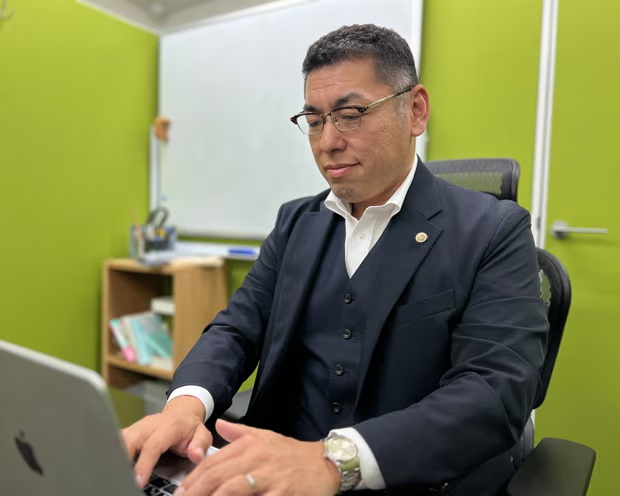


In Tokyo’s bustling legal district, Yoshitomo Morohashi appears every bit the professional: suited in a tailored three-piece ensemble, adorned with designer glasses, and wearing a sunflower lapel pin symbolizing his membership in the Japan Federation of Bar Associations. But beneath the formal façade lies a remarkable story of transformation. When prompted, Morohashi reveals his past in an unexpected way—by removing his shirt to display a full-back tattoo of a warrior clenching a samurai blade between his teeth, a permanent reminder of his former life in Japan’s underworld.


I. A Double Life: From Model Student to Yakuza Recruit
1. A Promising Start Darkened by Tragedy
Despite what many might assume, Morohashi’s early years were filled with promise. He excelled academically, often leading his class in grades. However, the sudden death of his father when he was just 14 disrupted that path. Raised solely by his mother in the town of Iwaki, Fukushima prefecture, Morohashi’s loss sent him spiraling into rebellion, derailing his academic prospects and pushing him toward delinquency.

2. University Dreams Derailed by Drugs
In hopes of a fresh start, his mother sent him to Tokyo for cram school, which led to his admission into Seikei University. But by then, Morohashi had fallen into drug use—specifically aburi, a method of inhaling methamphetamine vapors. He became increasingly entangled with people connected to the yakuza, spending his days in mahjong parlors rather than classrooms. His descent into addiction and anti-social behavior soon made him an ideal candidate for Japan’s third-largest yakuza group, the Inagawa-kai.
II. Life in the Yakuza and the Breaking Point
1. A Family Found in Crime
For Morohashi, the yakuza filled the emotional void left by his father’s death. Though he never used lethal force, he admitted to violence, such as using a baseball bat on debtors. “I avoided hitting their heads,” he noted. Despite the brutality, the gang felt like home—a place of belonging that welcomed him in a way society no longer did.

2. Collapse in Shibuya and the Road to Redemption
Everything changed in 2005. During a public breakdown at Shibuya’s iconic scramble crossing, a shirtless Morohashi suffered a very public humiliation. The yakuza expelled him, considering his behavior an embarrassment. Hospitalized for six months due to his mental health crisis, he began to reconsider his life. His estranged mother rushed to his side, rekindling a long-lost bond despite the emotional pain his addiction and criminal past had caused.
III. Legal Aspirations Sparked by Compassion and Literature
1. Words That Changed His Life
Following his release from psychiatric care, Morohashi was arrested on drug charges and sentenced to 18 months in prison, suspended for three years. It was during this time that a judge offered him rare compassion, expressing belief in his stated desire to reform and study law. His mother later gave him a memoir written by Mitsuyo Ōhira, a former yakuza wife who had become a lawyer. Her story inspired him deeply.
2. A New Academic Journey
Determined to follow in Ōhira’s footsteps, Morohashi spent the next seven years reclaiming his academic talents. He first became a licensed estate agent and then passed the exam to become a judicial scrivener. Eventually, he enrolled in law school in Osaka and passed the national bar exam in 2013—a daunting achievement, given the low pass rate of 45%.
IV. Reinventing Himself as a Lawyer
1. Hiding and Then Embracing the Past
Initially, Morohashi kept his yakuza history hidden, even from his peers in law school and legal offices where he began practicing criminal law. However, in 2022, he chose to reveal his background in a YouTube interview. He realized that sharing his story could help others break free from gang life and start over.
2. Helping Others Leave Organized Crime
Today, Morohashi runs his own legal practice and has written an autobiography titled Motoyakuza Bengōshi (“The Ex-Yakuza Lawyer”). Many of his clients are former or current gang members looking to reintegrate into society. “They need to serve their time, show remorse, and rebuild,” he explains. He encourages them to leave organized crime not just for society’s benefit, but for the well-being of their families and themselves.
V. Japan’s Shifting Underworld and Societal Barriers
1. An Aging Yakuza and Rise of New Criminal Gangs
Due to stricter anti-yakuza laws and Japan’s aging population, traditional yakuza memberships are at historic lows. However, new loosely organized groups known as tokuryū are emerging, often operating without the rigid hierarchy of the old syndicates. These ad hoc gangs are responsible for various crimes, including fraud and violent offenses.
2. Reentry Barriers for Ex-Members
Despite efforts to reintegrate, former yakuza members face systemic hurdles. Those who leave are barred from opening bank accounts for five years, which complicates finding housing or employment. This leaves many trapped in a cycle of poverty and marginalization, making Morohashi’s work all the more critical.
VI. A New Purpose Fueled by Hope
1. Personal Redemption and Reconnection
Now a husband and father, Morohashi has reconciled with his mother—an achievement he cherishes more than any legal victory. “Making her happy again is what I’m most proud of,” he says. The samurai tattoo on his back serves not only as a symbol of his past but also as a mark of how far he has come.
2. Empowering Others Through Experience
Morohashi believes his journey can offer a powerful lesson: no matter one’s past, redemption is possible. “Convincing people they can change and giving them hope—that’s the most important thing I do as a lawyer,” he says with conviction.
Conclusion
Yoshitomo Morohashi’s life is a story of remarkable transformation—from a drug-addicted gang member to a respected defense attorney. His journey highlights the potential for redemption even after profound mistakes. In a society where former yakuza face enduring stigma and legal restrictions, Morohashi’s work brings hope, showing that second chances are not only possible but worth fighting for. By using his own painful past as a bridge to help others, he proves that change is not just a dream—it’s a reality he lives every day.








