





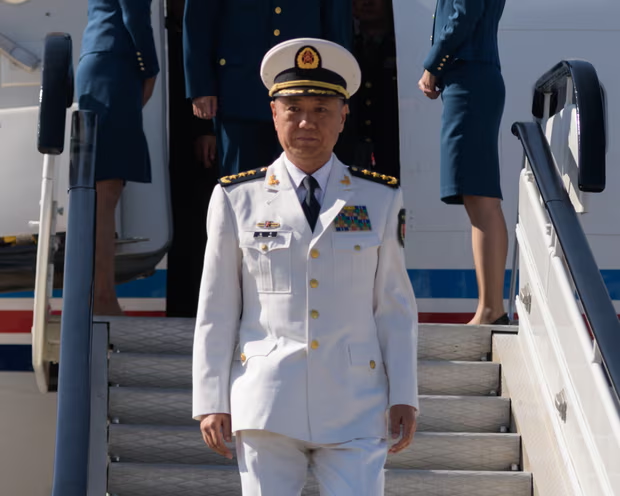


In a powerful move underscoring President Xi Jinping’s determination to clean up the Chinese military, Admiral Miao Hua has been removed from his senior post within the Central Military Commission (CMC), the highest governing body of China’s armed forces. This development highlights the continued intensity of Beijing’s anti-corruption efforts, which now extend to the uppermost echelons of military leadership. Miao’s fall from grace is part of a broader shakeup that has already seen several key figures in the defense sector removed, raising questions about internal oversight and Xi’s long-term strategy for consolidating power.

I. Power Shakeup Within the Central Military Commission
1. Admiral Miao Hua Removed from Military Leadership
Miao Hua, one of the most senior admirals in the People’s Liberation Army (PLA) Navy, served as the director of the Political Work Department within the CMC, a role essential for maintaining political loyalty and ideological alignment across the military. His dismissal, officially confirmed by Beijing on Friday, follows his suspension last year due to “serious violations of discipline,” a euphemism widely used to denote corruption.
2. One of the Highest-Level Purges in Decades
The decision to remove Miao marks one of the most significant dismissals from the CMC since the 1960s. He had already been expelled from the National People’s Congress in April, further signaling his complete fall from political favor. His removal adds to a growing list of high-ranking military officials who have faced investigation or been purged in recent years.
II. Expanding Scope of Military Purges
1. Additional Top Officials Under Investigation
He Weidong, a vice-chair of the CMC, is reportedly also being scrutinized, hinting at a broader internal audit of the military’s top brass. These developments reflect the increased vulnerability even of those in the highest ranks, and further signal the widening scope of the crackdown.
2. Pattern of High-Level Dismissals
Over the past two years, Xi Jinping has removed a string of key military leaders, including two defense ministers—Li Shangfu and Wei Fenghe—as well as two heads of the PLA’s powerful rocket force and two other CMC officials. The Rocket Force is a crucial military branch tasked with managing China’s strategic missiles and nuclear capabilities. The purges also reached into the civilian sector, affecting aerospace executives and major defense contractors linked to the Communist Party’s advisory organs.
III. Implications for Xi Jinping’s Leadership
1. Xi’s Long-Running Anti-Corruption Drive
Since coming to power in 2012, Xi has vowed to eliminate corruption at all levels of government, targeting both the “tigers and flies”—terms symbolizing top officials and lower-level bureaucrats. Over the years, millions of civil servants have been investigated, and hundreds of thousands have faced disciplinary measures or legal consequences.
2. Questioning the President’s Vetting Process
What’s particularly striking in the current wave of dismissals is that many of the individuals now under investigation—such as Miao Hua and Li Shangfu—were appointed by Xi himself. Their removal raises uncomfortable questions about his ability to vet top-level personnel. These incidents suggest possible blind spots in his leadership, despite his reputation for centralized control and rigorous internal scrutiny.
IV. The Broader Political and Global Context
1. Strategic Concerns Amid Global Unrest
China is eager to present an image of internal strength and continuity, especially as international attention remains focused on ongoing wars in Ukraine and the Middle East. However, the dismissal of senior military officials may challenge that image, highlighting instability within the ranks of the PLA and undermining Beijing’s efforts to project a stable, rising power.
2. US-China Military Communications Lagging
Military communication between China and the United States has been inconsistent in recent years. While American military officials visited Shanghai for talks in April, high-level meetings remain sparse. This year’s Shangri-La Dialogue in Singapore—an annual defense forum that usually features senior military representation from both nations—saw China send only a lower-level delegation, further illustrating the strain in bilateral defense engagement.
V. Procurement Scandals and Corruption in Defense Contracts
1. Equipment Procurement Under Scrutiny
Many of the recent purges appear to be tied to allegations of misconduct in military procurement. Li Shangfu, who was removed from his post as defense minister in 2023, once headed the PLA’s Equipment Development Department, which oversees acquisitions of arms and defense systems. A number of his associates within the department have also been implicated and investigated.
2. Military Industrial Complex Faces Pressure
In addition to senior personnel in the armed forces, major figures from China’s aerospace and defense industry have also been removed from government advisory roles. This reflects broader attempts to crack down on corruption across all levels of China’s military-industrial complex, indicating that the campaign is not limited to uniformed officials alone.
VI. Comparisons to Past Political Purges
1. Echoes of Mao-Era Political Cleansing
Miao Hua’s removal makes him the eighth CMC member to be ousted since Xi assumed power. Such purges within the CMC were virtually nonexistent since the days of Mao Zedong. That trend appears to be reversing under Xi, with his leadership style bearing increasing resemblance to Mao’s highly centralized and deeply loyalist governance model.
2. Other High-Profile Removals
One notable example beyond the military is Qin Gang, the former foreign minister and a close confidant of Xi. Qin abruptly disappeared from public view in June 2023, sparking global speculation. Although his removal was later confirmed in October, no explanation was provided, underscoring the opaque nature of internal party discipline under Xi’s rule.
Conclusion
The removal of Admiral Miao Hua from the Central Military Commission marks a pivotal moment in Xi Jinping’s decade-long crusade against corruption. This latest purge not only reflects Xi’s ongoing resolve to enforce loyalty and discipline within the Chinese military but also exposes the internal challenges of governance in an era where even handpicked officials are vulnerable to misconduct. As the president’s anti-corruption campaign deepens, questions persist over whether these moves are driven by genuine reform or political consolidation. Regardless, the ripple effects of these dismissals are likely to shape the future of China’s military and political landscape in the years to come.








