





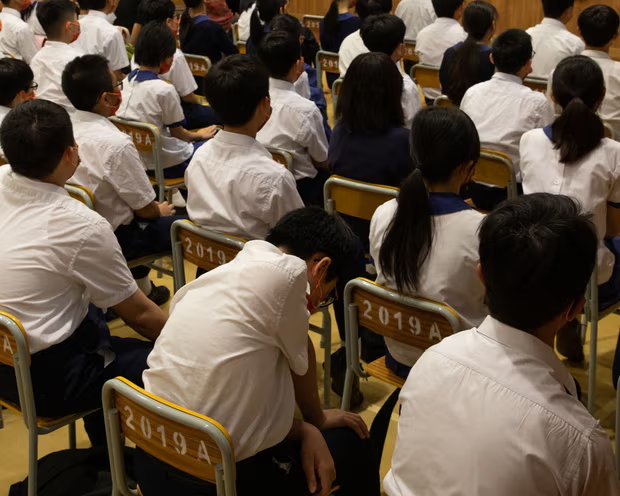


Teachers in Hong Kong have reportedly been advised to avoid participating in or allowing students to attend any U.S. Independence Day celebrations, citing concerns over potential violations of the city’s sweeping national security law. According to educators, these instructions reflect a broader trend of tightening control over the city’s education system since the introduction of the national security legislation in 2020. Messages circulating among school staff have raised alarm over the extent to which even symbolic participation in foreign events is being scrutinized under the guise of safeguarding national security.


I. Educators Warned Over U.S. Independence Day Events
1. Message Cautions Against July 4 Participation
An internal message, allegedly from a Hong Kong school principal, urged teachers to avoid involvement in any U.S. Independence Day activities organized by the American consulate. The warning cited guidance from the regional education office, which reportedly emphasized potential breaches of national security and local laws. The message, shared publicly on Edu Lancet—a Facebook platform managed by former Hong Kong education official Hans Yeung—stressed the need to discourage student participation and be vigilant in protecting them from legal risks.
2. Official Clearance Required for Foreign Invitations
Another document circulated among teachers stated that any invitations to events hosted by embassies or organizations with embassy funding must receive prior approval from school principals. The stated purpose was to ensure that participation did not compromise national security, further reinforcing the increasing regulation of teachers’ public and private interactions.
II. Government Justifies Security-Focused Education Policy
1. Bureau Stands by Security Measures in Schools
When approached for comment, the Hong Kong Education Bureau neither confirmed nor denied the authenticity of the messages. However, it emphasized that schools are expected to implement mechanisms aimed at deterring activities deemed harmful to national security. Officials said clear policies had been put in place requiring schools to tailor security measures to their individual circumstances, ensuring compliance with the national law.
2. No Clarification on Specific Legal Violations
Despite widespread concern, authorities did not elaborate on which specific laws would be broken by attending Fourth of July events. Nor did they indicate whether the warning applied exclusively to U.S. celebrations or other foreign observances as well. The U.S. Consulate in Hong Kong has not yet responded to requests for clarification on the matter.
III. Surveillance and Self-Censorship in Hong Kong Classrooms
1. Growing Fears of Surveillance Among Teachers
Several educators in Hong Kong have previously expressed to international media their fear of being targeted or reported over remarks perceived as unpatriotic. Since 2020, a heightened culture of surveillance has developed within the city’s schools, with teachers increasingly resorting to self-censorship to avoid potential disciplinary action or legal consequences.
2. Mandatory Exams on National Security Laws
Beginning in the 2023–24 academic year, all new teachers employed in public schools, kindergartens, and government-subsidized institutions are now required to pass an exam covering both the Basic Law and the national security law. This testing requirement is seen as part of a broader strategy to ensure ideological alignment among educators with the government’s emphasis on patriotism and political conformity.
IV. Political Repercussions for Critics of the System
1. Edu Lancet Faces Government Scrutiny
The Facebook page Edu Lancet, run by former education assessment official Hans Yeung, has been openly critical of Hong Kong’s education policies under the national security framework. Yeung, now residing in the United Kingdom, has faced public condemnation from Hong Kong officials. Security Secretary Chris Tang has accused him of inciting unrest and spreading misinformation about the education system.
2. Allegations of “Soft Resistance” in Education
Education Minister Christine Choi has repeatedly raised alarms over what she refers to as “soft resistance” within the city’s schools. She claims that such resistance can manifest through subtle channels like extracurricular activities, book fairs, and teaching materials that do not align with the government’s security agenda. This month, Choi warned educators to be wary of “hostile forces” using seemingly benign platforms to promote dissenting narratives.
V. National Security and the Transformation of Education
1. Overhaul of Curriculum Post-2019 Protests
The crackdown on education reform can be traced back to the mass pro-democracy demonstrations that engulfed Hong Kong in 2019. In the aftermath, the Chinese Communist Party imposed a strict national security law that criminalized various forms of dissent. Former Chief Executive Carrie Lam accused the education sector of contributing to the unrest, which paved the way for a dramatic overhaul of the curriculum.
2. Patriotic Education Takes Center Stage
Since the law’s enactment, patriotic content has been integrated into nearly all subjects—including English, mathematics, and even physical education. The government has actively banned publications and other learning materials deemed subversive, including a picture book about sheep, which officials claimed posed a national security threat. Authors and publishers involved in such works have faced legal prosecution, contributing to a culture of censorship and fear among educators.
Conclusion
The warnings issued to Hong Kong teachers regarding U.S. Independence Day celebrations reflect a broader transformation of the city’s education system under China’s national security agenda. What was once a relatively open academic environment has become a tightly controlled sector where political loyalty is prioritized over pedagogical freedom. As educators navigate increasing restrictions, many fear for their ability to teach critical thinking without running afoul of the state. These developments are indicative of Hong Kong’s shifting identity—from a semi-autonomous region with liberal traditions to one increasingly aligned with Beijing’s centralized and authoritarian model of governance.








