






In a move driven by escalating political tensions and pressure over irregular migration, Poland has announced the reintroduction of temporary border checks with Germany and Lithuania beginning Monday. The decision, unveiled by Prime Minister Donald Tusk following consultations with the Polish border guard, marks a significant shift in the country’s stance toward cross-border migration within the Schengen Zone.

I. Background of the Policy Shift
1. Mounting Pressure from Far-Right Protests
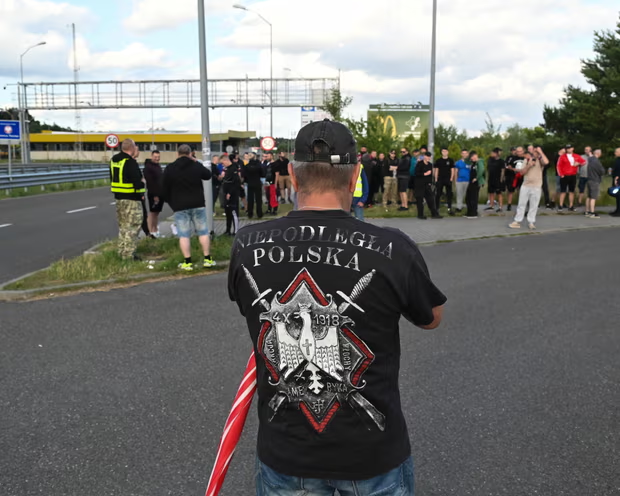
Recent demonstrations backed by far-right groups at Polish border crossings with Germany over the weekend amplified domestic concerns over immigration. These protests, coupled with a surge in political criticism, have compelled the Polish government to act swiftly in response.
2. Border Management Becoming a Political Flashpoint
During a cabinet meeting on Tuesday, Prime Minister Tusk directly attributed the current migration dilemma to changes in Germany’s border enforcement strategies. He claimed that Germany had begun refusing entry to migrants aiming to seek asylum or protection, effectively forcing them back toward Poland.
“The dynamics at the Polish-German border have clearly shifted in recent weeks,” Tusk stated, emphasizing that Germany’s approach was increasingly unilateral and leaving neighboring countries to bear the brunt of migration pressures.
II. German Migration Policy as a Trigger
1. Chancellor Merz’s Tougher Stance
Since taking office in May, German Chancellor Friedrich Merz has introduced stricter border enforcement, deploying more police to monitor crossings and returning unauthorized individuals. This approach stems from his electoral campaign, where a more restrictive migration policy was a key pledge.
Earlier in the year, Merz’s predecessor had already extended temporary border checks to curb migration surges. These decisions, however, have led to unintended consequences for neighboring countries like Poland.
2. Poland’s Growing Frustration
Tusk expressed concern that without adequate border screening on the Polish side, it becomes increasingly difficult to determine whether individuals rejected by Germany had any legitimate entry route through Poland. He warned that Poland’s tolerance for such discrepancies was diminishing.
“I’ve had numerous conversations with Chancellor Merz,” Tusk noted, “but our patience has limits. Poland remains committed to the values of the Schengen Zone, but this requires mutual respect and cooperation.”
III. Legal Grounds and Regional Implications
1. Temporary Controls Within EU Law
The European Union allows member states to reintroduce border checks temporarily when faced with serious security threats or extraordinary circumstances. These measures, however, must remain proportional and time-bound, serving as a last resort rather than a norm.
Poland is now invoking this provision, citing national security and the need to prevent unregulated migration flows. Tusk emphasized that the aim was to reduce uncontrolled border crossings “to an absolute minimum.”
2. A Warning for Future Diplomatic Frictions
Tusk also delivered a pointed message to Berlin: should Germany decide to continue its unilateral controls beyond September, Poland would retaliate accordingly. “The era when Poland would ignore such moves is over,” he declared.
IV. Lithuania and the Broader Migration Route
1. Extending Controls Beyond Germany
While Germany remains the primary focus of Poland’s border concerns, Lithuania has also been included in the new measures. Tusk explained that with Poland’s border with Belarus now highly fortified and closed to irregular crossings, migrants were seeking alternative routes through the Baltics.
According to Polish officials, unauthorized migrants—allegedly encouraged by Russian and Belarusian activities—have been moving through Latvia and Lithuania en route to Poland and, ultimately, deeper into the EU.
2. Tensions with Belarus and Russia
Tusk reiterated that “the flow of illegal migration continues through channels orchestrated by Belarus and Russia,” accusing the two countries of leveraging migration as a form of hybrid warfare against the EU. These developments have further complicated regional security and added urgency to Poland’s decision.
V. German Response to Polish Criticism
1. Diplomatic Engagements Between Leaders
At a press conference held jointly with Luxembourg’s prime minister, Chancellor Merz addressed the controversy, stating that he was well aware of Polish concerns. He confirmed that he had been in contact with Tusk in recent days to discuss the situation.
However, Merz denied allegations that asylum seekers were being forcibly returned to Poland, saying: “There are no cases of Germany deporting migrants back to Poland who have already entered German territory.”
2. A Call for Collaborative Solutions
Despite the disagreement, Merz expressed a desire to maintain constructive dialogue. “Poland and Germany share a mutual challenge,” he said. “We both want to protect the Schengen system, but this requires preventing its misuse—especially by those facilitating illegal migration through smuggling operations.”
VI. Broader European Context
1. Rising Migration and Internal Divisions
The migration issue continues to expose deep divisions within the EU, as member states balance humanitarian commitments with domestic political pressures. Poland’s latest move illustrates the challenge of aligning national interests with broader European goals.
The Schengen Zone, one of the EU’s core achievements, depends on mutual trust and consistent policy enforcement. However, differing approaches to migration—particularly between western and eastern member states—threaten to undermine this foundation.
2. Growing Role of Populism
In both Germany and Poland, far-right narratives have influenced policy shifts, particularly around immigration. The protests at the German-Polish border over the weekend were emblematic of this growing influence, pushing governments to adopt stricter controls to appease domestic constituents.
Conclusion
Poland’s decision to reintroduce temporary border controls with Germany and Lithuania underscores the complex and often contentious dynamics of European migration policy. While framed as a response to security concerns and irregular migration, the move also reflects deeper political tensions and divergent views on how to manage shared responsibilities within the EU.
With Germany pushing for stricter border enforcement and Poland warning of retaliatory measures, the future of free movement within the Schengen Zone could be at stake. If cooperative dialogue does not prevail, the EU may face further internal fractures—at a time when unity is more critical than ever.