





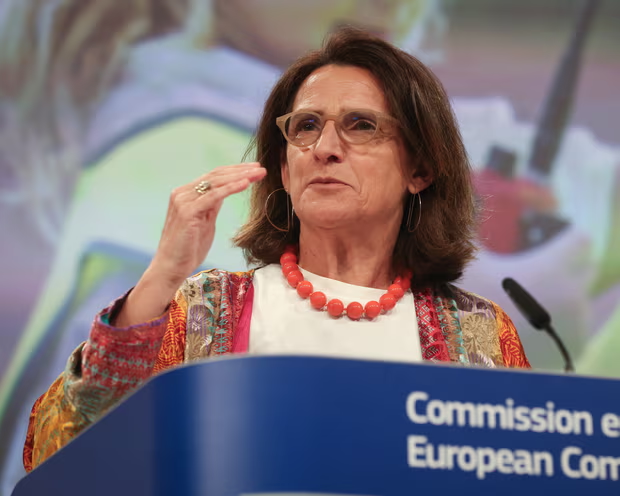


As Europe grapples with unprecedented summer temperatures, senior EU officials are sounding the alarm over the political inaction that continues to stall meaningful climate adaptation. Teresa Ribera, the European Commission’s executive vice-president for the green transition, has condemned what she describes as a lack of courage among politicians unwilling to confront the climate crisis head-on. Her warnings come during a historic heatwave affecting countries from Spain and Portugal to the UK, raising new concerns over the continent’s preparedness for climate-related disasters.

I. Extreme Temperatures Highlight Growing Climate Risks
1. A Summer of Shattered Records
Across Europe, temperatures have reached new highs, with Spain’s Huelva province recording a blistering 46°C over the weekend—levels more commonly associated with mid-summer peaks than early June. The capital of Belgium, Brussels, reported 36°C, while parts of eastern Europe recorded up to 38°C. Spain’s meteorological agency Aemet confirmed that June 2025 has set a new benchmark, averaging 23.6°C—3.5°C above the 1991–2020 baseline and 0.8°C hotter than the previous record set in 2017.
These developments are not isolated anomalies, according to Ribera. “When you look at the map of Europe, it’s terrifying,” she told The Guardian. “These temperatures have severe consequences—not just on human health and the environment, but on our economy and infrastructure.”
2. Impact Beyond the Heat
It’s not just the heat that’s proving disastrous. Ribera cited last October’s deadly floods in Valencia, which claimed 229 lives after days of torrential rain, as further proof that climate-related events are intensifying. “These aren’t random episodes anymore,” she warned. “And yet, many still treat them as if they were isolated incidents.”
Despite the mounting evidence, Ribera stressed that a true shift in policy and public readiness has yet to occur. The European Union, she argues, remains stuck in a reactionary mode, failing to move from alarmist headlines to strategic preparation and resilience-building.
II. Political Paralysis in the Face of Crisis
1. The Cost of Inaction
Ribera was blunt in her assessment: many politicians are choosing convenience over courage. “It’s a huge mistake to assume these problems will resolve themselves or that markets will magically adapt,” she said. “We can’t tell people that climate change is the defining issue of our time and then continue to ignore it.”
She pointed out that denying the climate crisis—or refusing to engage with the solutions out of fear of voter backlash—ultimately undermines public trust in political institutions. “By avoiding difficult conversations, we are weakening democracy,” Ribera added.
2. A Growing Divide Over Climate Policy
Far-right parties across Europe continue to treat the climate crisis as a political battleground rather than a scientific reality. In Spain, the nationalist Vox party is actively campaigning to repeal existing climate legislation, favoring expanded use of nuclear energy instead. Hungary’s Prime Minister Viktor Orbán has gone further, labeling the EU’s climate goals a “utopian fantasy” that would only raise energy prices.
Despite this political resistance, Ribera insists that consensus is possible. She cited the €1.4 billion agreement struck between Spain’s central government and Andalusian authorities last year to protect the Doñana wetlands—a region critical for biodiversity and carbon storage—as proof that cooperation can yield tangible results.
III. Water: A Vital and Overlooked Resource
1. Changing Perceptions About Water
Joining Ribera in her climate push is Jessika Roswall, the EU’s commissioner for environment, water resilience, and circular economy. Roswall emphasized that one of the key challenges Europe faces is reshaping how societies perceive and use water.
With droughts becoming more frequent and prolonged, she said, water should now be treated as a strategic asset. “We have taken water for granted for too long,” Roswall stated. “We’ve assumed it would always be there, without recognizing that it’s a finite resource.”
2. Water’s Role in Security and Economy
Roswall highlighted that water is not just essential for agriculture or human consumption but is also fundamental to energy production and digital infrastructure. Datacenters, for example, consume massive volumes of water to remain operational.
“When we talk about security, it’s not only about military equipment,” she explained. “Nature itself is part of our security system. Investing in nature—like protecting rivers, forests, and wetlands—is as crucial as investing in borders or defense.”
Doñana, the wetland they visited together, exemplifies how natural ecosystems can buffer against climate events like fires and floods while supporting biodiversity and absorbing carbon emissions.
IV. The Price of Denial
1. Rising Costs of Delay
Ribera was unequivocal in her message: failing to act will be far more expensive than taking preemptive measures. “We already know the cost of inaction—it’s being paid in lives, livelihoods, and the stability of our ecosystems,” she said.
The green transition, she argued, is not a matter of ideological preference but of practical necessity. Without major investments in infrastructure, renewable energy, and environmental protection, the toll from climate events will continue to rise exponentially.
2. The Need for Political Courage
Addressing the underlying issue, Ribera stressed that what Europe needs most right now is political will. “Often, courage in politics means acknowledging difficult truths and taking collective responsibility,” she said. “It’s not about being popular, it’s about being honest.”
She called on leaders across the continent to stop minimizing the crisis and start treating it with the urgency it demands. Only by being “big, not small,” she said, can politicians deliver the solutions their citizens and the planet desperately need.
Conclusion
As Europe faces the brunt of climate change—from record-breaking temperatures to deadly floods—the time for half-measures is over. Teresa Ribera and Jessika Roswall are among the growing number of EU officials demanding not just recognition of the climate crisis, but bold and unified action. The choices made today will define the quality of life for generations to come. Whether Europe can muster the political will to face these challenges remains the defining question of our era








