




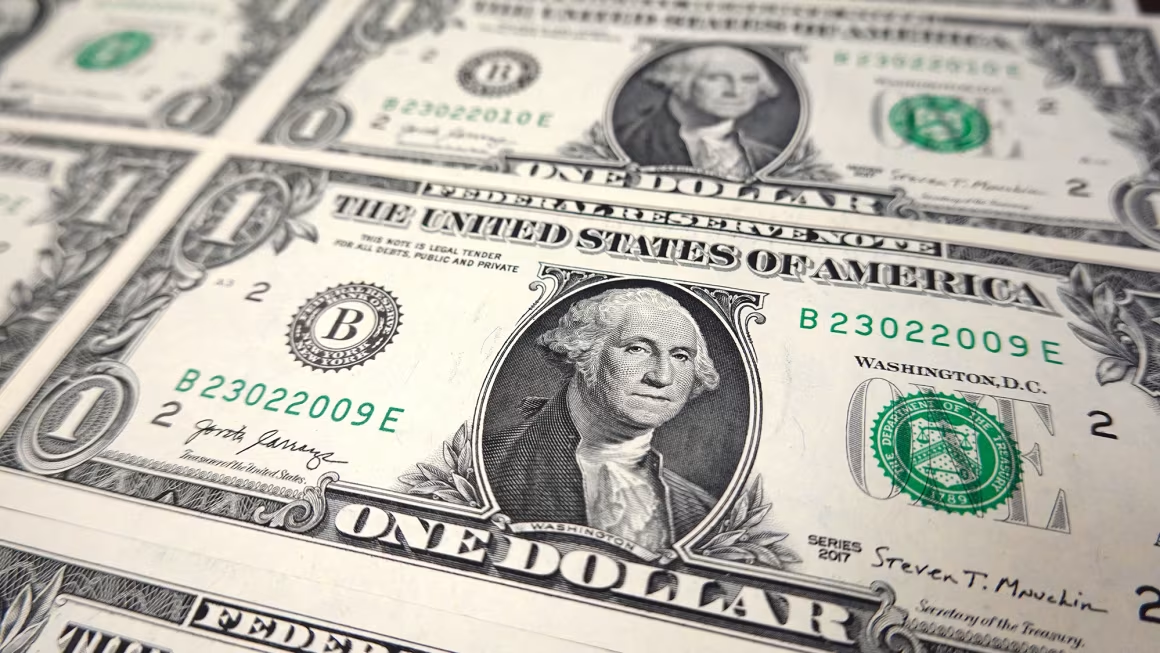


In a year marked by economic unpredictability and political turbulence, the US dollar is experiencing one of its steepest drops in decades. While equities have recovered from their April slumps and bond demand remains steady, the greenback continues to weaken—raising concerns among investors and economists alike. Despite expectations of a stronger dollar under President Trump’s second term, shifting trade policies and mixed economic signals have contributed to a sharp loss in value and global confidence.


I. The Dollar’s Unprecedented Decline
1. A Steep Drop in Value
The US dollar index, which gauges the dollar’s strength against six major foreign currencies, has plummeted nearly 10% since the beginning of the year. By Wednesday, it hovered around its lowest point since 2022. Wall Street had largely anticipated a stronger dollar in Trump’s second term, expecting that tax cuts would stimulate domestic growth and tariffs would curb demand for foreign goods—thereby increasing demand for the dollar.

However, those expectations have not materialized. Instead, the dollar has steadily lost ground, undermined by policy volatility and international unease about the US economic outlook.
2. Impact of Trade Policy Confusion
Rather than stabilizing the dollar, the administration’s fluctuating stance on tariffs—imposing, lifting, and adjusting them repeatedly—has created a climate of uncertainty. Barry Eichengreen, a professor of economics and political science at UC Berkeley, explained that this unpredictability has played a major role in driving the dollar’s depreciation.

“Investors shy away from uncertainty,” Eichengreen said, noting that while the US economy faces a murky outlook, Europe appears comparatively more stable. This has shifted investor focus overseas and weakened confidence in the dollar’s traditional role as a safe haven.
II. Economic Consequences of a Weaker Dollar
1. Exporters and Tourists May Benefit
While a weaker dollar presents challenges, it can also offer short-term advantages. American goods become more competitively priced on the global market, benefiting exporters. US companies with international revenue streams may also see improved earnings when foreign profits are converted back to dollars.
Moreover, the decline makes travel to the United States more affordable for international visitors, potentially boosting the domestic tourism industry.
2. Challenges with US Debt and Investor Sentiment
Despite some positives, concerns persist about how a declining dollar affects foreign demand for US assets. As the federal government prepares to pass the “One Big Beautiful Bill Act,” worries over ballooning national debt are surfacing. Foreign investors typically prefer a strong dollar when purchasing US debt, as it ensures better returns once converted back to their local currencies.
With the dollar weakening, those returns diminish, prompting some international investors to demand higher yields to offset currency losses. This shift could lead to increased borrowing costs for both the US government and everyday consumers.
III. A Crisis of Confidence
1. Political Instability Undermining the Dollar
Arun Sai, a senior strategist at Pictet Asset Management, believes the dollar’s slide is not just about economic fundamentals but also reflects broader doubts about America’s political direction. “If investors can’t confidently assess where US policy is heading, they’ll hesitate to commit capital,” he said.
According to Sai, the administration’s indecisive approach to tariffs has eroded global trust in the dollar. This sentiment was exacerbated in April when US stocks, bonds, and the dollar all dropped simultaneously—a rare and unsettling event that signaled a broader loss of market confidence.
2. Dollar’s Safe Haven Status in Question
Francesco Pesole, FX strategist at ING, emphasized that while the dollar remains the world’s dominant currency, its reputation as a reliable hedge during crises is beginning to fray. “This doesn’t mean the dollar is being dethroned,” he said. “But the pace of its relative decline in global dominance appears to be accelerating.”
This shift is evident in recent data: a Bank of America survey from June showed fund managers had the lowest exposure to the dollar since 2005. In contrast, investors are showing increased interest in foreign currencies and markets.
IV. Rise of Global Alternatives
1. The Euro’s Strength
As confidence in the dollar wanes, the euro has gained momentum. Up 11.5% against the dollar this year, the euro recently hit its strongest position in over four years. This resurgence reflects growing investor preference for European assets, seen as relatively safer amid American policy unpredictability.
Jason Blackwell, Chief Investment Strategist at Focus Partners Wealth, noted that this trend offers a compelling opportunity for portfolio diversification. “International equities are looking increasingly attractive,” he said, pointing to the improved performance of non-US holdings in a weak dollar environment.
2. Shifting Investment Strategies
With the dollar underperforming, global investors are reevaluating their allocations. Blackwell suggested that mutual funds and ETFs focused on international markets present viable alternatives to US-centric investments. He views the dollar’s decline less as a condemnation of American fundamentals and more as an endorsement of opportunities abroad.
“There’s a growing belief that other economies are on firmer footing right now,” Blackwell added. This perspective may encourage a more balanced approach to global investing in the months ahead.
V. Broader Implications and the Path Forward
1. Repercussions for Monetary Policy
The weakening dollar also complicates monetary policy. A depreciating currency can stoke inflation by making imports more expensive, even as the Federal Reserve attempts to keep interest rates aligned with economic conditions.
If inflation accelerates, the Fed could be forced into tightening monetary policy sooner than expected—an outcome that may put further strain on borrowing and consumer spending.
2. America’s Economic Image at Risk
Ultimately, the dollar’s decline reflects a perceived erosion of the United States’ role as a financial anchor. The once-unquestioned status of the dollar as the default destination for global capital is being challenged—not by a single event, but by a pattern of erratic policies and diminishing investor trust.
As Eichengreen pointed out, “The weakness of the dollar is a symptom of deeper concerns—about governance, debt, and long-term economic stability.”
Conclusion
The US dollar’s steep fall in 2025 marks a critical moment for the global financial system. As investors reassess their faith in American economic leadership, the ripple effects are being felt across currency markets, equity portfolios, and international trade. While there may be silver linings—such as increased competitiveness for US exporters and improved returns for global investors—underlying issues like policy inconsistency and growing debt must be addressed to restore confidence.
Whether the dollar’s decline is a short-term correction or a sign of lasting change remains to be seen. But for now, the greenback’s faltering status is forcing investors, policymakers, and businesses to confront a new financial reality.