





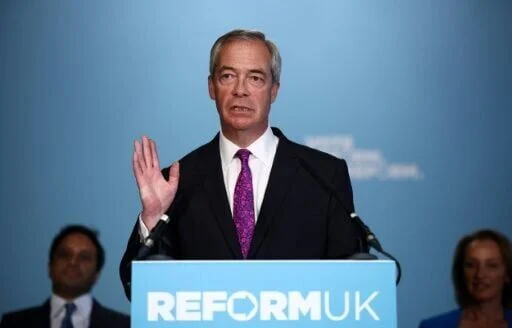


The intersection of politics and cryptocurrency is growing stronger in the UK, with Reform UK becoming the first major British political party to formally accept donations in digital assets such as Bitcoin. Party leader Nigel Farage made the announcement during a cryptocurrency conference in Las Vegas, unveiling his vision for a “crypto revolution” that, if his party comes to power, could transform the nation’s financial system. This move places Reform UK at the center of the debate surrounding digital currency adoption in politics and raises both opportunities and concerns regarding transparency and regulation.


I. Reform UK’s New Chapter with Crypto
1. Farage Announces Crypto Integration at Global Event
Speaking at a high-profile Bitcoin conference in Las Vegas, Nigel Farage revealed that Reform UK is now officially accepting cryptocurrency donations. He stated, “As of now, provided you are an eligible UK donor… we are the first political party in Britain that can accept donations in Bitcoin and other cryptocurrencies.”

The announcement marks a bold step toward integrating decentralized finance into the UK’s political landscape, signaling a wider ambition from Farage and his party to reshape how campaign funding and political engagement are approached.
2. A Vision for a Digital Reserve and Crypto-Led Economy
Farage’s crypto advocacy doesn’t end at donations. If Reform UK assumes leadership, the party intends to establish a national Bitcoin digital reserve at the Bank of England, mirroring recent initiatives in the United States. This measure is part of a broader goal to align the UK with the evolving digital finance world and enhance the country’s economic sovereignty through blockchain technology.

The party’s website now facilitates crypto donations, making it possible for supporters to contribute in digital assets directly and securely—a move touted as a first among major political organizations in Europe.
II. Reactions and Implications in the Political Landscape
1. Reform UK: A European First in Crypto Contributions
According to Radom, the British payment platform managing Reform UK’s crypto transactions, the party is now “the first major political party in Europe to accept cryptocurrency donations.” This development reflects a wider shift toward integrating emerging technologies into democratic processes.
However, while the move is seen by supporters as a modern and inclusive approach to campaign funding, it has not gone without criticism—especially concerning accountability and misuse.
2. Transparency Concerns Among Financial Experts
Experts have voiced concerns about the transparency and oversight of crypto-based political donations. Larisa Yarovaya, an associate professor of finance at Southampton Business School, warned that while cryptocurrencies provide access to financial systems for individuals excluded from traditional banking, they also pose significant regulatory challenges.
“Anyone can receive crypto donations, as cryptocurrencies are permissionless and don’t require bank authorization,” she explained. While this removes barriers to participation, it simultaneously opens the door to anonymity and potential illicit financing. “Crypto donations raise concerns around transparency, regulation, and potential misuse,” Yarovaya added.
III. The Global Context of Political Crypto Adoption
1. Trump’s Crypto Support and Influence
The concerns surrounding crypto in political fundraising are not limited to the UK. In the United States, former President Donald Trump has also embraced cryptocurrency donations, with millions raised through digital assets for his previous campaigns.
Trump’s public support of crypto has stirred debate about possible conflicts of interest, especially given his involvement in blockchain ventures. Nonetheless, his stance has energized a segment of the electorate eager for digital innovation within traditional political systems.
2. Farage Aligns with Global Pro-Crypto Figures
By allowing crypto donations and advocating for a blockchain-powered central reserve, Farage positions himself alongside other pro-crypto political figures like Trump. Charles Morris, founder of the analytics firm ByteTree, remarked that Farage’s stance represents “a way to demonstrate his allegiance with financial technology.”
This alignment suggests a potential political strategy: attracting younger, tech-savvy voters and entrepreneurs who support decentralization, financial innovation, and reduced reliance on traditional institutions.
IV. Competing Visions: Labour Party’s Regulatory Focus
1. Labour’s Regulatory Roadmap for Crypto
Not to be left behind in the digital currency debate, the UK’s Labour Party also envisions a future shaped by crypto—though with a markedly different approach. In April, finance minister Rachel Reeves introduced a set of regulatory guidelines aimed at governing crypto-related activities, suggesting a more cautious and rules-based integration of the technology.
Rather than prioritizing crypto adoption as a political tool, Labour’s focus lies in balancing innovation with protection, particularly regarding investor rights and the prevention of money laundering.
2. A Competitive Crypto Race in British Politics
With Reform UK pushing for rapid crypto inclusion and Labour advocating for structured oversight, the UK appears to be entering a competitive phase in defining its national blockchain strategy. Both parties recognize crypto’s potential, but diverge sharply on the method and pace of implementation.
The result is a political landscape increasingly shaped by digital currency, with voters likely to consider each party’s crypto stance when casting ballots—especially younger demographics who are already active in the digital finance space.
V. Electoral Impact and Future Prospects
1. Reform UK’s Growing Influence
In the UK’s general election in July 2024, Reform UK made a noticeable impact, securing over 14% of the national vote and five seats in Parliament. The party also achieved significant gains in local elections earlier this month, reflecting a growing base of support.
Farage’s recent crypto initiatives could serve to strengthen this momentum, appealing to both disaffected voters and those interested in technological innovation.
2. Digital Finance as a Campaign Strategy
By embracing crypto at a structural and symbolic level, Reform UK is framing digital finance as more than just a technological shift—it’s being positioned as a core aspect of its political identity. Whether this strategy pays off in the long term remains to be seen, but it has undeniably placed crypto on the national political agenda.
If Farage’s vision gains traction, the UK could witness a fundamental transformation in both its financial systems and political fundraising mechanisms, setting a precedent for other European nations.
Conclusion
Reform UK’s decision to accept cryptocurrency donations marks a historic moment in European political history and signals a broader trend of blockchain integration into governance. Led by Nigel Farage, the party’s crypto-forward stance has sparked conversations about innovation, transparency, and financial accessibility in politics.
While the initiative has drawn both praise and scrutiny, it positions Reform UK as a disruptive force in the evolving relationship between politics and financial technology. As more political entities explore crypto’s potential, the UK could become a testing ground for the intersection of decentralized finance and democratic participation.








