





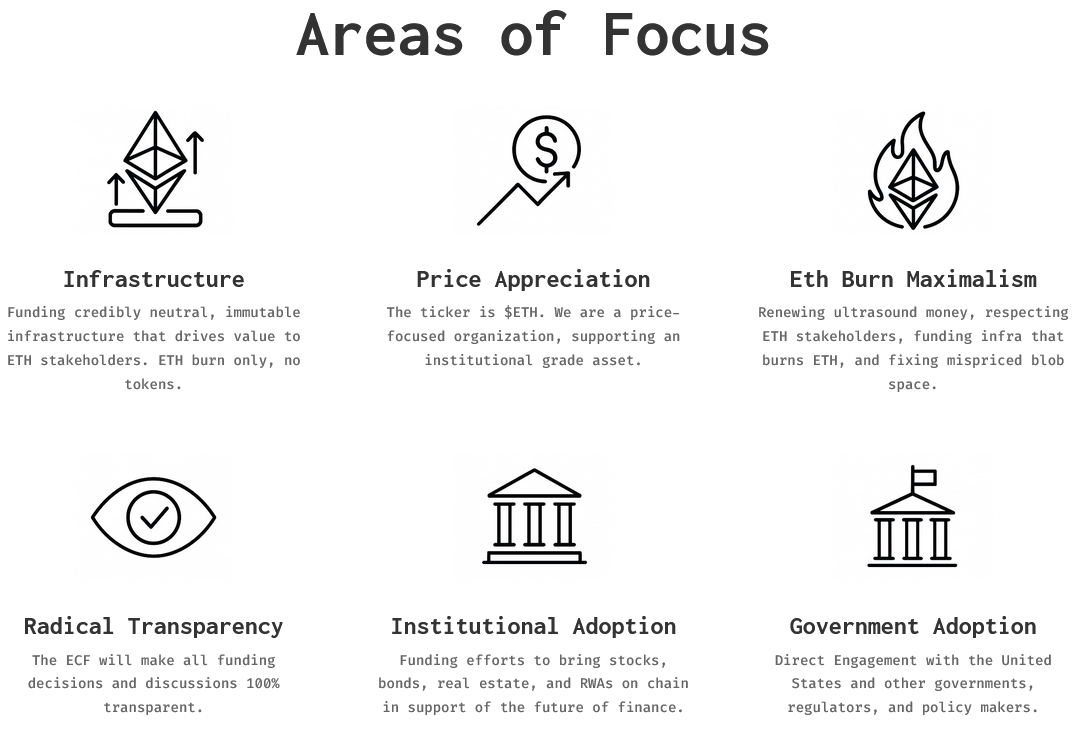


A prominent Ethereum core developer, Zak Cole, has launched a new initiative known as the Ethereum Community Foundation (ECF). Unveiled at the Ethereum Community Conference (EthCC) in Cannes, France, the foundation seeks to push the boundaries of Ethereum’s development — and to directly champion Ether (ETH) as an asset. One of its most ambitious objectives? Driving the price of ETH to $10,000.


I. A New Vision for Ethereum’s Asset Value
1. Filling the Void Left by the Ethereum Foundation
Zak Cole, known for his technical contributions to Ethereum, argued that the Ethereum Foundation has neglected ETH in its role as an investment asset. According to Cole, there’s a disconnect between Ethereum’s technological evolution and the financial mechanisms that underpin its token value.

The ECF, as described by Cole, was born from a desire to close that gap. It plans to fund and empower projects that not only grow the Ethereum ecosystem but also increase the demand and utility of ETH, thereby positively impacting its market value.
2. “We Serve ETH Holders”
During his speech at EthCC, Cole made it clear that the Ethereum Community Foundation would act where others have not.
“We are the Ethereum Community Foundation. We say what the [Ethereum Foundation] can’t, we do what the [Ethereum Foundation] won’t. We serve ETH holders because you deserve better,” he declared.
In a subsequent post on X (formerly Twitter), Cole explained his belief that the value of ETH is directly tied to the network’s security. For that reason, he argued, the push toward a $10,000 ETH isn’t just speculative — it’s necessary.
II. Funding Projects That Reinforce Ethereum’s Core
1. Prioritizing Infrastructure and Public Goods
The ECF intends to offer grants to developers and projects that align with several strict criteria. Among these, applicants must contribute to Ethereum’s core infrastructure, increase ETH burn, and support the network’s scalability and decentralization.
These grants aim to reward projects that run on Ethereum’s mainnet, which inherently generates ETH burns due to gas fees. This mechanism reduces ETH supply over time, supporting its price.
2. A Focus on Tokenless, Immutable Projects
Unlike many Web3 initiatives that issue their own tokens — often with backing from venture capital firms — the ECF will only support tokenless and immutable projects. According to Cole, this approach ensures that funded initiatives stay true to Ethereum’s ethos of decentralization and public ownership.
He took a strong stance against popular Ethereum-based projects such as Uniswap, Optimism, and Ethereum Name Service (ENS), criticizing them for accepting Ethereum Foundation support and later launching their own tokens with VC funding.
“Publicly funded projects should remain public and benefit those who have paid for them,” Cole argued.
III. Ethereum Validator Association: The First Step
1. Launching EVA to Empower Validators
The Ethereum Validator Association (EVA) was revealed as the first grant recipient of the Ethereum Community Foundation. According to Cole, the EVA will represent the interests of validators — the entities responsible for securing the network — and allow them to play a more active role in Ethereum’s governance.
This includes having influence over Ethereum’s EIP (Ethereum Improvement Proposal) roadmaps and the prioritization of Ethereum clients, two aspects that significantly affect the network’s performance and security.
2. Incentivizing Performance-Based Client Support
The EVA will also introduce mechanisms to empower Ethereum clients based on their technical performance and reliability. Cole suggested that validator preferences could shape which clients receive more support or adoption, ensuring that high-performing clients are prioritized over others.
3. Raising Transparency in Client Ecosystems
Cole pointed out a possible conflict of interest involving Offchain Labs, the team behind Arbitrum, a popular Ethereum layer-2 solution. He revealed that Offchain Labs has an ownership stake in Prysmatic Labs, the developers of Prysm, which is the second-largest Ethereum consensus layer client.
This, Cole suggested, may compromise the neutrality expected from core Ethereum infrastructure providers and raised the need for greater oversight and community involvement.
Conclusion
The creation of the Ethereum Community Foundation marks a turning point in Ethereum’s evolution — one where ETH holders and infrastructure integrity are placed front and center. By deliberately avoiding the paths paved by token-based incentives and venture capital influence, Zak Cole and the ECF aim to revive Ethereum’s grassroots values while pushing the network to new heights, including a bold target price of $10,000 for ETH.
Through funding strategic projects and empowering validators with greater governance control, the ECF is determined to make ETH not just a technical marvel but also a financially powerful asset. Whether this effort will redefine Ethereum’s future or create deeper divides in the ecosystem remains to be seen. What’s certain, however, is that a new chapter of Ethereum advocacy has just begun.








