





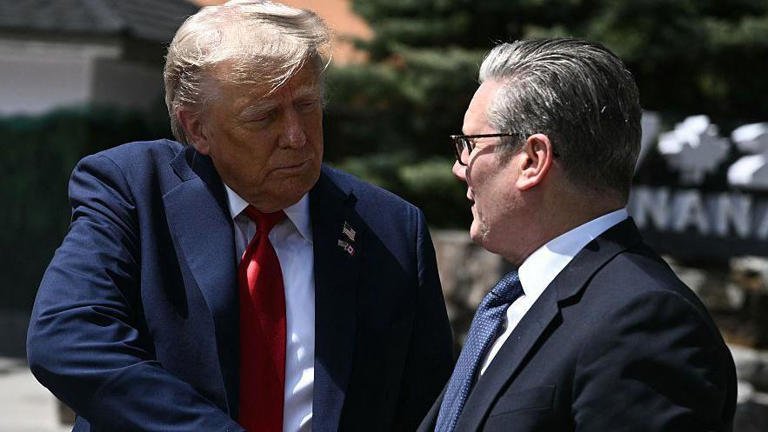


After weeks of intense negotiations, President Donald Trump has formally approved a limited trade agreement between the United Kingdom and the United States, signaling a partial reduction of trade barriers between the two nations. The agreement includes reduced tariffs on British vehicles exported to the U.S., but leaves key industries—particularly steel and bioethanol—facing uncertainty and demanding greater clarity from the UK government.


I. Easing Car Tariffs, But Questions Linger
1. A Win for the UK Auto Sector
One of the most notable aspects of the agreement is the easing of tariffs on UK-manufactured cars entering the American market. The new terms will allow up to 100,000 British vehicles to be imported into the U.S. with a 10% tariff, a considerable reduction from the 25% tariff imposed earlier this year. This adjustment offers some relief to an industry heavily reliant on U.S. exports.

Mike Hawes, head of the Society of Motor Manufacturers and Traders, welcomed the move, calling it “a huge reassurance” to the automotive sector. He explained that the uncertainty had already slowed British car shipments to the U.S., and the revised tariff offers a competitive edge, particularly over Italian and German manufacturers still subject to the higher 27.5% levy.
2. Fallout for Jaguar Land Rover
Despite this positive shift, some manufacturers had already felt the pinch. Jaguar Land Rover (JLR), owned by Tata Motors, had paused exports to the U.S. in April due to the tariff uncertainty. On the same day the agreement was finalized, the company lowered its earnings projections, underscoring how vulnerable even established firms are to trade disruptions.

II. Steel Industry Left in Limbo
1. No Resolution Yet on Steel Tariffs
While the new agreement includes progress on car tariffs, steel remains a contentious issue. U.S. import taxes on UK steel and aluminum still stand at 25%, and a clear exemption plan has yet to be revealed. President Trump vaguely mentioned that a similar arrangement to cars might be introduced for steel but declined to offer specific details, suggesting further announcements would follow.
Transport Secretary Heidi Alexander acknowledged ongoing talks to reduce the 25% tariff, indicating that “technical details” were still being worked out.
2. Industry Demands Urgent Clarity
Gareth Stace, director of UK Steel, emphasized the need for more precise guidelines, especially concerning the “melted and poured” rule, which requires steel to be entirely produced in the exporting country to qualify for tariff exemptions. This regulation poses a challenge for UK steelmakers like Tata Steel, which recently closed its blast furnaces and now imports material while transitioning to electric furnace operations.
III. Bioethanol and Beef: Trade-offs and Trade Fears
1. US Ethanol Floodgates Open
The agreement also grants the U.S. a tariff-free quota of 1.4 billion litres of ethanol, removing the 19% tariff previously applied to American imports. While this may reduce fuel prices and support environmental goals, it has sparked strong backlash from domestic producers.
Paul Kenward, CEO of ABF Sugar—the owner of the UK’s largest bioethanol plant, Vivergo Fuels in Hull—warned that the government has “handed over the entire UK market” for ethanol. Without swift state support, Kenward said the company would be forced to begin a redundancy consultation, putting around 200 jobs at risk. The company has set a deadline of June 25 to secure assistance.
2. US Beef Quotas Raised, Standards Maintained
In another major development, the UK agreed to scrap a 20% tariff on American beef and raised the import quota to 13,000 tonnes. While this opens up new supply options for British consumers and retailers, critics worry about the potential impact on domestic farmers and food safety.
Business and Trade Secretary Jonathan Reynolds assured the public that U.S. beef would still need to comply with UK food safety regulations. However, Liberal Democrat MP Daisy Cooper demanded full transparency, including impact assessments on British farming and food standards.
IV. Political Reactions and Limitations of the Pact
1. Not a Full Free Trade Agreement
Despite the celebratory tone from Prime Minister Sir Keir Starmer, who called the deal a “sign of strength” between the two nations, the agreement falls far short of a comprehensive free trade deal. The pact only covers specific sectors and was signed through executive order without congressional approval, limiting its scope and durability.
President Trump has touted it as a “major trade deal,” but without legislative backing, the agreement lacks the breadth and permanence of a formal treaty. Negotiations on other areas, including broader tariff reductions and regulatory alignment, are ongoing.
2. Opposition Voices Raise Alarm
Opposition leaders in the UK have criticized the deal for its narrow scope. Conservative leader Kemi Badenoch dismissed it as a “tiny tariff deal,” while others expressed concerns about its long-term consequences for strategic sectors like steel, farming, and clean energy.
Conclusion
The new UK-US tariff agreement represents a step forward in stabilizing trade relations amid a volatile global economic landscape. It provides some relief to carmakers and aerospace firms and marks progress in rebuilding transatlantic ties after a period of uncertainty. However, major UK industries—including steel and bioethanol—remain vulnerable, and critics argue that the government must do more to protect domestic producers from being undercut by subsidized American goods.
As the deal comes into force, the UK must navigate the fine line between opening up its markets and safeguarding key sectors. With negotiations still underway and critical industries seeking answers, the next few months will be vital in shaping the future of UK-US trade cooperation.








