




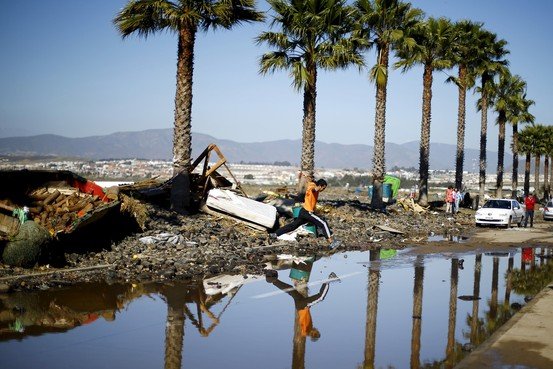


In the early hours of Wednesday morning, the tranquil rhythm of coastal life in Chile was violently disrupted by a powerful 7.4 magnitude earthquake that struck off its southern coastline. The undersea tremor, centered approximately 90 kilometers west of Puerto Montt at a depth of 25 kilometers, sent shockwaves not only through the country’s geological structure but also through the nerves of its people. The quake triggered immediate tsunami warnings, prompting mass evacuations and emergency responses along Chile’s long Pacific coast and beyond.


While the full extent of the damage is still being assessed, preliminary reports indicate significant structural impacts, coastal flooding in some low-lying areas, and widespread power outages. Fortunately, early warning systems and disaster preparedness measures appear to have helped mitigate casualties in what could have been a far deadlier event.

The Earthquake: Sudden Shock Beneath the Pacific
At precisely 3:42 a.m. local time, Chile’s National Seismological Center recorded the tremor as a magnitude 7.4 earthquake. The U.S. Geological Survey (USGS) later confirmed the reading, classifying it as a major seismic event. The epicenter was located offshore in the Pacific Ocean, in a seismically active area known as the Nazca-South American plate boundary—one of the most earthquake-prone regions in the world.
Residents in cities as far north as Concepción and as far south as Punta Arenas reported being awakened by intense and prolonged shaking. Buildings swayed, windows shattered, and alarms wailed across Chile’s southern provinces. The quake lasted approximately 50 seconds but felt like an eternity to those experiencing it firsthand.

“It was like the earth was roaring,” said Marta González, a hotel manager in Puerto Montt. “The lights flickered, furniture moved, and we just ran outside, terrified.”
Tsunami Warnings and Coastal Evacuations
Almost immediately after the earthquake was detected, Chile’s Office of National Emergency (ONEMI) issued tsunami warnings for a broad swath of the coastline. Sirens blared in coastal towns, and local authorities ordered evacuations from beaches and low-lying areas. Similar alerts were echoed by the Pacific Tsunami Warning Center (PTWC), which extended advisories to parts of Peru, Ecuador, and even as far as Hawaii and French Polynesia.
In Chile, more than 100,000 people were evacuated from vulnerable areas, including the coastal districts of Valdivia, Puerto Montt, and Ancud. Emergency services, police, and the military coordinated efforts to usher people to higher ground, using loudspeakers, mobile alerts, and door-to-door warnings.
“Evacuations were carried out in an orderly fashion,” said Colonel Luis Fernández of Chile’s emergency response unit. “The drills and planning paid off. People knew what to do.”
At around 5:30 a.m., small tsunami waves measuring between 0.3 to 0.6 meters were observed reaching Chile’s shores. Fortunately, the tsunami did not escalate into a large, destructive wave. However, authorities maintained alerts for several hours to monitor the possibility of aftershocks and secondary surges.
Structural Damage and Human Impact
Despite the earthquake’s offshore origin, the tremors caused significant disruption across multiple cities. In Puerto Montt, structural cracks appeared in several residential buildings, and at least three bridges were closed due to safety concerns. Power lines toppled in some rural areas, leaving over 250,000 people without electricity for several hours. Telecommunications were also temporarily interrupted.
In the towns of Ancud and Castro on Chiloé Island, several wooden houses collapsed or were damaged due to the soil liquefaction effect. Local hospitals reported dozens of injuries, most of them minor, including broken bones, lacerations, and panic-induced trauma.
One fatality was confirmed when an elderly man in Puerto Varas suffered a cardiac arrest during the tremor. Officials stated that while the death toll remained low, the psychological toll on residents was significant.
“People are shaken. Many spent the night outside or in emergency shelters,” said Dr. Valeria López, a psychologist volunteering at a local disaster relief center. “There’s fear of aftershocks and uncertainty about returning home.”
Aftershocks and Ongoing Seismic Activity
Since the initial quake, a series of aftershocks—ranging between magnitude 4.2 and 5.6—have been recorded, adding to public anxiety. Authorities warned that more aftershocks are likely in the coming days, some potentially strong enough to cause further damage.
Seismologists from the University of Chile stated that the quake is part of a complex tectonic interaction between the Nazca Plate and the South American Plate, where the oceanic plate is being subducted beneath the continental shelf. This zone has historically produced some of the world’s largest earthquakes, including the devastating 9.5 magnitude Valdivia earthquake in 1960—the strongest ever recorded.
“This event reminds us that Chile lies along one of the most active seismic belts on the planet,” said Dr. Rodrigo Aguilar, a leading geophysicist. “Preparedness is not optional here—it’s a necessity.”
Government and Emergency Response
Within hours of the quake, President Carolina Reyes addressed the nation, assuring citizens that the government was fully mobilized to respond. Emergency funds were released, military units were deployed to assist in logistics, and mobile medical teams were dispatched to rural regions.
“We are grateful that this tragedy was not greater,” said President Reyes. “Our emergency systems worked, our people responded with discipline, and now we will focus on recovery and rebuilding.”
The Ministry of Public Works has begun assessing infrastructure for safety, while the Ministry of Health has opened temporary clinics in affected areas. The National Emergency Office has also activated psychological support teams to assist trauma victims.
International assistance offers poured in as well. Countries such as Argentina, Japan, and Germany expressed solidarity and readiness to provide logistical or humanitarian aid if needed. The United Nations Office for the Coordination of Humanitarian Affairs (UNOCHA) also offered technical support for disaster assessment.
The Role of Preparedness and Technology
Chile is often cited as a model for earthquake preparedness, and this event again highlighted the importance of proactive disaster planning. Regular nationwide drills, stringent building codes, public education campaigns, and investment in early-warning technology have all contributed to reducing casualties in seismic events.
The country’s Seismic Alert System, launched in 2018, sent out automated messages within seconds of detecting the tremor, giving many people crucial seconds to take cover or evacuate.
Additionally, seismic-resistant architecture played a significant role in minimizing damage. Modern buildings in Chile are designed to sway with tremors rather than resist them rigidly, preventing catastrophic collapses.
“Chile has shown once again that investment in preparedness saves lives,” said Mariana Soto, a disaster management expert from the Red Cross. “Other nations prone to natural disasters should study and adopt similar systems.”
Economic Impact and Recovery Outlook
Although the quake caused relatively limited loss of life, the economic repercussions are expected to be substantial. Chile’s southern region, rich in fishing, agriculture, and tourism, faces disruptions in supply chains, port operations, and local economies.
The fishing industry, a major employer in the Puerto Montt region, has reported damage to harbor infrastructure and equipment. Meanwhile, tourism operators on Chiloé Island are bracing for cancellations and property damage claims just as the high season approaches.
Initial estimates suggest that economic losses could range between $800 million and $1.2 billion, though the full scope will become clearer in the coming weeks. The government has pledged to support rebuilding efforts and to provide grants and low-interest loans to affected households and businesses.
Climate and Geological Synergies: A Dangerous Intersection?
Some scientists have pointed out the increasing frequency of powerful earthquakes and natural disasters around the Pacific Ring of Fire in recent years. While direct correlations between climate change and seismic activity remain scientifically inconclusive, the combined stress of climate-related sea level rise, glacial melt, and ocean warming on geological systems is the subject of ongoing research.
“There’s growing interest in how climate and tectonics may interact,” said Dr. Andrés Valdivieso, a volcanologist at Santiago University. “Even if climate change doesn’t cause earthquakes, it could exacerbate their consequences, especially in coastal zones.”
Human Resilience and the Road Ahead
While nature’s fury can strike with little warning, the human capacity for resilience has once again proven strong. Across Chile’s southern coast, community volunteers, neighbors, and emergency responders are working side by side—sharing resources, organizing shelters, and helping those in need.
In the city of Ancud, students from the local university have set up donation drives and mobile kitchens. Teachers are organizing temporary classrooms in open spaces so children can return to some sense of normalcy.
“This is who we are,” said Rosa Muñoz, a volunteer cook at a relief center. “We help each other, and we rebuild—again and again.”
Conclusion: A Wake-Up Call Beneath the Waves
The 7.4 magnitude earthquake off the coast of Chile is a stark reminder of the forces constantly at play beneath our planet’s surface. It is also a testament to the importance of vigilance, science, preparedness, and community resilience.
As Chile assesses the damage, supports its citizens, and rebuilds, the event will undoubtedly feed into global conversations about natural disaster readiness, sustainable infrastructure, and the pressing need for international cooperation in disaster risk reduction.
For now, Chile stands firm—a nation shaken but not broken, once again proving its resolve in the face of nature’s most fearsome trials.