





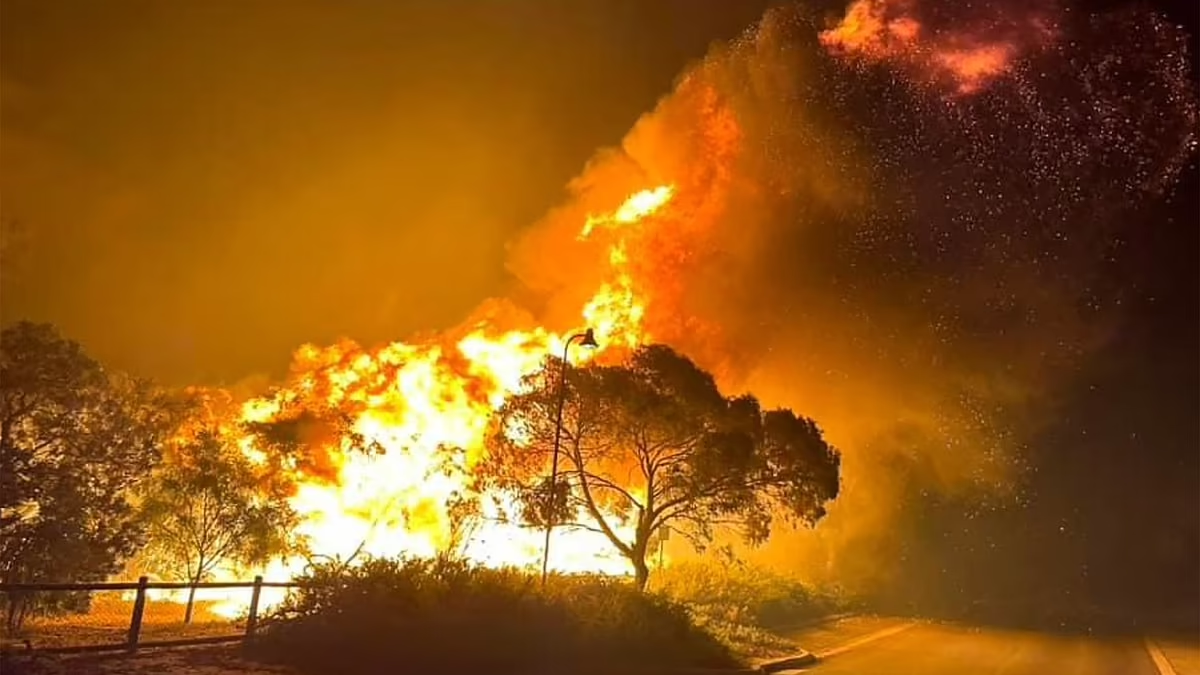


In the early hours of Saturday morning, residents of several semi-rural communities on the outskirts of Perth, Western Australia, awoke to a sky tinged orange with smoke and the distant roar of flames. What began as a small grassfire in the Shire of Mundaring rapidly escalated into one of the most devastating bushfires the region has seen in recent memory, fueled by strong northerly winds, record-high temperatures, and bone-dry vegetation. By the time firefighting crews finally contained the blaze late Sunday afternoon, more than one hundred homes lay in smoldering ruins, with hundreds of families displaced and an entire region grappling with the enormity of the loss.


This article offers an in-depth look at the bushfire’s origins, its rapid spread, the human and environmental toll, and the community’s ongoing efforts to recover and rebuild. It also examines the broader context of Australia’s bushfire season, the challenges faced by emergency services, and the sobering reality of climate change’s role in intensifying such disasters.

I. Prelude to Disaster: Conditions on the Ground
In the weeks leading up to the fire, meteorological data painted a stark warning. Perth had recorded its hottest June on record, with daytime highs regularly soaring above 35°C. Anomalously low winter rainfall had left grasslands and forest understoreys exceptionally dry, essentially providing a tinderbox underfoot. Meanwhile, a high-pressure system over central Australia trapped hot air against the west coast, contributing to a prolonged heatwave that stressed both human communities and the region’s accustomed fire-prevention measures.
On Friday, June 21, an unseasonably strong northerly wind gusted through the Darling Scarp and into the Swan Coastal Plain, whipping up dust storms in the day and making campfires and barbecues—common in these semi-rural areas—even more hazardous. Local fire authorities had already issued a “Restricted Fire Danger” rating for much of the region, banning all open flame activities outside designated fireplaces and warning residents to remain vigilant.

Yet, despite the warnings, many semi-rural properties—graced by sprawling bush lots and large, fuel-laden paddocks—remained largely unprepared for a fire of this magnitude. Underbrush and leaf litter, a natural byproduct of seasonal deciduous shedding, had not been adequately cleared in numerous areas, and several old, weathered fences—commonly used to mark property boundaries—lay dormant and unmaintained, creating ideal fire corridors.
II. Ignition: The Moment the Blaze Began
At approximately 1:47 AM on Saturday, June 22, the first 000 (emergency) call was logged by the Fire and Rescue Service WA (FRSWA), reporting flames spotted along Thomas Road, roughly 10 kilometers east of Midland. Initial reports suggested a lightning strike had ignited a small patch of grassland, though subsequent investigations would later indicate that powerline equipment might have sparked the first flames—an all-too-common occurrence in extreme heat and wind conditions.
Within minutes, volunteer bushfire brigades in Gidgegannup, Chidlow, and Mount Helena were notified of the fire. However, by the time the first local crew arrived, the flame front had already grown to a quarter of a hectare, leaping from one fence line to the next in a matter of seconds. The northerly gusts—measured at up to 60 km/h—fanned the flames and created spot fires ahead of the main front, making direct firefighting efforts hazardous.
As the fire gained ground, Queensland Rural Fire Service (RFS) airtanker was scrambled from Jandakot Airport at 2:15 AM, carrying 3,000 liters of fire retardant. Simultaneously, a WA DoT helicopter equipped for water bombing lifted off from Jandakot, intending to slow the blaze around the small cluster of homesteads along Thomas Road. Yet, despite these swift aerial responses, the fire’s speed, and unpredictability in the darkness severely hampered aerial operations, as smoke-choked skies and erratic wind shifts made accurate water drops nearly impossible.
III. Rapid Spread: From Grassland to Hamlets
By 3:30 AM, the blaze had ballooned into a full-scale bushfire, with multiple “hands of flame”—areas where the fire front had bulged outward—visible to early-morning observers. The fire line stretched three kilometers from east to west and nearly five kilometers in length, consuming both grass paddocks and sections of jarrah-marri forest. Embers tossed by the wind landed on thatched roofs, gumleaf thatch, and wooden outbuildings; in several cases, homes ignited within moments of embers reaching their gutters.
The local State Emergency Service (SES) units reported receiving calls from residents in Baker Hill, Gidgegannup, and Stoneville, requesting urgent evacuation assistance. With narrow, winding roads quickly overtaken by fleeing vehicles, police enforcement had to step in to manage traffic and coordinate safe exit routes. The smoke was so thick in some stretches that visibility was reduced to less than five meters, and dozens of vehicles skidded off the road or collided in the panic.
By 4:00 AM, the bushfire’s size had expanded to 500 hectares. Firefighters working along the initial containment line began to fall back as spot fires ignited a mile to the south. At this point, the Department of Fire and Emergency Services (DFES) issued an “Emergency Warning” for residents in the Shire of Mundaring, urging those in the paths of the fire to relocate immediately. The mobile phone network became congested with emergency texts, while many cell towers briefly went offline due to power surges and mid-interruption equipment damage.
IV. First Evacuations: Saving Lives amid Chaos
As dawn approached, tens of thousands of residents had already been forced from their homes. DFES, the WA Police, and local SES teams established three large evacuation centers: one at Jane Brook Community Hall, another at Swan Christian College in Middle Swan, and a third at Mundaring Recreation and Events Centre. Volunteers from the Red Cross, St John Ambulance, and dozens of community groups converged on these centers, providing hot meals, blankets, and medical triage stations for the displaced.
One evacuee, 67-year-old Graham Sinclair of Darlington, recounted the scene: “We had about five minutes to grab what we could. I could see the red glow reflecting off my bedroom window, and the roar of the fire was like a jet engine. I didn’t even have time to close the front door.”
The evacuation process was complicated by the early-hour timing: many families were asleep, and some elderly residents in Jamison Creek and Stanford Mill did not have immediate access to vehicles. In such cases, DFES officers and SES volunteers went door-to-door, knocking on windows and standing outside windows to awaken residents. It was an enormous, heart-pounding effort that likely saved dozens of lives, though strains on resources were evident as teams raced to cover multiple firefronts simultaneously.
V. The Toll on Homes and Livelihoods
By midday Saturday, satellite imagery and ground patrols confirmed that over 100 homes had been engulfed in flames. Most of these were single-story wooden dwellings nestled within thick bush or sprawling paddocks. Many structures collapsed almost instantaneously as radiant heat reached critical temperatures, obliterating fences, sheds, workshops, and belongings. Several heritage cottages built in the early 1900s—an intrinsic part of the region’s historical identity—were reduced to charred ruins.
Beyond the residential losses, an estimated 200 outbuildings—barns, hay sheds, stables, and farm machinery bays—went up in smoke. Livestock losses included the deaths of over 150 sheep and 20 head of cattle, many found sheltering in creeks but unable to escape rapidly advancing flames that scorched the banks and water too hot to provide refuge. Dozens more animals were treated for burns and smoke inhalation at mobile veterinary clinics, but many had to be euthanized due to severe injuries.
Local vineyards, a growing agricultural sector in the region, also suffered. Smoke taint—a condition that imparts undesirable flavors to wine grapes—has affected at least three vineyards along South Guildford Road, with growers fearing significant crop losses for the remainder of the season. Apiculture (beekeeping) operations in the Darling Range foothills also reported the loss of more than a dozen hives, imperiling honey production and raising concerns about pollination services for the broader agricultural community.
VI. Firefighting Efforts: Man Against Flame
More than 300 firefighters—drawn from DFES brigades, volunteer bushfire units, and interstate strike teams—battled the inferno around the clock. Their efforts were complicated by the rapidly changing wind direction: what had been a northerly gale began shifting northwest to southwest by midmorning, directing the blaze towards the towns of Mount Helena and Mundaring. A secondary front also emerged, racing down into the Helena Valley, prompting a fresh wave of evacuation orders for residents in that area.
Fire crews used a combination of tanker trucks, bulldozers carving containment lines, and aerial waterbombing operations provided by Fire and Rescue Service air tankers (C-130 “Hercules” craft retrofitted for retardant drops). Despite dropping more than 200,000 liters of water and foam retardant, firefighters found it challenging to establish secure backburn lines because the fire would jump over scorched zones via ember storms—windborne blazing embers that can travel over a kilometer at high speed.
By late afternoon, a massive 4,500 liters-per-minute pump had been deployed to suction water from the Helena River into a portable dam, allowing tanker trucks to refill more quickly. Dozens of local farmers opened their private dams for firefighting efforts, while some households traveling to safer ground brought extra water trucks to assist crews at the fire’s cutting edge. The sense of community solidarity was stark: farmers, displaced families, and professional firefighters melded into an impromptu alliance, racing against time and flame to protect what remained.
VII. Environmental Impact: Scorching the Landscape
As night fell on Saturday, roughly 10,000 hectares of forest, farmland, and protected reserves had burned. The Jarrah and Marri forest ecosystems—home to rare flora like the Woylie, honey possum, and numerous bird species—suffered extensive damage. Conservation biologists are now scrambling to estimate the full impact on endangered species, some of which may have lost significant portions of their habitat in a single event.
Smoke columns deposited a thick layer of ash on the Swan Coastal Plain—extending even into the Perth metropolitan area—forcing city dwellers to close windows and wear masks to reduce inhalation of fine particulate matter. Air quality indices soared into the “hazardous” range, and schools in Perth’s northern suburbs canceled outdoor activities for several days.
Bushland regeneration experts warned that the unusually intense heat had “cooked” the soil at depths of up to 10 centimeters, killing vital microbial life and seed banks needed for natural regrowth. Erosion risk has now spiked: winter rains, likely to arrive in the coming weeks, could wash nutrient-rich topsoil into waterways, jeopardizing water quality in reservoirs such as Mundaring Weir and the Helena Dam.
VIII. Human Cost: Stories of Survival and Loss
While exact casualty figures remained thankfully low, the human toll goes beyond mere statistics. At least 12 people, including two firefighters, were hospitalized for smoke inhalation and dehydration; three remain in serious condition due to burns sustained while attempting to defend their properties. Scores of residents are now grappling with the loss of irreplaceable family heirlooms, precious photographs, and even the homes in which their descendants were born.
The Sinclair family—Graham, his wife Marjorie, and their daughter Ellen (age 12)—lost their home of twenty years. The charred remains of their weatherboard cottage stand as a skeletal reminder of what once was. “Everything is gone,” Graham said, voice breaking. “We have some clothes, but all our memories are ash.” In contrast, neighbors across the street were spared when firefighters successfully halted the blaze inches from their front yard. “It happened so fast,” said neighbor Peter Williams. “We heard the Sinclairs screaming for help, and within ten minutes, we knew we had to get out.”
Stories of survival abound. In Mount Helena, volunteer SES member and father of three, Jason Clarke, arrived too late to help his own neighbors but helped rescue an elderly couple whose home was completely surrounded by flames. “I’ve never felt anything like it,” Clarke recalled. “I could feel the heat through my protective gear, and the sound of the fire was like a freight train bearing down on us. But we managed to get them out, and that’s what matters.”
IX. Aftermath: The Path to Recovery
By Sunday evening, DFES declared the bushfire “contained,” though not fully “controlled.” Small, isolated hotspots remained smoldering at the fire’s periphery, requiring overnight patrols to ensure reignition did not occur. The official destruction tally stood at 104 homes, 15 small businesses, and numerous outbuildings. Over 1,200 residents had been forced from nearly 600 properties.
Local governments, in partnership with the Red Cross and the WA Department of Communities, established a Bushfire Support Centre in Midland. Here, displaced families can access emergency financial assistance, counseling services, and help navigating insurance claims. The federal government committed $2 million in immediate relief funds, while the State Premier announced an additional $5 million for rebuilding grants and infrastructure repairs.
Meanwhile, community groups and charities organized donation drives for clothing, bedding, and essential supplies. Several Perth schools and businesses set up dedicated fundraisers, raising more than $500,000 in just two days. Even in the face of such destruction, the resilience and generosity shown by neighbors and strangers alike offered a glimmer of hope.
X. Broader Context: Bushfires in a Warming Climate
Australia’s notorious bushfire seasons have become longer and more intense in recent years. Climate scientists attribute this trend to rising average temperatures, reduced rainfall, and extended drought conditions—factors that align with global warming projections. The 2023–24 bushfire season in Australia was already one of the worst on record, devastating southeastern forests. The Perth fire represents another grim indicator that the West Australian bush is growing increasingly volatile.
Experts have urged that land management practices, including controlled burns and fuel load reduction, must evolve in response to a hotter, drier climate. DFES Commissioner Darren Klemm stated, “Traditional hazard-reduction burns can help, but they are no longer enough when faced with extreme weather conditions. We need more comprehensive planning, stronger building codes, and better community education on preparedness.”
XI. Community Healing: Beyond Firefighting
In the days following the initial containment, local clergy, psychologists, and nonprofit groups began organizing community gatherings—“yarning circles,” as they are called locally—where residents can share experiences, process grief, and discuss plans for rebuilding. For many, simply having a space to talk through trauma has been an essential step toward healing.
Youth volunteers organized a cleanup project at the Mundaring Cricket Club grounds, a traditional community meeting point. Teens who evacuated with little more than the clothes on their backs are now lending a hand to erect temporary fencing around property lines so that returning families can secure their land.
Local artists have united to create a “Fire Memorial Mural” on the side of a salvage yard in Gidgegannup, featuring the silhouettes of eucalypts against a fiery horizon and the faces of community members who lost everything. The mural’s unveiling is set for late July, a symbolic gesture of both remembrance and renewal.
XII. Lessons Learned and Future Preparedness
As investigations into the precise cause of the blaze proceed, it is already clear that a combination of factors—record heat, dry fuels, and strong winds—created a perfect storm. While it may be impossible to prevent every bushfire, authorities emphasize that better coordination between volunteer brigades, improved early-warning systems, and more resilient building materials could help reduce future losses.
In response, DFES announced plans to invest in new “smart sensors” along critical fire corridors to detect ignition points within seconds. Proposed upgrades to the suburban electricity distribution network aim to reduce the risk of powerline-related sparks during high-wind events. Additionally, a collaborative research grant was approved for the University of Western Australia to study how bushfire patterns around Perth are shifting geographically due to warming trends.
For home and landowners, programs are being rolled out to subsidize “fire-smart” property upgrades—installing ember-resistant roofing, creating cleared buffer zones around homes, and connecting properties to backup water supplies dedicated to firefighting. Local fire brigades have offered to conduct free “defensible space” assessments, advising residents on how to reduce fuel accumulation, prune dangerous tree limbs, and maintain proper firebreaks.
XIII. Government and Insurance Sector Responses
In a joint press briefing, the WA Treasurer and Attorney-General announced that the state government would fast-track legislative changes to streamline building permit approvals and expedite grant disbursements for bushfire-affected families. Temporary zoning moratoriums were lifted, allowing homeowners to rebuild on the same footprint with updated fire-resistant standards—such as Colorbond steel roofs and double-glazed windows designed to resist ember penetration.
The insurance industry, which had already been under strain from a series of natural disasters, faces an enormous challenge in processing claims from more than 1,500 affected households. The Insurance Council of Australia (ICA) dispatched additional claims assessors to Perth to handle the influx and urged residents to lodge claims as soon as possible. Nevertheless, several insurance companies warned that premiums in high-risk bushfire zones may rise significantly in the coming years.
XIV. International Solidarity
Globally, several firefighting agencies have reached out with offers of assistance. The New South Wales Rural Fire Service and Victoria’s Country Fire Authority extended invitations to share best practices and aerial suppression resources, if needed. New Zealand’s Fire and Emergency NZ offered to send specialized wildfire support crews, equipment, and personnel to assist in recovery and training.
International donors also pledged support through the Australian Red Cross and the Global Disaster Relief Fund. Messages of solidarity poured in from firefighting agencies in California, Chile, Greece, and Turkey—countries that have grappled with similarly savage wildfire seasons. “We stand with you,” read one message from the California Department of Forestry and Fire Protection (“CAL FIRE”). “Your recovery is our hope.”
XV. A Changed Landscape: Looking Toward Rebirth
For many residents who have lost their homes and livelihoods, the notion of “back to normal” seems distant. Yet, amid the devastated landscape—blackened tree trunks, rusted farm machinery, and the faint, lingering smell of smoke—there are signs of life and resilience.
By mid-July, the first delicate green shoots of fire-adapted species such as fireweed and grass trees began to appear. Woylies (brush-tailed bettongs) and other small marsupials cautiously emerged from underground warrens. Community planting days have been scheduled for winter rains: volunteers will sow banksias, jarrah, and coastal banksia seedlings in areas cleared of underbrush.
In the human community, too, there is a sense of cautious optimism. Local councils and citizen-led planning groups are convening weekly to map out a “Resilient Shire” strategy—focusing on sustainable rebuilding, bushfire education in schools, and bolstering local economies with small-business grants aimed at helping farmers switch to fire-resistant crops or eco-tourism.
Conclusion
The fast-moving bushfire that tore through Perth’s outskirts, destroying over 100 homes in a matter of hours, stands as a stark and tragic reminder of nature’s unpredictable fury. Within two days, entire communities saw the loss of homes, heritage, livelihoods, and in some cases, the very identity of their towns. The environmental toll extends beyond charred earth to the disruption of fragile ecosystems, waterway threats, and socioeconomic upheaval.
Yet, amid the ashes are powerful stories of survival, solidarity, and an unyielding spirit to rebuild. As communities begin the long process of recovery—replanting forests, reconstructing homes, and fortifying against future infernos—they carry with them lessons learned about preparation, resilience, and the urgent need to adapt to a changing climate.
Perth’s bushfire is not an isolated incident but part of a mounting pattern of extreme weather events globally. It underscores the essential work of firefighters, volunteers, scientists, and policymakers in understanding and mitigating the risks of a warming planet. Above all, it exemplifies the resilience of communities who, even in the face of devastating loss, come together—hand in hand, heart to heart—to build a safer, more prepared future.








