




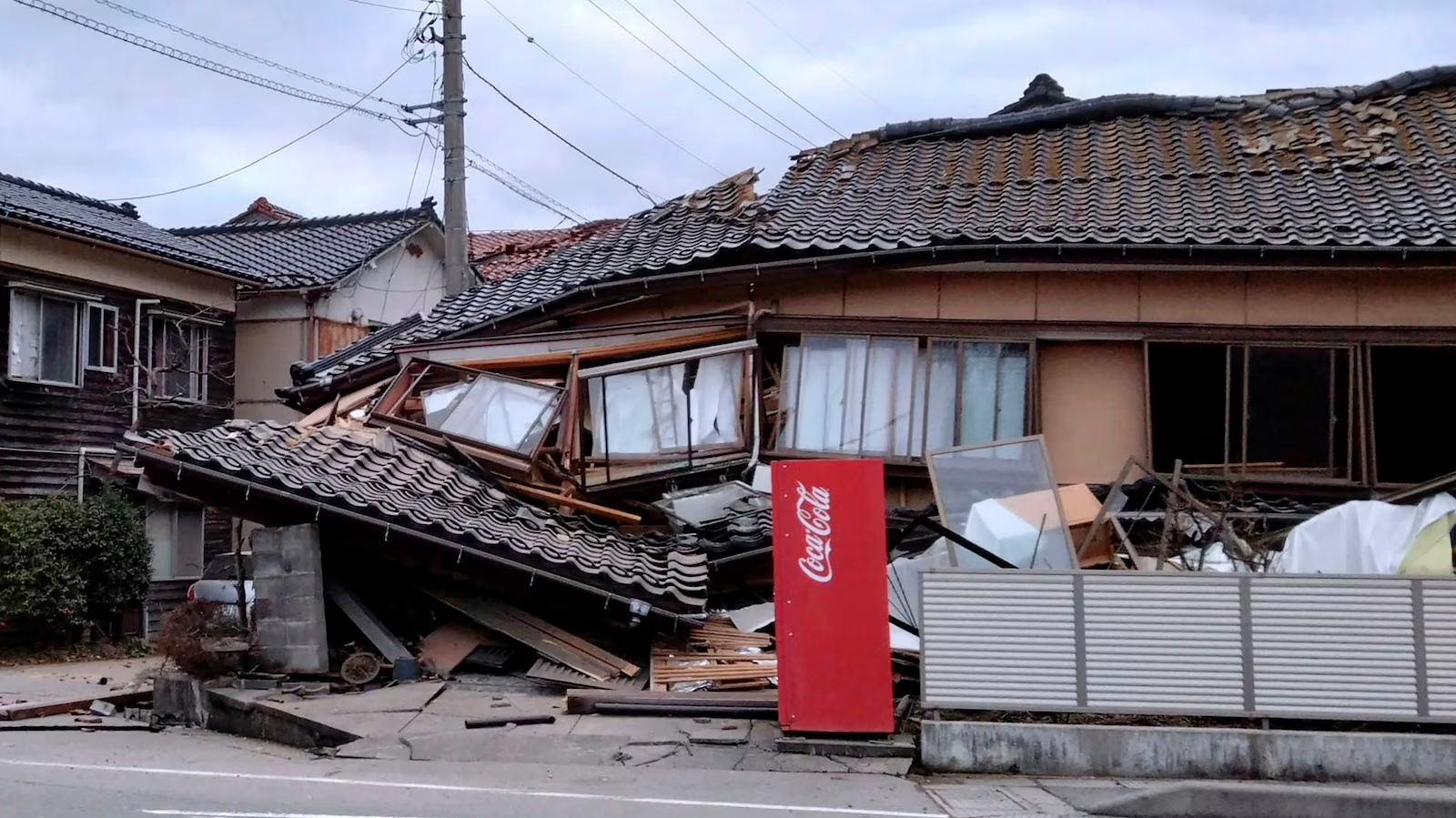


In a harrowing reminder of Japan’s seismic vulnerability, a powerful earthquake struck central Japan, sending shockwaves across the nation and leaving a trail of destruction in its wake. Measuring 7.2 on the Richter scale, the quake rattled multiple prefectures including Ishikawa, Niigata, Toyama, and Nagano, causing buildings to collapse, roads to crack open, train services to halt, and widespread power outages to plunge cities into darkness.


The earthquake, which struck just after midday local time, has resulted in significant injuries, mass evacuations, and widespread disruption to daily life. Emergency responders are working around the clock to locate trapped individuals, restore essential services, and provide aid to the thousands affected. Japan’s Meteorological Agency (JMA) warned that aftershocks are expected to continue for days, possibly weeks, keeping residents on edge and hampering recovery efforts.

The Quake: Epicenter and Seismic Impact
The quake’s epicenter was located approximately 20 kilometers off the coast of Ishikawa Prefecture at a depth of about 12 kilometers beneath the seabed. The Japan Meteorological Agency (JMA) initially issued a tsunami warning for parts of the western coast, though this was later downgraded to an advisory after waves of less than a meter were observed. Nevertheless, residents in coastal towns quickly evacuated to higher ground, having learned hard lessons from previous disasters.
According to the United States Geological Survey (USGS), the shallow depth of the earthquake contributed to its intensity, with tremors being felt as far away as Tokyo. In major cities like Kanazawa and Toyama, office buildings swayed violently, furniture toppled, and ceiling panels collapsed. Public transportation systems, including the Shinkansen bullet train, were temporarily suspended for safety inspections, stranding thousands of passengers.

In mountainous areas, landslides blocked roads and isolated communities, complicating the response by emergency teams. Fire departments reported hundreds of calls related to injuries, gas leaks, and small fires caused by ruptured fuel lines.
Human Toll: Injuries and Psychological Trauma
Though the official death toll is still being confirmed, authorities report over 300 injuries ranging from minor cuts and fractures to serious trauma caused by falling debris and structural collapse. Hospitals in affected regions, some operating on backup power, are overwhelmed with patients. Emergency shelters have been opened in schools, community centers, and sports arenas to house displaced families.
In Suzu City, Ishikawa Prefecture—close to the epicenter—residents described terrifying moments when the quake hit. “The ground rumbled like thunder and everything shook violently. Our house cracked, and furniture fell everywhere,” said Keiko Tanaka, a local mother of two who has since relocated to a shelter.
In addition to physical injuries, the psychological toll is mounting. Many residents are grappling with fear, anxiety, and the trauma of aftershocks. Mental health services have been mobilized to provide counseling and emotional support to affected families, particularly children and the elderly.
Infrastructure Damage and Power Disruptions
Japan, despite its state-of-the-art earthquake-resistant infrastructure, has seen extensive damage to both public and private property. Residential buildings, particularly older wooden structures in rural areas, were among the worst hit. Highways and bridges in Ishikawa and Nagano have visible cracks and buckling, making transportation of aid supplies difficult.
Power outages affected more than 150,000 households at the peak of the crisis. Utility companies such as Hokuriku Electric Power and TEPCO deployed emergency crews to assess damage to substations and restore electricity. In the affected prefectures, water supply systems have also been compromised, forcing many to rely on water trucks and bottled supplies.
Communication networks have experienced intermittent failures, prompting telecom providers to set up mobile base stations and Wi-Fi hubs in evacuation centers to help residents connect with loved ones.
Government Response and Emergency Measures
Prime Minister Fumio Kishida convened an emergency task force shortly after the quake and pledged a swift and coordinated response. “The safety of our citizens is our utmost priority,” he said in a televised address. “We will use all available resources to ensure rescue operations, restore infrastructure, and support recovery efforts.”
The Self-Defense Forces (SDF) have been deployed to aid in search and rescue operations, particularly in remote or hard-to-reach areas. Helicopters are conducting aerial surveys to assess damage, while engineering units are working to clear debris and repair roads.
The Ministry of Land, Infrastructure, Transport and Tourism has also activated its disaster-response protocol, dispatching engineers to inspect the structural integrity of public infrastructure. Local governments in affected prefectures have issued disaster declarations to unlock emergency funding and facilitate the delivery of essential supplies, including food, blankets, and medical equipment.
Public Reaction and Community Resilience
Despite the severity of the quake, Japan’s rigorous disaster preparedness culture has helped reduce the scale of casualties. Earthquake drills, reinforced buildings, and an efficient early warning system gave many residents a few precious seconds to take cover.
Communities quickly mobilized to support one another. Volunteers helped evacuate the elderly, shared food, and provided emotional support at shelters. Local businesses opened their doors to offer refuge, and neighborhood associations coordinated logistics to support vulnerable members.
In Toyama City, high school students were seen helping clear rubble from an elderly neighbor’s home. “We’ve been trained for this in school, and now it’s time to help,” said Ryo Nakagawa, a 17-year-old volunteer.
Challenges Ahead: Aftershocks and Recovery
Seismologists warn that strong aftershocks may persist for days or weeks, posing risks to already weakened structures. The JMA has urged residents not to return to damaged buildings and to stay vigilant for signs of landslides, especially with rain forecasted in the coming days.
Long-term recovery efforts will require significant resources. Rebuilding homes, schools, and public facilities may take months, if not years. Insurance claims are expected to surge, with estimates of economic losses potentially exceeding ¥1 trillion (approximately USD 7 billion).
The government is considering emergency budget reallocations and may seek parliamentary approval for additional disaster relief funding. Financial institutions are preparing low-interest loan packages to help individuals and businesses rebuild.
Global Support and International Solidarity
Leaders from around the world have expressed solidarity with Japan. The United Nations, European Union, and neighboring countries like South Korea and Taiwan have offered condolences and assistance. The U.S. Embassy in Tokyo issued a statement of support and pledged readiness to provide technical or logistical aid if requested.
Global humanitarian organizations such as the Red Cross and Médecins Sans Frontières are coordinating with Japanese authorities to assess potential support needs.
Social media platforms have also played a critical role, with people using hashtags like #PrayForJapan and #JapanEarthquake to spread information, share safety updates, and organize aid initiatives.
Looking Forward: A Call for Preparedness
The earthquake has once again emphasized the importance of disaster preparedness in a seismically active country like Japan. It has also reignited discussions about urban planning, early warning systems, and the resilience of critical infrastructure.
Urban planners and engineers are calling for updated building codes, particularly in older rural areas, and expanded investment in decentralized energy systems to avoid large-scale blackouts.
Schools and public institutions are also being urged to conduct more frequent evacuation drills and improve emergency communication channels.
Conclusion
The powerful earthquake that rattled central Japan is a sobering reminder of nature’s unpredictability and power. While the immediate focus remains on rescuing the injured and restoring essential services, the road to full recovery will be long and complex. However, in the face of adversity, Japan has once again shown the resilience, solidarity, and determination that has defined its responses to past disasters.
With national resolve, global support, and lessons learned, the nation stands poised not only to rebuild but to strengthen its defenses against future seismic threats. In the words of one elderly survivor in Nagano: “We have lost much, but we still have each other. That is where we begin again.”