







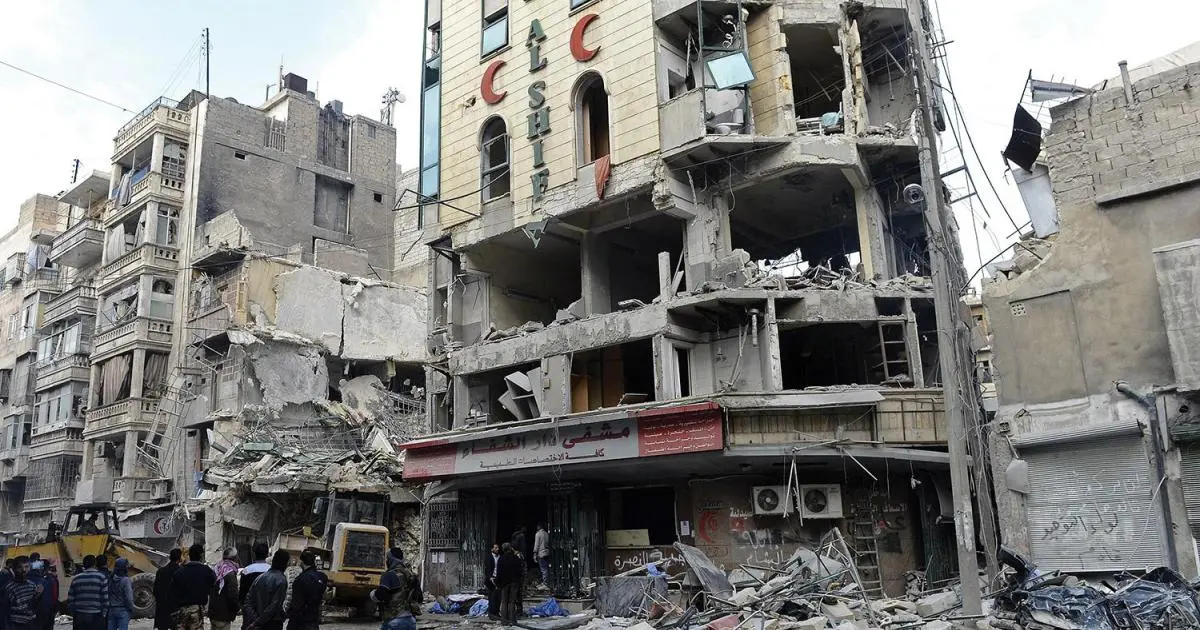


In the early hours of dawn, as families in the bustling city of Aleppo prepared to start another day amidst the remnants of a country torn by over a decade of conflict, a deafening explosion shattered the fragile silence. A sudden airstrike, targeting a densely populated residential area in the eastern district of Aleppo, Syria, has left at least fifteen civilians dead, dozens more injured, and an entire neighborhood reeling from devastation.

The Attack: A City Wakes Up to Horror
According to eyewitness accounts and local monitoring groups, the airstrike occurred at approximately 5:40 AM local time. Without warning, a single jet—its origin yet to be officially confirmed—dropped multiple bombs on Al-Salheen, a neighborhood known for housing working-class families, street vendors, and children heading to nearby schools. The suddenness of the attack left residents with little time to seek shelter.
One survivor, 28-year-old Fawaz Al-Masri, described the moment the bomb hit: “There was no siren, no indication. I was making tea when the whole building shook. The ceiling came crashing down, and I couldn’t hear anything but screaming.” Fawaz lost his two younger cousins in the explosion, both under the age of ten.
The force of the blast flattened several apartment buildings, shattered windows within a two-block radius, and ignited fires in nearby shops and vehicles. Civil defense teams, known as the White Helmets, were among the first on the scene, pulling bodies from the rubble and transporting the wounded to nearby medical facilities. Several children were rescued from under collapsed structures, their faces covered in dust and blood.

Casualties and Human Toll
The local health authority confirmed that at least 15 civilians, including 5 children and 3 women, were killed instantly in the airstrike. Another 40 individuals sustained injuries ranging from minor cuts to life-threatening trauma. Many of the wounded are in critical condition, prompting fears that the death toll may rise in the coming days.
Hospitals in the area, already stretched thin due to years of war, are struggling to accommodate the influx of patients. Dr. Samira Khoury, a surgeon at the Aleppo University Hospital, remarked, “This is one of the worst mornings we’ve had in months. We have no choice but to treat people on the floor. Supplies are running low, and many of the injured are children.”
The psychological impact of the attack is equally harrowing. Grieving families gathered outside hospitals and morgues, their faces marked by sorrow, disbelief, and rage. In one particularly heartbreaking scene, a father clutched the lifeless body of his son wrapped in a bloodstained blanket, refusing to let go.
International Reaction and Condemnation
News of the strike quickly sparked international outcry. The United Nations issued a statement condemning the attack and calling for an immediate investigation. “The use of air power in civilian areas violates international humanitarian law and may constitute a war crime,” said Martin Griffiths, UN Under-Secretary-General for Humanitarian Affairs. “We urge all parties to the conflict to respect the sanctity of civilian life.”
Human rights organizations such as Amnesty International and Human Rights Watch echoed this sentiment, urging transparency and accountability. “This is yet another tragic reminder that civilians are bearing the brunt of Syria’s unending conflict,” said Lama Fakih, Middle East director at Human Rights Watch. “Every civilian death is a failure of the international community to uphold justice and protect the vulnerable.”
Ongoing Conflict and Strategic Context
The strike comes amidst renewed tensions in northern Syria, where clashes between regime forces, opposition factions, and foreign powers have intensified in recent months. While Aleppo has largely returned to regime control since late 2016, pockets of instability persist, especially in the eastern and southern outskirts of the city.
Some analysts speculate that the strike may have targeted suspected militant hideouts, though the lack of prior warning and the choice of a residential area have drawn widespread criticism. Syrian government officials have neither confirmed nor denied responsibility, while Russian officials, long-time allies of the Assad regime, have also remained silent.
Local sources note that this is not the first time airstrikes have hit civilian areas under the pretext of targeting insurgents. In the past, similar strikes have killed hundreds of non-combatants, prompting accusations of indiscriminate bombing and disproportionate use of force.
Life in Aleppo: A City Caught in Perpetual Recovery
Once the economic and cultural capital of Syria, Aleppo has endured some of the most intense fighting in the civil war, which began in 2011. Though the city has seen periods of calm and partial reconstruction in recent years, today’s strike serves as a stark reminder that peace remains elusive.
Residents who had begun rebuilding their lives in the aftermath of conflict now face a renewed sense of insecurity. “We thought the worst was behind us,” said Layal Haddad, a schoolteacher whose home was damaged in the strike. “Now, we’re back to living in fear.”
Schools were closed for the day, and many families have sought temporary shelter in mosques and community centers, afraid that more attacks might follow. Power outages, water shortages, and crumbling infrastructure have made recovery efforts even more difficult.
The Faces of the Victims
As names of the victims began to emerge, local media and community groups started publishing tributes to the lives lost. Among them was Hiba Younis, a 34-year-old mother of three who had just returned from a night shift at a local bakery. Her youngest son, Marwan, only four years old, was also killed.
“Every person who died this morning had dreams, had a family, had plans,” said Imam Abdul Rahman during a vigil at Al-Farouq Mosque. “We are tired of counting bodies. We want to count birthdays, weddings, and reunions instead.”
A group of teenagers from the neighborhood held a silent march, holding candles and pictures of the victims. Chants of “Peace for Aleppo” and “Enough with the war” echoed through the broken streets.
Media Coverage and the Role of Journalism
Footage of the aftermath, captured by local journalists and shared on social media, has brought global attention to the attack. Images of burning buildings, rescue efforts, and weeping families have dominated international headlines, reigniting debates over military intervention, foreign policy, and the role of the global community in Syria’s prolonged suffering.
Al Jazeera, BBC, and Reuters were among the first international outlets to verify and broadcast the incident. Social media users around the world expressed solidarity, with hashtags like #PrayForAleppo and #StopTheBombing trending within hours.
Yet, many Syrians fear that outrage will fade as quickly as it emerged. “We’ve seen this before,” said Mohamad Al-Khatib, a local reporter. “The world cares for a few hours, maybe a few days. Then we’re forgotten again.”
Calls for Ceasefire and Justice
The tragedy has renewed calls for a nationwide ceasefire and a revival of peace talks under the Geneva and Astana processes. Several humanitarian organizations have appealed for safe zones to be established in densely populated areas, and for international monitors to investigate violations of international law.
“There can be no peace without accountability,” stated Michelle Bachelet, UN High Commissioner for Human Rights. “Those responsible for targeting civilians must be brought to justice.”
Despite years of diplomacy, efforts to end the Syrian conflict remain deadlocked. With competing interests from regional powers and a fractured opposition, the path to lasting peace continues to be fraught with challenges.
A Plea from the People of Aleppo
In the wake of the bombing, voices from Aleppo have grown louder in their plea for peace. Community leaders, educators, doctors, and ordinary citizens have called upon the international community not only to condemn the attack but to take meaningful steps toward preventing further bloodshed.
“Help us build a future,” read a hand-painted banner draped across a collapsed building. “Don’t let our children die in their beds.”
As the dust settles and rescue efforts continue, the people of Aleppo once again find themselves burying the dead, tending to the wounded, and picking up the pieces of shattered lives. The pain is raw, the anger is real, and the fear is ever-present. But amid the grief, there is also resilience—a quiet but unyielding determination to endure, to hope, and to demand a better tomorrow.








