






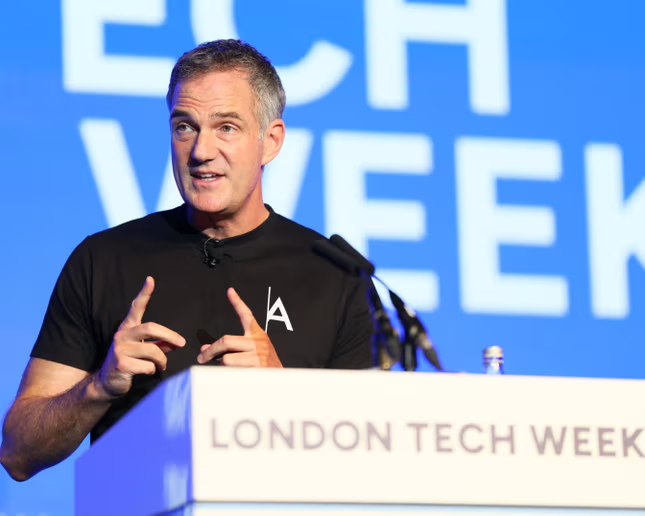


Artificial Intelligence (AI) is rapidly reshaping industries across the globe, but one of its most impactful applications may lie in education—specifically, in supporting students with learning difficulties like dyslexia. UK Science and Technology Secretary Peter Kyle has urged the government to leverage AI to create equal opportunities for dyslexic children, highlighting the lack of specialized human resources to address their unique needs. With over six million individuals in the UK affected by dyslexia, AI could offer a scalable, personalized solution to help bridge the learning gap—if implemented wisely and ethically.


I. The Potential of AI in Dyslexia Support
1. Personalized Learning Through Technology
Peter Kyle, who has dyslexia himself, shared his personal experience of using AI to enhance his learning and work. He emphasized that AI can adapt to an individual’s unique way of thinking and asking questions, essentially functioning as a highly customized tutor. This personalized interaction enables students with dyslexia to learn at their own pace, supported by a system that understands their cognitive preferences.

2. Addressing the Human Resource Gap
Kyle pointed out a major challenge in the current education system: a shortage of trained professionals who can provide individualized support for dyslexic students. With AI, there is an opportunity to fill this gap by offering scalable, accessible assistance tailored to each student’s specific learning characteristics. This could reduce disparities in educational outcomes, especially in standardized testing where dyslexic students often underperform.
II. National Calls for Early Intervention and Better Training
1. Jamie Oliver’s Campaign for Awareness
Celebrity chef Jamie Oliver, also diagnosed with dyslexia, has launched a campaign calling for earlier detection and better teacher training to support students with learning difficulties. He argues that the current system delays diagnosis and often lacks sufficient support mechanisms. His advocacy complements Kyle’s vision by emphasizing the importance of human involvement alongside technological tools.
2. Shifting Educational Focus
Kay Carter, CEO of the Dyslexia Association, supports the use of AI to “level the playing field” in education. She notes that if AI takes on tasks like memorizing and rapid information retrieval, educators can focus more on nurturing skills where dyslexic learners often shine, such as problem-solving and critical thinking. However, she also warns that AI must serve as a complement—not a substitute—for quality teaching.
III. Broader Policy and Ethical Considerations
1. The Role of AI in Exams
Although Kyle did not go as far as advocating for AI tools in exam settings, he acknowledged the significant performance gap in standardized assessments. Only 22% of students with specific learning difficulties (including dyslexia) passed English and math with a grade 5 or above in recent GCSEs, compared to 52% of students without special educational needs. While the current examination framework is considered robust, it may not fully account for the diverse capabilities of all learners.
2. Curriculum Reform and AI Integration
Kyle mentioned that the UK government is currently reviewing the national curriculum and emphasized the importance of exploring how AI could revolutionize both education and student assessments. The goal is to build a system that not only evaluates but understands a young person’s abilities holistically—something traditional testing often fails to do.
3. Legislative Challenges Around AI and Copyright
Beyond education, Kyle addressed growing tensions between the government and the creative industries regarding the use of copyrighted content in AI model training. Artists like Elton John have criticized the government for not doing enough to protect creative rights. Kyle noted that the existing data bill is inadequate for regulating AI in this context and promised to introduce a comprehensive AI bill in the upcoming parliamentary session. He also committed to forming working groups to fast-track legislation once the current bill is passed.
IV. The Balance Between Innovation and Integrity
1. Collaboration Over Conflict
Kyle expressed openness to discussions with prominent figures in the creative sector, stating he has already met with musicians and publishers to understand their concerns. His aim is to strike a balance between encouraging AI innovation and protecting intellectual property—a delicate but necessary undertaking as AI technologies become more pervasive.
2. Ethical Deployment of AI in Education
The use of AI in supporting dyslexic learners must also be handled with ethical care. While the technology offers immense potential, it should not compromise privacy, autonomy, or the human touch that is central to meaningful education. Stakeholders must ensure that AI tools are used to empower students, not reduce them to data points.
Conclusion
Artificial intelligence holds the promise of transforming education by providing dyslexic learners with the tools they need to thrive. UK Science and Technology Secretary Peter Kyle’s advocacy for AI-supported learning reflects a growing recognition that traditional methods alone cannot meet the complex needs of all students. By combining AI technology with early detection, better teacher training, and thoughtful policymaking, the UK could pioneer a more inclusive and effective educational system. However, as the country moves forward, it must also address ethical and legal concerns to ensure that the use of AI remains transparent, respectful, and beneficial for all.