







Artificial intelligence is increasingly reshaping how we explore both our past and our future. From revealing secrets hidden within charred scrolls to decoding ancient languages, uncovering lost archaeological wonders, and predicting vital biological structures, AI is revolutionizing science. These breakthroughs illustrate not just the raw power of algorithms, but their potential to assist in preserving cultural heritage, deepening biological understanding, and forging new scientific frontiers.


I. Revealing the Secrets of Burned Scrolls
1. Reconstructing Herculaneum’s Charred Papyri
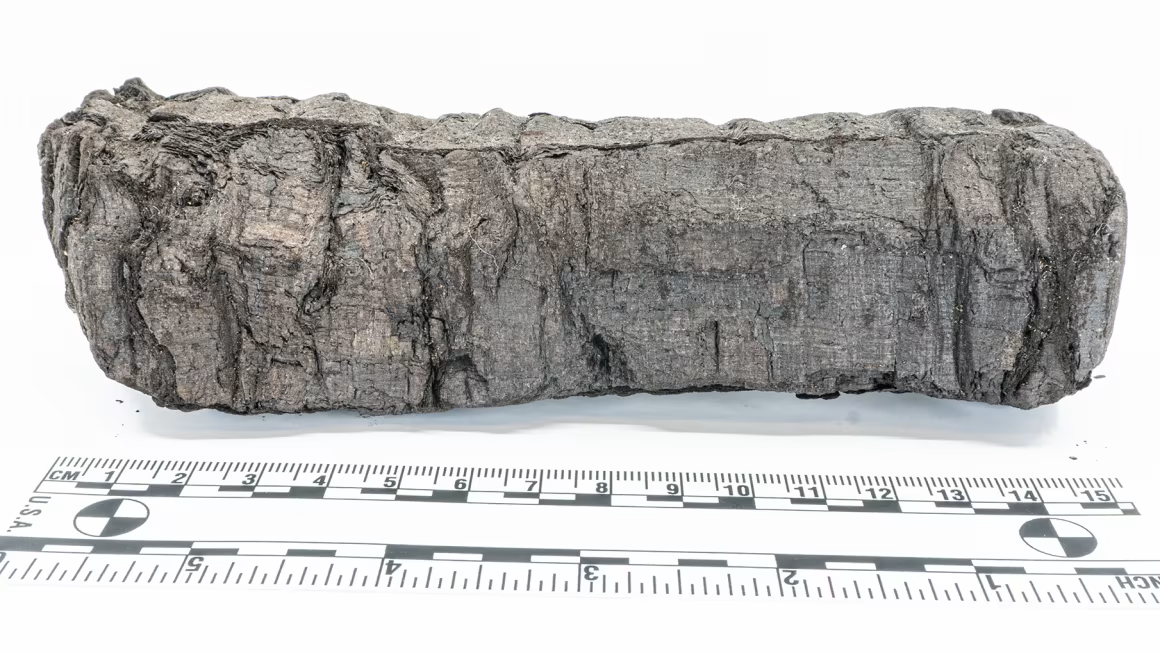
Deep within the ruins of Herculaneum lay a collection of fragile papyrus scrolls, reduced to brittle fragments by the eruption of Mount Vesuvius in AD 79. Their physical form rendered them nearly impossible to read—until AI intervened. In 2023, researchers employed high-resolution X-rays and AI-driven imaging to decode over 2,000 ancient characters. These scans “virtually flattened” the scrolls and isolated carbon-based ink from the burnt papyrus, unveiling fully legible passages in both Greek and Latin that had remained hidden for centuries.


2. The Vesuvius Challenge’s Ambitious Goal
The Herculaneum project is part of the Vesuvius Challenge, a global competition aimed at deciphering four scrolls by the end of 2024. Spearheaded by experts like Brent Seales of the University of Kentucky, this initiative relies on AI to highlight ink traces buried within complex materials. AI has effectively become a magnifying lens, exposing textual evidence that would be impossible for the human eye alone to detect.

II. AI Redefines Archaeological Discovery
1. Decoding Whale “Language” in the Deep Seas
AI is also gaining traction beneath the waves. Scientists have used machine-learning models to analyze nearly 9,000 sperm whale “codas”—series of clicks used for communication. These algorithms identified 18 rhythm patterns, five tempo styles, three rubato clusters, and two ornamental tweaks like extra clicks. While meaning remains elusive, these findings are a key step toward possibly one day understanding—or even conversing with—whales. Future experiments may involve real-time interaction and behavioral analysis to uncover the syntax behind these enigmatic sounds.
2. Surveying Remote Nazca Geoglyphs via AI
Above ground, Peru’s Nazca Desert geoglyphs have captivated archaeologists for decades. However, by combining high-resolution satellite imagery with AI, researchers led by Masato Sakai (Yamagata University) and IBM were able to discover 303 new geoglyphs between 2022 and 2023—almost doubling the known count. The AI model offered approximately 47,000 potential sites, of which 1,309 were highly promising. While the hit rate—one true site per 36 AI leads—is modest, the tool demonstrates AI’s unparalleled capability to locate archaeological treasures in harsh, remote landscapes, a feat unachievable by traditional fieldwork.

III. AI Shapes the Future of Biology
1. AlphaFold Unraveling Protein Mysteries
One of AI’s most celebrated triumphs in biology is the development of AlphaFold by DeepMind. Predicting the 3D structure of proteins from amino acid sequences has long been a major challenge in biochemistry. Since 2018, AlphaFold has provided structural models for nearly all 200 million known proteins—akin to having a biological “Google search” for molecular structures. This tool, recognized with a Nobel Prize in Chemistry (2024), now supports over two million researchers worldwide, accelerating drug discovery, cellular biology, and disease research. While its power is undeniable, AlphaFold does face limitations, particularly in predicting the impact of genetic mutations linked to diseases like certain cancers.
2. AI and the Quest for a Human Cell Atlas
Beyond proteins, AI is also being applied to map all the cell types within the human body and to identify novel drug molecules. From generating antibiotics to understanding cellular physiology, machine learning is proving indispensable in speeding up discoveries that once took years of laboratory work.
IV. Ethical Guardrails and Black‑Box Challenges
1. Bias and Transparency in AI
Not all AI applications are crisis-free. Systems used in social domains such as hiring, criminal justice, and finance have shown troubling bias—reflecting past social inequalities. Moreover, many AI models operate as “black boxes,” offering powerful predictions but little insight into their decision-making processes. This opacity undermines scientific reproducibility, a concern highlighted by institutions like the UK Royal Society.
2. Responsible Deployment in Research
Despite concerns, scientists argue that when responsibly employed, AI serves as a powerful aid. It amplifies human perception and problem-solving by revealing patterns and signals invisible to unaided observation. Projects like the Vesuvius Challenge demonstrate AI’s value when its use is disciplined, transparent, and firmly aligned with ethical guidelines.
V. The Broader Impacts of AI on Science
1. A Surge in AI-Powered Publications
Since 2015, the share of peer-reviewed research papers that leverage AI has climbed dramatically. These AI-informed studies often emerge as the most cited work, showcasing how computational tools are reshaping academic productivity. A recent survey by Nature indicated that a majority of scientists now view AI tools as “very important” or “essential” to their research.
2. Cultivating a New Research Paradigm
As AI integrates more deeply into scientific workflows, institutions are wrestling with data transparency, reproducibility, and algorithmic bias. But when applied with rigor and oversight, AI’s potential—from translating once unreadable scrolls to decoding nature’s most complex structures—is nothing short of revolutionary.
Conclusion
From cracking the burned manuscripts of ancient civilizations to illuminating the structure of life’s building blocks and mapping long-lost cultural heritage, AI has proved itself a transformative force in science. These achievements, while extraordinary in their own right, also highlight critical questions—around ethics, transparency, and oversight—that must be addressed. If scientific communities manage these responsibly, artificial intelligence stands to become humanity’s most powerful ally, whether we’re studying the past, saving endangered species, or exploring molecular frontiers.








