







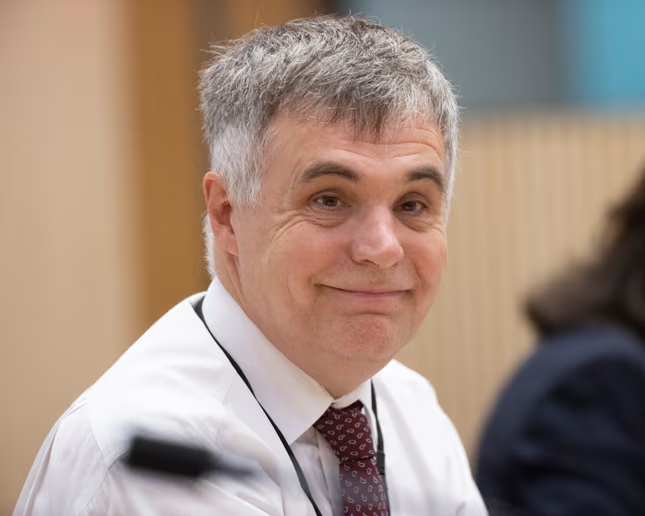


As the telecommunications industry navigates the rapidly evolving landscape of digital innovation, Optus’s new CEO Stephen Rue has emphasized the strategic role of artificial intelligence in reshaping services while reaffirming the enduring importance of human input. In his vision, AI will enhance efficiency, customer experience, and network performance, but people will remain central to decision-making and frontline operations.


I. Leadership Change Amidst Crisis and Recovery
1. New Era After Data Breach and Outage
Stephen Rue assumed leadership of Optus, the Australian subsidiary of Singapore’s Singtel, in November 2024. His arrival followed a turbulent period for the telco, which had faced a significant data breach affecting millions and a widespread network outage that triggered national concerns and regulatory scrutiny. The previous CEO, Kelly Bayer-Rosmarin, stepped down shortly after the crisis.

2. Signs of Subscriber Growth
Despite the recent setbacks, Optus has shown signs of recovery. For the financial year ending March 31, 2025, the company reported an increase of 238,000 new mobile subscribers, with 52,000 of them opting for postpaid plans. This uptick suggests a gradual rebuilding of consumer trust and operational stability.
II. Artificial Intelligence as a Catalyst for Progress
1. Enhancing Customer Engagement
Rue has outlined a future where artificial intelligence will be integral to improving customer experience. AI, he explained, can streamline processes by identifying service faults, analyzing user issues, and enabling customers to resolve problems independently. Furthermore, AI-driven analytics will help refine customer segmentation, allowing for more personalized and effective service offerings.

2. Operational Efficiency Without Replacing Humans
Although AI promises significant efficiencies, Rue made it clear that human expertise remains essential. “AI can rapidly process data and offer insights, but human judgment is irreplaceable,” he said. Technicians, creative teams, and customer service personnel will still be needed, with AI acting as a tool to support and amplify their roles.
III. Strategic Priorities: Governance, Resilience, and Innovation
1. Strengthening Internal Structures
Since joining Optus, Rue has focused on improving governance, strengthening risk management frameworks, and rebuilding public trust. His leadership is aimed at simplifying the company’s operations and managing costs while maintaining a competitive portfolio of services.
2. Focus on Long-Term Infrastructure Plans
Resilience remains a key concern following the network outage. Rue is also steering Optus toward a future-focused strategy that goes beyond crisis prevention. His approach includes not only fortifying the network infrastructure but also investing in long-term innovation and customer-focused services.
IV. Looking Beyond: Collaborating on National Connectivity Goals
1. Shifting Debate on the National Broadband Network
Having previously led the government’s National Broadband Network (NBN), Rue expressed little surprise at the reduced public and political attention to the project during the most recent federal election cycle. “Much of the debate over the NBN has been resolved,” he said, noting advancements such as expanded fibre networks and enhanced fixed wireless capabilities.
2. Expanding Mobile Coverage with Satellite Integration
Rue emphasized the need to further improve mobile connectivity across Australia, particularly in rural and remote areas. He supports the government’s plan to expand universal outdoor mobile coverage using low-earth orbit satellite networks like Starlink. According to Rue, such technologies will allow providers like Optus to offer cost-effective solutions where traditional mobile infrastructure is unfeasible.
V. Financial Performance and Growth Outlook
1. Strong Earnings Signal Stability
Optus reported a 5.7% increase in earnings before interest, tax, depreciation, and amortization (EBITDA), totaling $2.2 billion. This financial performance highlights the company’s resilience and successful recovery efforts amid recent challenges.
2. AI as a Long-Term Investment
While Rue acknowledges that AI integration will require upfront investment and careful planning, he remains confident in its potential to transform the business. From customer support to internal systems, AI will be a cornerstone of Optus’s long-term digital strategy—one that prioritizes both efficiency and human insight.
Conclusion
Under Stephen Rue’s leadership, Optus is entering a new chapter defined by resilience, technological advancement, and human-centric innovation. While artificial intelligence will undoubtedly reshape how the company delivers services and interacts with customers, it will not displace the essential role of human judgment and creativity. As Optus continues its recovery and pursues ambitious goals in connectivity and customer service, its strategy offers a balanced blueprint for integrating AI in ways that enhance rather than replace human contributions.








