







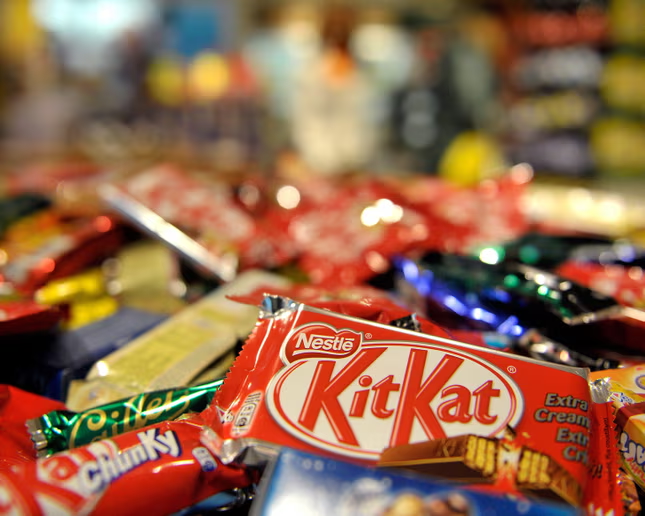


Artificial intelligence is taking on one of the UK’s most persistent challenges: food waste. With the potential to recover millions of meals’ worth of surplus food, a new AI-powered tool is being tested by major companies, including Nestlé. Early trials suggest that this innovation could dramatically cut food waste, reduce carbon emissions, and save millions in operational costs. By identifying edible but unsellable food products in real time, this technology offers a promising solution to both environmental and economic issues in the food industry.


I. AI at the Forefront of Food Waste Reduction
1. Nestlé’s Early Success with AI Trial
During an initial two-week trial at one of its UK factories, Nestlé reported an 87% reduction in edible food waste, thanks to the new AI system. The tool, developed by the tech company Zest, helps factories detect, track, and analyze food waste as it occurs. This real-time monitoring allows for immediate action, significantly reducing the amount of usable food that would otherwise be discarded.

2. Designing Out Waste with Data-Driven Insights
The AI platform is designed to “engineer out” waste from the manufacturing process by providing actionable insights into where and why waste is occurring. For instance, products such as broken KitKat bars or items approaching expiry that cannot be sold to retailers are logged by the system, creating new opportunities for redistribution instead of disposal.
II. Scaling the Solution: Industry Collaboration and Future Rollouts
1. From Pilot to Subscription Model
Zest, the startup behind the AI tool, plans to offer the software as a subscription-based service by March of next year. After successful initial trials, a second pilot with Nestlé has launched, supported by a £1.9 million match-funded grant from Innovate UK’s BridgeAI initiative. The project is set to expand across other manufacturers, targeting various points of the food supply chain.
2. Collaborative Innovation for a Sustainable Supply Chain
The pilot project is being coordinated by Sustainable Ventures, which brings together several partners, including Nestlé, logistics tech firm Bristol Superlight, Howard Tenens Logistics, supply chain management platform FuturePlus, and the nonprofit FareShare. Google Cloud’s BigQuery and Vertex AI are also being utilized for data processing and predictive analytics.
3. Environmental and Financial Impact
Estimates from the pilot indicate that up to 700 tonnes of surplus edible food could be saved—equivalent to 1.5 million meals. Preventing this waste could also avert the release of around 1,400 tonnes of CO₂ emissions and potentially save up to £14 million in operational costs.
III. Addressing the Broader Food Waste Challenge
1. The Scale of the Problem in the UK
Each year, the UK wastes approximately 4.6 million tonnes of edible food—enough to create 10 billion meals. Much of this waste is due to inefficiencies within the production and distribution systems, including unsellable but consumable products that are discarded rather than reused.
2. Supporting Charities and Local Communities
Simon Millard, Director of Food at the charity FareShare, emphasized the significant impact such technology can have on food redistribution. FareShare works with more than 8,000 charities and community groups across the UK, and reducing waste at the source means more food can reach those in need.
3. Government Backing and Policy Momentum
Esra Kasapoglu, Director of AI and Data Economy at Innovate UK, praised the initiative as an example of how advanced technology can tackle systemic issues. The AI-driven approach not only reduces waste but also supports sustainability goals by cutting emissions and lowering costs—critical objectives for both public and private sectors.
Conclusion
The introduction of AI into the fight against food waste marks a transformative moment for the UK’s food supply chain. With leading companies like Nestlé already seeing promising results, the expansion of this technology could have a widespread positive impact—both environmentally and socially. By detecting food waste in real time and facilitating redistribution, the AI tool developed by Zest and supported by Innovate UK stands to revolutionize how food is managed, delivered, and consumed across the country. As more companies join this effort, the potential to eliminate millions of meals’ worth of waste and reduce carbon emissions becomes not just a possibility, but an imminent reality.








