






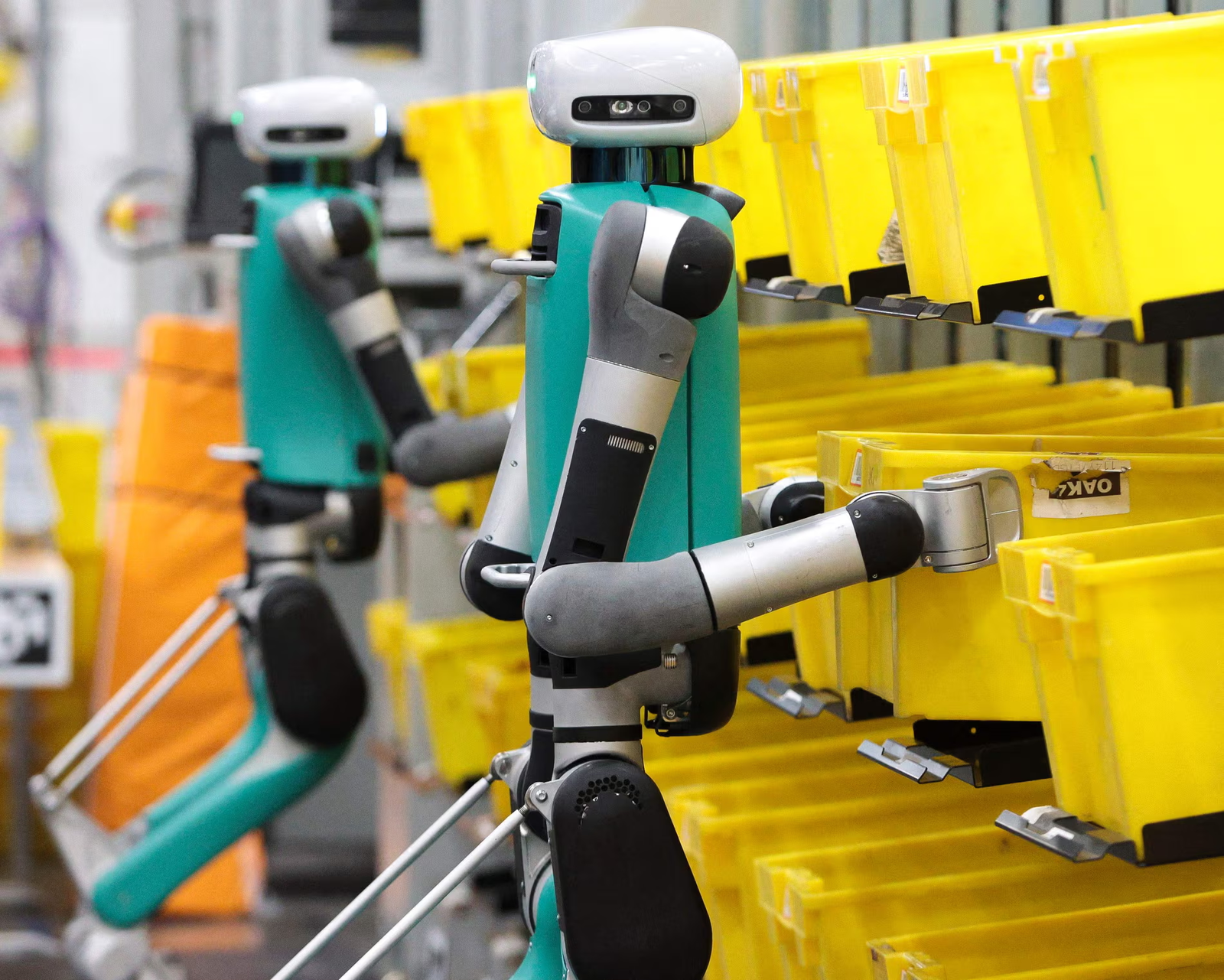


Amazon, one of the world’s largest tech companies, is reportedly working on a cutting-edge project that could redefine last-mile delivery. According to a recent report by The Information, the company is developing software for humanoid robots designed to assist—or potentially replace—human delivery drivers. These robots are being tested in a specially designed facility dubbed a “humanoid park” in the United States. While the hardware is being developed externally, Amazon is focusing on the artificial intelligence systems that would allow these machines to navigate real-world environments.


This development represents Amazon’s latest move toward integrating advanced robotics and AI into its delivery network. If successful, it could streamline logistics, cut delivery times, and reshape employment in the sector.

I. Amazon’s Investment in Delivery-Focused Robotics
1. The Humanoid Park: A Test Ground for Innovation
The testing ground for these humanoid robots is located at an Amazon office in San Francisco. The facility, reportedly the size of a coffee shop, simulates indoor obstacle courses that the robots must navigate. These scenarios aim to mimic the challenges robots would face during actual deliveries, such as navigating around furniture or opening doors.
What sets this initiative apart is Amazon’s intention to have the robots interact with their existing Rivian delivery vans. The company envisions a scenario where a humanoid robot can “spring out” of a van and deliver a package while a human driver continues on to the next destination. This type of multitasking could significantly enhance delivery efficiency.
2. Software by Amazon, Hardware by Partners
While Amazon is developing the AI brains behind the robots, the physical components—the humanoid hardware—are being sourced from third-party robotics companies. This division of labor allows Amazon to focus on its software strengths while leveraging specialized expertise in robotics engineering from companies like Agility Robotics.
Agility’s Digit robot has already been tested in Amazon’s warehouse environments. These humanoid robots were designed to take over repetitive tasks, with human workers transitioning into supervisory roles, becoming “robot managers,” as Agility CEO Peggy Johnson described.
II. Enhancing the Last-Mile Delivery Experience
1. Field Testing and Real-World Deployment
Once testing at the humanoid park is complete, Amazon plans to move its robots into real-world environments. The robots will attempt to deliver packages to actual homes during this “field trip” phase. These trials will provide valuable insights into how the robots handle the unpredictable variables of real neighborhoods—ranging from weather conditions to human interaction.
This approach is part of Amazon’s broader goal to streamline the “last mile” of delivery, a notoriously complex and costly phase in the logistics process. Even with a human driver, a robot that can independently complete certain deliveries could significantly reduce total route time.
2. Integration with Existing Fleet
Amazon’s commitment to transforming delivery logistics is evident in its existing infrastructure. The company already has over 20,000 Rivian electric delivery vans operating in the United States. According to reports, one of these vans is already stationed inside the humanoid test facility, enabling Amazon to closely examine how robots and vehicles could work together in real-world delivery workflows.
In parallel, Amazon’s interest in autonomous vehicles through its subsidiary Zoox also plays a role in its evolving delivery strategy. Combining autonomous driving with robotic delivery could one day eliminate the need for human drivers altogether.
III. The Broader Technological Landscape
1. Drone Deliveries and Airborne Logistics
Amazon’s ambitions aren’t limited to ground-based automation. The company has also made significant progress in aerial logistics. In 2023, it received permission in the UK to test-fly drones beyond the line of sight of a human operator. This regulatory green light paves the way for future drone-based home delivery services, adding another layer to Amazon’s automation strategy.
By integrating humanoid robots and drones, Amazon may eventually build a multi-modal delivery network capable of addressing urban, suburban, and even rural delivery challenges efficiently.
2. Challenges of Operating in Complex Environments
Despite the excitement surrounding humanoid delivery robots, experts caution that numerous technical hurdles remain. Professor Subramanian Ramamoorthy, chair of robot learning and autonomy at the University of Edinburgh, praised Amazon’s robotics team but noted the complexity of operating in uncontrolled environments.
He pointed out that while humanoid robots can perform well in structured settings, challenges arise when they must interact with unpredictable elements—such as pets, children, or unusual architectural features. “If Amazon restricts the scope… the task would be quite a bit simpler,” Ramamoorthy said. However, as variables increase, so does the difficulty.
IV. Implications for the Workforce and Industry
1. Redefining Human Roles in Logistics
If Amazon’s delivery robots prove successful, they could fundamentally alter the nature of work in logistics. Tasks traditionally performed by human delivery personnel—such as walking to the doorstep, navigating stairs, or handling packages—could be automated. This would allow human workers to take on supervisory or technical roles, overseeing robot performance and maintenance.
This shift echoes what has already occurred in Amazon warehouses, where robots now handle many of the physical tasks and employees are retrained to manage and coordinate machine operations.
2. Ethical and Social Considerations
As with any major technological advancement, the integration of humanoid robots raises ethical concerns. There are questions about job displacement, worker safety during co-working scenarios, and the public’s comfort with humanoid robots approaching their homes.
To address these issues, Amazon and other companies exploring similar technologies will need to engage with regulatory bodies, labor organizations, and the public to ensure that AI and robotics are implemented responsibly and ethically.
Conclusion
Amazon’s development of AI-driven humanoid robots for delivery represents a bold leap into the future of logistics. With tests already underway in a specialized “humanoid park,” and plans for real-world trials in the pipeline, the company is betting big on automation to optimize its last-mile delivery network.
While challenges remain—particularly around real-world reliability and public acceptance—the potential benefits are significant. Faster delivery times, improved efficiency, and reduced human labor in physically demanding roles could reshape the future of retail logistics.
As the technology matures, Amazon’s experiment could serve as a model for how robotics and artificial intelligence can transform not only e-commerce but the broader landscape of urban mobility and labor. The world will be watching closely as these robotic couriers begin stepping out of vans and onto the doorsteps of tomorrow.