






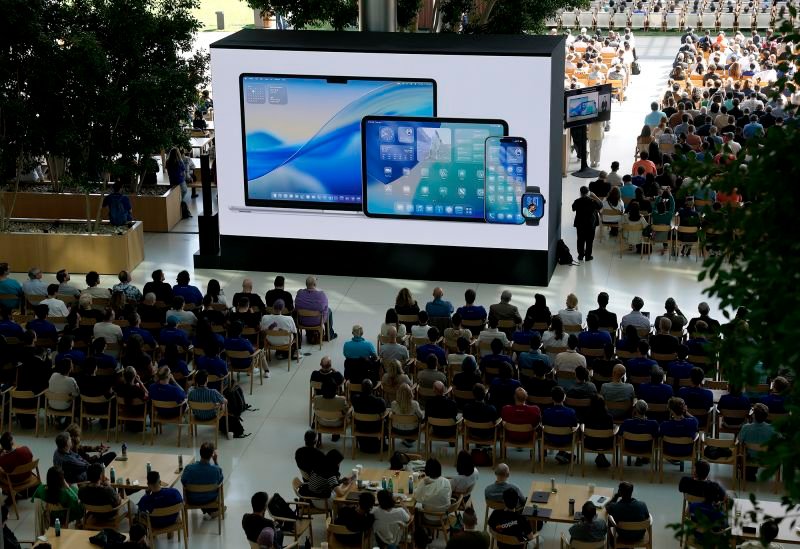


Apple’s Worldwide Developers Conference (WWDC) is a yearly staple in the tech world, revered by developers, analysts, and fans alike. Since its debut in 1983, it has grown into one of Silicon Valley’s marquee events—a showcase of software innovation and a barometer for where Apple is headed. However, this year’s conference, while polished and engaging, fell short of igniting the excitement that investors and consumers had anticipated. With AI at the forefront of tech industry discourse, Apple’s relatively muted presentation has raised eyebrows about the company’s progress—and strategy—in artificial intelligence.


I. WWDC 2025: Highlights and Underwhelming Surprises
1. Solid but Unspectacular Reveal
WWDC 2025 brought with it Apple’s signature design finesse and user-focused features, but lacked a breakthrough moment. Enthusiasts online discussed the “Liquid Glass” aesthetic—an evolution of the iOS interface that leans into fluid, semi-transparent visuals. It’s sleek and refined, but not revolutionary. Compared to past unveilings that changed the trajectory of Apple’s ecosystem, this year felt more like a placeholder than a pivot.

In short, it wasn’t a flop, but it also wasn’t the kind of moment that shifts cultural or technological narratives. It was a well-rehearsed performance that simply lacked the spark expected from one of the biggest players in the AI game.
2. The Notable Absence of AI Breakthroughs
Perhaps the most glaring omission was any real update on Siri and Apple Intelligence—the proprietary AI suite Apple teased last year with fanfare. Outside of a brief mention by Software Chief Craig Federighi, who stated that improvements to Siri needed more time, there was little substance to satisfy those hungry for AI advancements.

The subtle message was clear: Apple’s AI is not yet ready for the limelight. And with the AI race intensifying, that delay may cost Apple its edge in an increasingly competitive space.
II. Investor Disappointment and Market Reaction
1. Shares Reflect Discontent
Apple’s stock (AAPL) dipped by 1.2% shortly after the WWDC keynote, reflecting investor frustration. Many had been expecting a major update on Apple Intelligence, and perhaps even an announcement that would revive the long-predicted “super-cycle” of iPhone upgrades. Instead, what they got was a well-constructed yet conservative presentation—one that lacked the AI wow-factor necessary to jolt investor confidence.
The company’s stock has already seen a 17% decline this year, and the WWDC did little to reverse that trend. With AI taking center stage in the tech industry, Apple’s reserved tone may appear cautious, but to investors, it risks being interpreted as stagnation.
2. The Ghost of Siri Revamp
Last year’s promises regarding Siri’s transformation gave rise to enormous expectations. Apple hinted that Siri would soon become a truly intelligent digital assistant, finally catching up with its more advanced rivals. But over the past year, that vision quietly unraveled. Reports confirmed that the smarter Siri was put on hold, and even early AI features like text message summaries were pulled back after drawing criticism.
For a brand known for “stuff that just works,” releasing underwhelming or buggy features is more than a misstep—it undermines the very foundation of Apple’s reputation.
III. The Bigger Picture: Apple’s Cautious AI Strategy
1. Reliability Over Hype
Apple’s hesitation to roll out half-baked AI tools stems from its long-standing commitment to quality and consistency. While Google, Meta, and OpenAI have pushed aggressively into the AI frontier, Apple has opted for a more conservative approach.
As one of Apple’s own research papers recently revealed, even some of the most advanced large language models (LLMs) struggle with complex reasoning, sometimes collapsing entirely under pressure. That technical volatility doesn’t sit well with Apple’s product philosophy, which is deeply rooted in user trust.
2. Researchers Sound the Alarm
Apple’s internal research aligns with external critiques, such as those from AI commentator Gary Marcus. In a recent analysis, Marcus warned that anyone expecting current AI models to deliver transformative societal changes is overly optimistic. He emphasized that LLMs are still best suited for tasks like coding assistance and creative brainstorming—not replacing intelligent human judgment.
Apple’s AI team seems to agree, opting to take their time rather than chasing headlines. But this calculated patience could turn into a liability if competitors achieve meaningful breakthroughs first.
3. Acquisition May Be the Next Move
Analysts like Dan Ives of Wedbush Securities believe Apple’s path forward may involve strategic acquisitions. Rather than building all AI capabilities in-house, Apple might opt to buy up promising startups or technologies to accelerate progress. This playbook has worked in the past, especially with hardware innovations—Apple wasn’t first to the smartwatch or tablet market, but it eventually dominated both.
If history is any guide, Apple could still leap ahead. But time is not on its side, and investor patience is wearing thin.
IV. What Lies Ahead for Apple and AI
1. Playing the Long Game
Apple’s current trajectory suggests a long-term view of AI, one where integration is seamless, secure, and dependable. Unlike its rivals who are eager to push experimental features into the wild, Apple appears more interested in refining AI before presenting it to the masses.
The upside? When Apple does unveil its AI suite, it could very well set a new industry standard. The risk? Being late to a revolution that’s already transforming how people work, communicate, and create.
2. Pressure from the Competition
Meanwhile, competitors are not slowing down. Google’s Gemini, Microsoft’s Copilot, and Meta’s various AI tools continue to evolve rapidly, grabbing headlines and, in some cases, consumer market share. Apple, long viewed as a trendsetter, now finds itself in the unfamiliar position of playing catch-up.
Whether the company can reclaim the spotlight will depend on how effectively it can implement robust AI without compromising the user experience or its brand integrity.
Conclusion
WWDC 2025 was a polished, well-orchestrated event—but it wasn’t the AI breakthrough investors or fans were hoping for. With minimal updates on Siri, no tangible progress on Apple Intelligence, and a design-focused rather than functionality-heavy approach, the conference underscored Apple’s current AI dilemma: innovate too slowly, and risk falling behind; move too fast, and compromise quality.
Apple’s strategy seems rooted in caution and quality control, and while this may preserve its reputation in the short term, the pressure to deliver real AI solutions is mounting. As competitors race ahead and investor expectations climb, Apple must now find a way to transform its AI aspirations into reality—before the window of opportunity closes.