






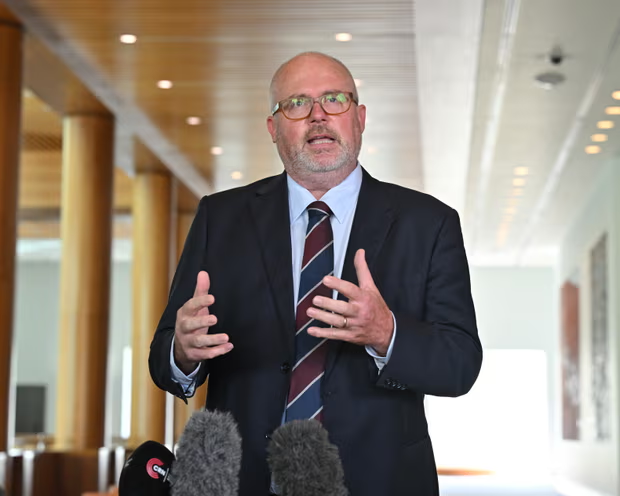


As the global race to harness artificial intelligence (AI) intensifies, Australia finds itself at a pivotal crossroads. The newly appointed Minister for Industry and Science, Tim Ayres, is urging the nation to fully engage with the opportunities AI presents. Ayres emphasizes that Australia cannot afford to fall behind in this technological evolution, warning that the alternative is being relegated to the end of global supply chains. With the government refining its AI policy, balancing innovation with worker protections has become a central concern.


I. Australia’s Urgent Push Into AI
1. Tim Ayres’ Vision for a Technological Future
Tim Ayres, who recently stepped into the cabinet role after serving as Assistant Minister for Manufacturing and Trade, is now steering the Labor government’s approach to AI. With his background in the manufacturing union, Ayres brings a pragmatic understanding of labor markets. He believes that embracing AI is not optional but a necessary step for national progress. His message is clear: Australia must adopt AI proactively and shape its future rather than passively accept changes dictated by global tech giants.

2. The Role of Strategy and Regulation
Ayres stresses that the government’s task is not only to seize opportunities but also to instill confidence among workers and businesses. He envisions a regulatory framework that ensures both productivity gains and social responsibility. Although the specifics of AI legislation are still being finalized, Ayres suggests that Australia will craft its approach by learning from like-minded nations, recognizing the speed at which AI technologies are evolving.
II. AI and Labor: Risks, Realities, and Rewards
1. Economic Growth and Workforce Transformation
The minister believes that both blue-collar and white-collar sectors stand to benefit from AI integration. He points out that automation can enhance productivity across industries—from traditional manufacturing to administrative roles. Drawing on his experience with the manufacturing union, Ayres argues that resisting technological advancement poses a greater threat to job security than adapting to it.

He acknowledges concerns about job losses but maintains that smart AI adoption can lead to better working conditions and new job opportunities. According to Ayres, proper consultation and planning at the firm level can help manage the transition in ways that support workers.
2. Public Skepticism and the Need for Trust
One of the significant hurdles to widespread AI adoption in Australia is public doubt. A recent report by the Business Council of Australia (BCA) highlighted the general wariness among Australians regarding emerging technologies. Ayres considers this skepticism understandable but believes it should not stall progress.
Referencing past technological shifts, he notes that while changes in labor markets are inevitable, history shows that innovation often results in net job creation through new industries and investments. Ayres insists that a strategic approach can deliver both economic benefits and job security.
III. Government Initiatives and Future Planning
1. The Future Made In Australia Framework
Ayres now oversees the Labor government’s Future Made In Australia initiative—an expansive strategy aimed at revitalizing manufacturing, accelerating the energy transition, and supporting homegrown innovation. AI policy is becoming a prominent component of this agenda, reflecting its role in boosting national competitiveness.
This initiative is designed to integrate industrial policy with digital transformation, positioning Australia not just as a technology user but as a leader in AI development and governance.
2. The Importance of Regional Development
The minister emphasizes that AI and technological investments should serve all Australians, especially those in regions historically reliant on manufacturing and mining. Ayres cites areas like central Queensland, the Hunter Valley, and La Trobe as vital to the country’s industrial resurgence.
With access to critical minerals and renewable energy, these regions offer an opportunity to build new industrial capabilities while supporting local communities. The government’s strategy includes developing infrastructure and encouraging the growth of industries such as iron and steel production within these zones.
IV. Balancing Innovation with Worker Protection
1. Industrial Relations and Responsible Implementation
Ayres advocates for thoughtful AI implementation through Australia’s existing industrial relations framework. He believes workplace-level consultation is essential to ensure AI tools improve job quality rather than degrade it. The government aims to create conditions where employers adopt automation in ways that benefit both their operations and their employees.
Through dialogue and firm-level agreements, the transition to AI-powered systems can be managed fairly, ensuring no group is left behind in the digital transformation.
2. AI Legislation and Global Influence
While Ayres’ predecessor, Ed Husic, initiated several processes regarding AI policy—including talks of a standalone AI act—Ayres plans to build on this foundation. The legislation will likely include mandatory safeguards and mechanisms to prevent misuse while encouraging innovation.
Australia’s AI response will take into account strategies from other democratic nations, aiming to strike a balance between freedom, regulation, and competitiveness. As a middle-power economy, Ayres believes Australia must carve out its voice in global AI standards rather than be subjected to decisions made elsewhere.
Conclusion
Australia stands at a defining moment in its technological journey. Under the leadership of Tim Ayres, the government is taking proactive steps to ensure that artificial intelligence becomes a tool for inclusive growth and national resilience. The Future Made In Australia initiative, combined with strategic AI regulation, offers a path forward where technology serves both the economy and society.
Despite public skepticism and labor concerns, Ayres envisions a future where Australians shape their digital destiny—not as passive recipients but as active architects. By integrating innovation with thoughtful regulation and local industry development, Australia aims not only to keep up with the global AI race but to lead it.