







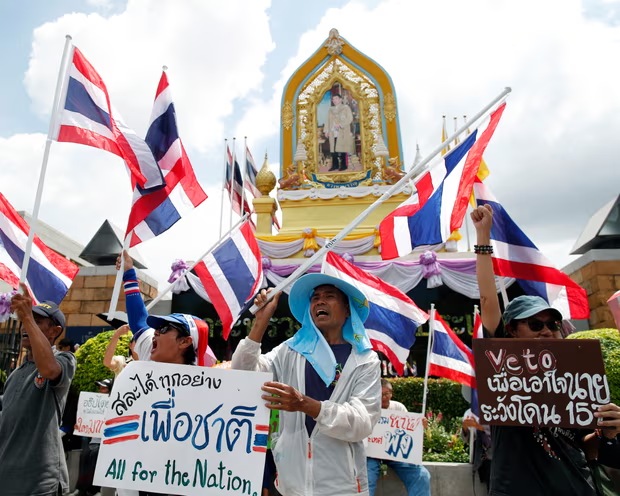


Cambodia has intensified its response to a simmering border dispute with Thailand by banning imports of Thai fruits and vegetables, marking the latest move in an ongoing series of retaliatory actions. The conflict, reignited by a deadly skirmish along the border in May, has sparked a wave of nationalist fervor and tit-for-tat policies from both Southeast Asian nations. As tensions escalate, both sides are navigating a mix of diplomatic, legal, and populist strategies to assert territorial claims rooted in a colonial-era boundary disagreement.


I. Escalating Tensions Over Border Dispute
1. May Skirmish Reignites Centuries-Old Conflict
Hostilities between Cambodia and Thailand surged in May when troops from both sides exchanged fire in a disputed border zone, resulting in the death of a Cambodian soldier. This flashpoint has reignited a historical dispute dating back over a century, when colonial-era maps drawn under French rule left the land demarcation between the two nations unresolved.
2. Rising Nationalist Sentiment Fuels Policy Reactions
In the wake of the clash, both governments have implemented retaliatory measures that have fueled nationalistic sentiment. Thailand recently tightened restrictions at its border crossings, while Cambodia has responded by closing checkpoints, reducing internet access from Thailand, banning Thai movies, and enforcing new limitations on visa stays for Thai citizens. The most notable escalation came this week with Cambodia’s announcement of a complete ban on Thai fruit and vegetable imports.
II. Cambodian Government’s Domestic Rally and ICJ Appeal
1. Massive Rally in Support of Government’s Stance
On Wednesday, tens of thousands of Cambodians marched through the capital, Phnom Penh, waving national flags and holding portraits of their leaders. The rally was organized to demonstrate support for the government’s hardline position. Deputy Prime Minister Hun Many, brother to Prime Minister Hun Manet, told the gathered crowd that this mass demonstration was a symbol of national unity and resilience.
2. ICJ as Cambodia’s Preferred Path to Resolution
In a bid to resolve the territorial dispute peacefully, Cambodia has formally petitioned the International Court of Justice (ICJ) to adjudicate the contested areas, including the Mom Bei or Chong Bok region—where the borders of Cambodia, Thailand, and Laos converge—and three ancient temples. However, Thailand has rejected the ICJ’s jurisdiction over the matter, stating a preference for bilateral dialogue.
III. Historical Context of the Dispute
1. Legacy of French Colonial Borders
The origins of the territorial disagreement lie in boundary maps created during the French colonial era. France controlled Cambodia until its independence in 1953, and inconsistencies in colonial cartography have led to long-standing ambiguities over specific border zones. These disagreements have periodically reignited tensions between the two nations.
2. Past Episodes of Nationalist Violence
The border row has flared multiple times over the years. In 2003, anti-Thai riots erupted in Phnom Penh after a Thai celebrity was accused of questioning Cambodian sovereignty over the famed Angkor Wat temple. In 2011, the dispute escalated into violence again, resulting in nearly 30 deaths and the displacement of tens of thousands.
IV. Diplomatic Statements and Political Maneuvering
1. Hun Manet Pushes for Legal and Peaceful Resolution
Prime Minister Hun Manet, who succeeded his father Hun Sen in 2023, emphasized Cambodia’s intent to protect its territorial rights through legal channels while maintaining diplomatic relations with Thailand. In a recent statement, Hun Manet reiterated his government’s determination to resolve the issue responsibly and in the interest of national integrity.
2. Thailand Reaffirms Commitment to Sovereignty
Thailand’s Prime Minister Paetongtarn Shinawatra has expressed her government’s commitment to defending Thailand’s territorial claims while also seeking peaceful coexistence. She took issue with what she described as “unprofessional communication,” an apparent jab at Hun Sen’s frequent commentary on social media platforms. Shinawatra also underscored the need for measured diplomacy rather than public provocations.
V. Legal History of the Preah Vihear Temple
1. Cambodia’s Legal Wins at the ICJ
Cambodia has turned to the ICJ in the past to resolve border disputes. In 1962, the court ruled that the ancient Preah Vihear Hindu temple belonged to Cambodia. However, the court did not specify who held sovereignty over the land surrounding the temple. Seeking clarification, Cambodia returned to the ICJ in 2011, and by 2013, the court determined that adjacent land near the temple also fell under Cambodian sovereignty.
2. Ongoing Uncertainty in Disputed Areas
Despite the ICJ rulings, other disputed regions remain contentious. The current request to the ICJ includes four separate locations, with the aim of solidifying Cambodia’s claims through international legal channels. However, Thailand’s refusal to recognize the court’s jurisdiction may delay or complicate any resolution.
VI. Regional and Economic Impact
1. Trade Disruptions and Economic Fallout
Cambodia’s ban on Thai agricultural imports is expected to have economic repercussions for both countries, particularly for Thai farmers who rely on cross-border trade. The timing of the ban—following an ultimatum issued by former Cambodian leader Hun Sen—demonstrates that political tensions are beginning to affect everyday commerce.
2. Mutual Visa Restrictions and Internet Bandwidth Cuts
In addition to trade limitations, both countries have shortened visa durations for each other’s citizens and imposed restrictions on digital infrastructure. Cambodia has reduced bandwidth available to Thai internet services, further signaling a deteriorating relationship that is spreading across multiple policy arenas.
Conclusion
The longstanding border conflict between Cambodia and Thailand, rooted in colonial-era ambiguities, has once again taken center stage in regional politics. What began as a brief military skirmish has escalated into broader diplomatic and economic hostilities, including a fresh round of trade sanctions, nationalist rallies, and appeals to international courts. While both countries profess a desire for peace, their actions point to deep-rooted mistrust and political maneuvering. Whether through the ICJ or future negotiations, a sustainable resolution will require more than symbolism and nationalism—it will demand consistent diplomacy and mutual recognition of historical grievances.








