







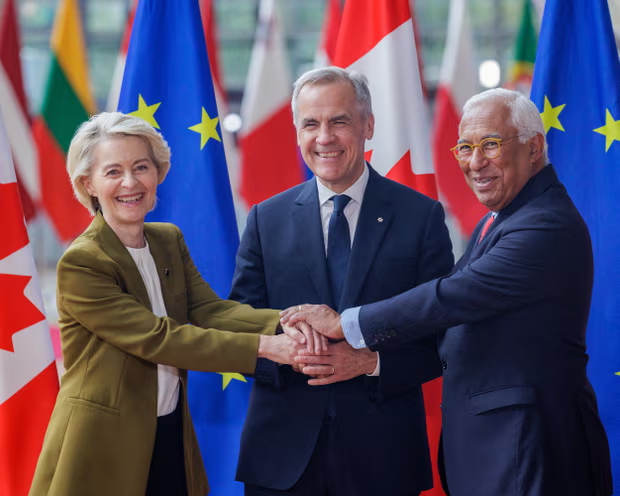

In a landmark moment for transatlantic cooperation, Canada and the European Union have signed a comprehensive security and defense agreement, reinforcing their strategic alliance as global instability intensifies. The move, which expands upon an already robust relationship, reflects a shared desire to bolster collective defense efforts and explore new areas of collaboration—from supporting Ukraine to enhancing cooperation on artificial intelligence and climate action. As trust in traditional U.S. leadership wavers, particularly under Donald Trump’s influence, Canada and the EU appear more determined than ever to deepen their ties.


I. A NEW TRANSATLANTIC DEFENSE ALLIANCE
1. Canada and EU Seal Security and Defense Agreement
Canadian Prime Minister Mark Carney met with European Commission President Ursula von der Leyen and European Council President António Costa in Brussels to finalize a significant new security partnership. The agreement, which aims to strengthen cooperation on military capabilities, procurement, and interoperability, underscores both sides’ commitment to a rules-based international order. According to von der Leyen, the pact gives Canada access to joint defense procurement under the EU’s €150 billion defense initiative, known as the Safe program.
Carney emphasized Canada’s European affinity, referring to his country as “the most European of the non-European countries” and highlighting a shared commitment to building a better world in cooperation with Europe. The agreement enables Canada to play a greater role in European defense planning and contribute to common security initiatives across multiple domains, including cyber, space, and maritime.
2. Strengthened Ties Amid Global Tensions
This agreement comes at what Carney called “a hinge moment in history,” marked by a deteriorating global security landscape and threats to the international rules-based order. Without directly naming him, the deal also serves as a response to Donald Trump’s strained relationship with U.S. allies. Trump’s recurring rhetoric questioning longstanding alliances has motivated several global leaders to seek stability through diversified partnerships—particularly among like-minded democratic nations.
II. KEY ELEMENTS OF THE EU-CANADA DEFENSE PARTNERSHIP
1. Expanded Military and Technological Cooperation
Under the new pact, Canada and the EU will collaborate in key areas such as arms control, cybersecurity, maritime patrols, and satellite-based security operations. Von der Leyen stated that Canada is now welcome to participate in the EU’s joint defense procurement efforts, with detailed negotiations expected soon. This opens the path for Canada to contribute to, and benefit from, EU defense capabilities and infrastructure.
This agreement mirrors a recent deal struck between the EU and British Prime Minister Keir Starmer, and follows similar arrangements the EU maintains with countries like Norway and Japan. However, this marks the first time such a partnership has been formalized with a country in the Americas.
2. Support for Ukraine and Global Stability
The EU and Canada reaffirmed their shared support for Ukraine in the face of continued Russian aggression. The defense pact includes specific provisions for coordinating aid to Kyiv, ranging from military supplies to cyber defense assistance. Both sides reiterated their stance on standing up for democratic values and supporting those under threat from authoritarian regimes.
Costa, speaking alongside Carney and von der Leyen, described Canada and the EU as close allies with parallel worldviews. “We see the world through the same lens. We stand for the same values,” he said, reinforcing the shared ideological foundation underpinning the deal.
3. Access to the €150 Billion ‘Safe’ Defense Fund
Participation in the Safe fund provides a significant boost to Canada’s defense procurement potential. Although formal access requires an additional technical agreement, von der Leyen expressed optimism that negotiations would move forward quickly. Once finalized, Canada could jointly develop and procure weaponry and defense systems alongside EU member states, enhancing both its national capabilities and broader NATO readiness.
Carney stressed that this access would allow Canada to “deliver on our new capabilities more rapidly and more effectively.” This partnership is especially critical given that Canada currently lags behind NATO spending targets, with its defense budget accounting for just 1.37% of GDP in 2024—well below the 2% guideline agreed upon by member nations in 2014.
III. BROADER CONTEXT AND POLITICAL SYMBOLISM
1. Rejection of U.S. Dependence and Trumpism
The defense pact with the EU is widely interpreted as a political signal that Canada is seeking greater autonomy from U.S. influence—especially in the face of Donald Trump’s disruptive approach to international relations. Carney, who emerged victorious in April on a platform that emphasized national sovereignty and international diversification, made clear his intention to strengthen partnerships beyond Washington. His campaign pledged to avoid any scenario in which Canada might be seen as the “51st U.S. state”—a reference to proposals occasionally floated by Trump and his supporters.
By aligning more closely with Europe, Carney is repositioning Canada as a key transatlantic partner with independent global ambitions. He described the summit as taking place during a time of global division and rising threats, emphasizing that Canada must act decisively to help shape a stable, multilateral world order.
2. Economic Ties and the Legacy of CETA
While the new security deal attracted headlines, the foundation of Canada-EU relations remains strongly economic. The two parties currently enjoy a €125 billion trade relationship underpinned by the Comprehensive Economic and Trade Agreement (CETA), signed in 2016. The agreement removed 98% of tariffs between the two markets. However, CETA has yet to be fully ratified by 10 EU member states—including France, Italy, and Belgium—meaning some provisions remain inactive.
Despite these delays, the economic relationship remains robust, and the new defense accord may help encourage hesitant parliaments to fully endorse CETA in the spirit of deeper cooperation.
3. Honoring Shared History and Sacrifice
Before the summit, Carney and his wife, Diana Fox Carney, visited the Schoonselhof military cemetery in Antwerp, where 348 Canadian soldiers are buried. The site commemorates those who gave their lives defending Europe during the World Wars. Accompanied by Belgian Prime Minister Bart De Wever, the Carneys laid wreaths and participated in a solemn ceremony. De Wever’s son played the Last Post, adding a personal touch to the tribute.
Carney later wrote on social media that the fallen soldiers were “brave young soldiers who ventured across the Atlantic to defend the freedom of Europe,” emphasizing the historical roots of Canada’s partnership with the continent and the sacrifices that continue to bind the two regions together.
CONCLUSION
Canada’s new defense pact with the European Union marks a significant pivot in its international strategy—one that aligns the country more closely with Europe during a time of growing global uncertainty. The agreement not only strengthens military cooperation and opens access to key EU defense mechanisms but also reinforces a shared commitment to democratic values, multilateralism, and global stability. As threats to the rules-based order intensify, this renewed alliance signals that Canada and the EU are prepared to stand together to confront emerging challenges. It is a strategic move that reflects a broader shift in global power dynamics—and a recognition that strong, reliable partnerships are more essential than ever.








