







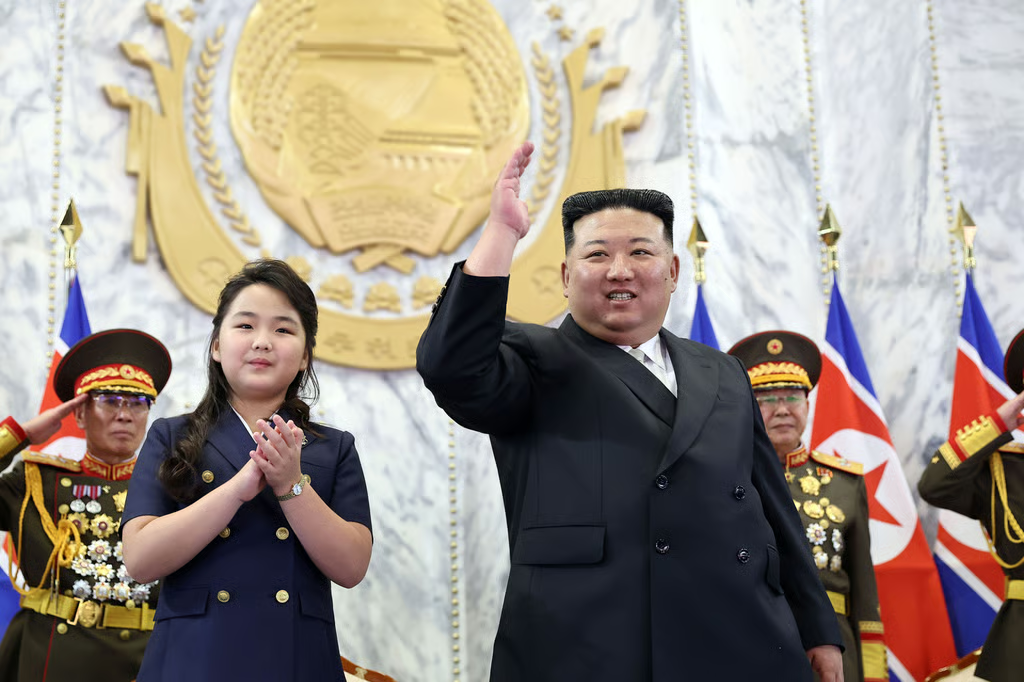

In a move that has captured international attention, the President of China has embarked on a high-profile visit to North Korea, marking a rare and symbolic moment in the diplomatic relationship between two of the world’s most closely watched nations. This visit comes at a time of heightened geopolitical tension between China and Western powers, particularly the United States, the European Union, and several Indo-Pacific allies. The journey underscores the complex, often opaque alliance between Beijing and Pyongyang and has prompted a flurry of global commentary on its potential strategic significance.


A Rare Diplomatic Gesture
The Chinese President’s visit to Pyongyang is only the second such visit in over a decade and the first since the COVID-19 pandemic closed North Korea’s borders to nearly all foreign dignitaries. It represents not just a political gesture, but a reaffirmation of the two countries’ historic partnership at a time when both face growing pressure from Western-led coalitions. The trip included high-level talks, a military parade, cultural displays, and symbolic visits to revolutionary monuments, all designed to highlight the shared ideological heritage and longstanding political friendship.
The Chinese head of state was welcomed with grand celebrations, complete with red-carpet receptions, synchronized parades, and displays of unity between the ruling Chinese Communist Party and North Korea’s Workers’ Party. Behind the pageantry, however, lies a more serious and strategic purpose — a recalibration of alliances and a bid to shore up regional influence.
Strategic Timing Amid Global Frictions
This visit comes as China finds itself embroiled in multiple fronts of international tension. Trade disputes with the United States, military maneuvers in the South China Sea, tensions over Taiwan, and accusations of espionage and cyberattacks have all contributed to a fraught diplomatic climate. Simultaneously, North Korea continues to ramp up missile testing and rhetoric against South Korea and the United States, sparking renewed calls for sanctions and heightened regional defense postures.

Beijing’s move to engage Pyongyang directly can be seen as a deliberate signal to the West. It reflects China’s broader strategy of strengthening ties with its historical allies to counterbalance what it perceives as containment efforts by NATO and the U.S.-led Indo-Pacific strategies. The visit also serves as a reminder of China’s potential leverage in regional security issues, including the denuclearization of the Korean Peninsula and the future of multilateral diplomacy in East Asia.
The Sino–North Korean Alliance: Historical Foundations
The relationship between China and North Korea is rooted in a shared ideological and revolutionary past. Both nations emerged from mid-20th-century revolutions and wars that shaped their current political systems. During the Korean War (1950–1953), China played a decisive role in supporting North Korea against U.S.-led United Nations forces, cementing a military and political alliance that has persisted—albeit unevenly—for decades.
The alliance is often described as being “as close as lips and teeth,” a metaphor frequently cited by Chinese and North Korean officials. While the relationship has undergone strains—particularly over North Korea’s nuclear ambitions and the international sanctions that followed—China has remained North Korea’s primary economic partner and political shield in international forums.
Diplomatic and Economic Objectives
From a diplomatic standpoint, the visit allows both China and North Korea to present a united front against what they perceive as Western hegemony. North Korea, suffering under severe economic sanctions and global isolation, welcomes any gesture of support from a powerful ally. The visit provides Pyongyang with legitimacy on the world stage and reaffirms that it has not been entirely abandoned.
For China, the visit also serves several domestic and international purposes. Domestically, it demonstrates strength and resolve in maintaining key strategic partnerships. Internationally, it communicates that China is not a passive observer in regional affairs, but an active shaper of the geopolitical environment.
Economically, there may also be discussions regarding limited border trade, humanitarian aid, and infrastructure collaboration. While most of these dealings are bound by international sanctions, subtle increases in trade or aid—especially in energy, food supplies, and medical equipment—could help alleviate North Korea’s internal pressures and strengthen bilateral trust.
Security Concerns and Military Implications
The visit has raised alarm bells in Seoul, Tokyo, Washington, and beyond. Military analysts and foreign policy experts are watching closely for any signs of enhanced military cooperation between China and North Korea, especially at a time when both nations are conducting increasingly provocative military exercises.
Though no official agreements have been announced, there is speculation that the two leaders may have discussed military coordination in case of a regional conflict, particularly involving Taiwan or the Korean Peninsula. The optics of the Chinese President standing alongside North Korea’s Supreme Leader during a military parade filled with ballistic missiles and conventional forces adds fuel to these concerns.
For the United States and its allies, the visit reaffirms the need to maintain strong deterrence and defense capabilities across the Indo-Pacific. It could lead to renewed joint military drills by the U.S., South Korea, and Japan, as well as further deployments of strategic assets in the region. The visit could also prompt the acceleration of trilateral defense agreements and arms modernization programs in East Asia.
International Reactions and Strategic Calculations
Western reactions to the visit have been mixed but largely cautious. The United States has reaffirmed its commitment to regional allies and emphasized the importance of diplomacy and deterrence. European leaders, while less directly affected, have expressed concern over the growing alignment between authoritarian regimes that challenge the rules-based international order.
Russia, another key player in the global power realignment, has welcomed the visit, viewing it as a potential precursor to a broader anti-Western bloc. In fact, the three countries—China, Russia, and North Korea—have been increasingly coordinating their diplomatic rhetoric and occasionally voting in concert at international bodies like the United Nations.
The implications for multilateral negotiations, such as the long-stalled six-party talks on North Korea’s nuclear program, are profound. With Beijing and Pyongyang demonstrating closer ties, the space for Western influence or mediation on denuclearization is shrinking. Diplomacy may need to take new forms, involving regional powers like ASEAN, or pivot to backchannel and humanitarian-focused approaches.
Humanitarian Dimensions
Beyond the strategic and military implications, the visit also raises humanitarian concerns. North Korea remains one of the most isolated and impoverished countries in the world, suffering from chronic food shortages, limited healthcare access, and economic stagnation. China, as North Korea’s largest and most influential neighbor, holds unique leverage in helping address these issues.
Observers hope that part of the visit’s agenda included quiet commitments to increase humanitarian assistance, especially in food and medicine. However, given the secrecy surrounding such matters and the sensitivities involved, concrete information is scarce. Nonetheless, any signs of greater Chinese support in humanitarian terms could be welcomed by international NGOs and UN agencies.
Future Outlook
Looking ahead, the Chinese President’s visit to North Korea could be a pivotal moment in the shifting dynamics of global power. As the world grapples with an increasingly multipolar order, the alignment of authoritarian regimes with shared interests and mutual insecurities is likely to become more pronounced.
While the immediate outcomes of the visit remain largely symbolic, the long-term implications are profound. It signals a recalibration of alliances, the reinforcement of ideological partnerships, and the projection of strategic resolve in the face of growing international friction. For China, it is a statement of leadership in the Asian sphere. For North Korea, it is a reaffirmation of relevance and survival.
For the rest of the world, particularly Western democracies, the visit is both a challenge and an opportunity — a challenge to maintain unity and deterrence, and an opportunity to reassess diplomatic strategies in an era where old alliances are being tested and new ones are emerging.
Conclusion
The Chinese President’s visit to North Korea is more than a diplomatic courtesy — it is a strategic maneuver at a time when global tensions are nearing new heights. It underscores the enduring bond between two of Asia’s most powerful and unpredictable nations, and it sends a clear message to the West: the balance of power in East Asia is fluid, and China is actively shaping it.
As the world watches closely, the visit may well mark a new chapter in 21st-century geopolitics, one defined not only by rivalry and realignment, but by the careful calculation of risks, interests, and global narratives.








