






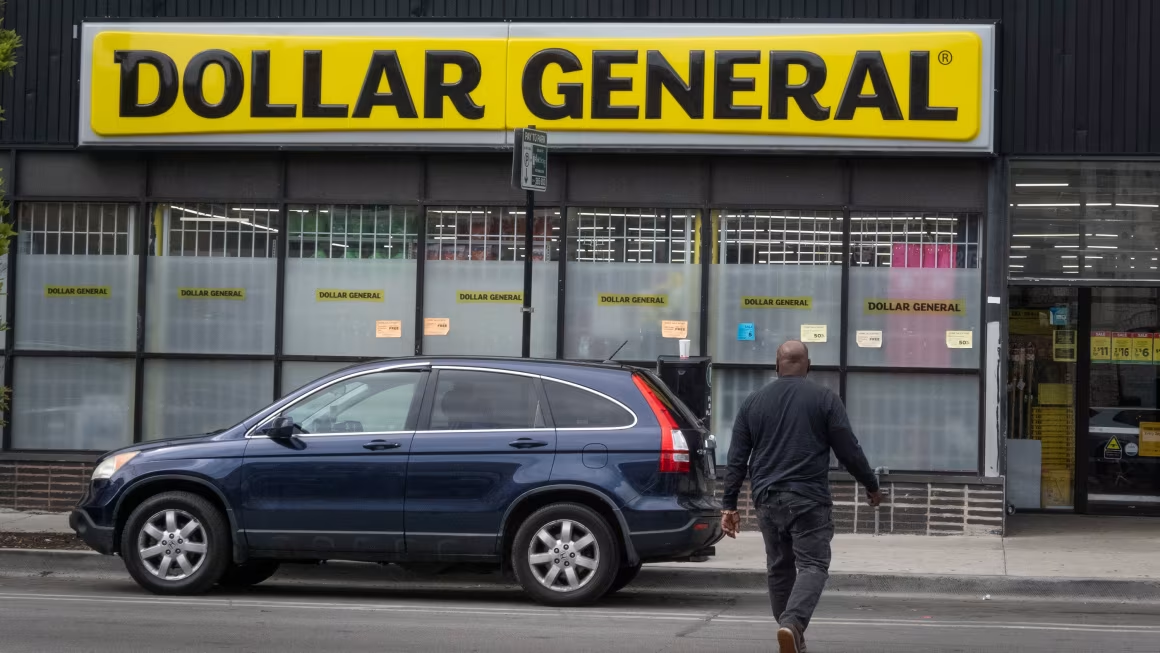


Amid growing economic uncertainty and shifting consumer behavior, Dollar General has emerged as a surprising winner — and possibly a harbinger of broader economic trouble. The discount retailer recently reported a notable uptick in foot traffic and sales, including a rise in visits from middle- and upper-income shoppers. While this is a positive development for the company, it may point to underlying strain in the U.S. economy, where even financially stable Americans are seeking lower prices amid fears of inflation and recession.


I. Dollar General’s Sales Growth Reflects Changing Consumer Behavior
1. Strong Quarterly Performance Surpasses Expectations
In its latest earnings report, Dollar General announced a 2.4% increase in same-store sales, outperforming Wall Street’s projections. This solid performance prompted the company to raise its profit forecast for the remainder of the year, driving its stock price up by 15% during early Tuesday trading.

CEO Todd Vasos emphasized the company’s adaptability, stating, “We believe we are well positioned to succeed in a wide range of economic environments.” That confidence appears to be paying off as consumers from various income brackets turn to Dollar General for savings.
2. Shoppers from All Walks of Life Are Turning to Discount Stores
While Dollar General traditionally caters to households earning less than $40,000 annually, the retailer is seeing growing traction with middle- and upper-income consumers. According to Vasos, new customers from higher income brackets are visiting more often and spending more per trip compared to last year.
This trend underscores a significant behavioral shift. As economic anxiety grows, consumers who previously shopped at premium or mid-tier stores are beginning to prioritize value and affordability — a space Dollar General has long dominated.
II. Economic Signals Behind Dollar General’s Success
1. Trade Tensions and Inflation Anxiety
The Trump administration’s trade policies have introduced volatility into the economic landscape, raising concerns over inflation and reducing consumer confidence. These developments have historically driven more consumers toward discount chains, and current trends appear to be no exception.
Consumer sentiment has dropped to some of the lowest levels on record, reflecting widespread unease about personal finances and the economy at large. Dollar General’s growth in this environment is consistent with past patterns where discount retailers benefit when consumers feel economically squeezed.
2. Market Share Gains in a Competitive Retail Environment
Vasos also highlighted Dollar General’s ability to capture market share from competitors, not only among its traditional customer base but also among more affluent demographics. This shift suggests that the chain is expanding beyond its roots as a rural discount store and becoming a go-to option for a broader segment of the population looking to stretch their dollars.
In an increasingly price-sensitive retail landscape, Dollar General’s extensive network — with over 20,000 stores across rural America — gives it a logistical advantage in reaching customers who may be scaling back on discretionary spending.
3. The Realities Facing Low-Income Consumers
While the store’s appeal is growing among higher earners, its core low-income clientele is facing worsening financial conditions. Earlier this year, the company reported that more of its shoppers were struggling to afford basic necessities — a stark indicator of growing economic hardship among America’s most vulnerable populations.
This segment, which forms the backbone of Dollar General’s customer base, is likely to feel the effects of rising costs more acutely, especially as prices inch upward due to external factors like tariffs and supply chain disruptions.
III. The Tariff Effect: Potential Headwinds Ahead
1. Imported Goods and the Threat of Price Hikes
One of Dollar General’s biggest vulnerabilities lies in its reliance on imported goods. While the retailer has tried to shield customers from price increases, Vasos acknowledged that tariffs may eventually force the company to pass on some of those costs.
“We expect tariffs to result in some price increases as a last resort, though we intend to work to minimize them as much as possible,” he said.
Tariff-related cost pressures may lead Dollar General to discontinue certain items or reconfigure its supply chain, strategies that could help maintain affordability but might also reduce product variety — a trade-off that could affect customer satisfaction.
2. Consumer Spending May Weaken Further
Looking ahead, Dollar General warned that rising costs associated with tariffs could dampen consumer spending even more. While current trends show strong performance, these gains may be tested if shoppers are forced to cut back further due to escalating prices.
The possibility of higher prices in a market already sensitive to affordability could deter some shoppers and potentially slow down the momentum that Dollar General has built over recent quarters.
IV. Broader Implications for the U.S. Economy
1. A Shift in Spending Habits Across Income Levels
The fact that wealthier Americans are now frequenting Dollar General stores suggests a fundamental change in consumer behavior. Rather than signaling success alone, this could reflect deeper anxiety about financial stability — even among those who traditionally had more purchasing power.
This behavioral shift may indicate that people are preparing for continued economic uncertainty, with even the middle class seeking cost-effective alternatives to weather potential downturns.
2. Discount Retail as a Barometer for Economic Health
Historically, increased activity in discount chains has been a reliable sign of economic distress. When consumers of all income levels begin flocking to value-based retailers, it often suggests that confidence in the economy is waning.
Dollar General’s current boom may therefore serve as a cautionary signal. While the company is thriving, the reasons behind that success — rising economic anxiety, falling consumer sentiment, and inflation fears — suggest that the wider economy could face turbulence in the months ahead.
Conclusion
Dollar General’s rising sales and expanding customer base underscore its growing importance in a shifting retail landscape. Yet the very trends fueling its growth — economic uncertainty, inflation concerns, and the trickle-down effects of trade policy — may be warning signs for the broader U.S. economy. As middle- and upper-income shoppers increasingly turn to discount retailers, it’s clear that financial caution is not limited to low-income households. Whether this is a temporary adaptation or a sign of deeper trouble remains to be seen, but the signals are hard to ignore: Americans are tightening their belts, and Dollar General is where many of them are turning.