






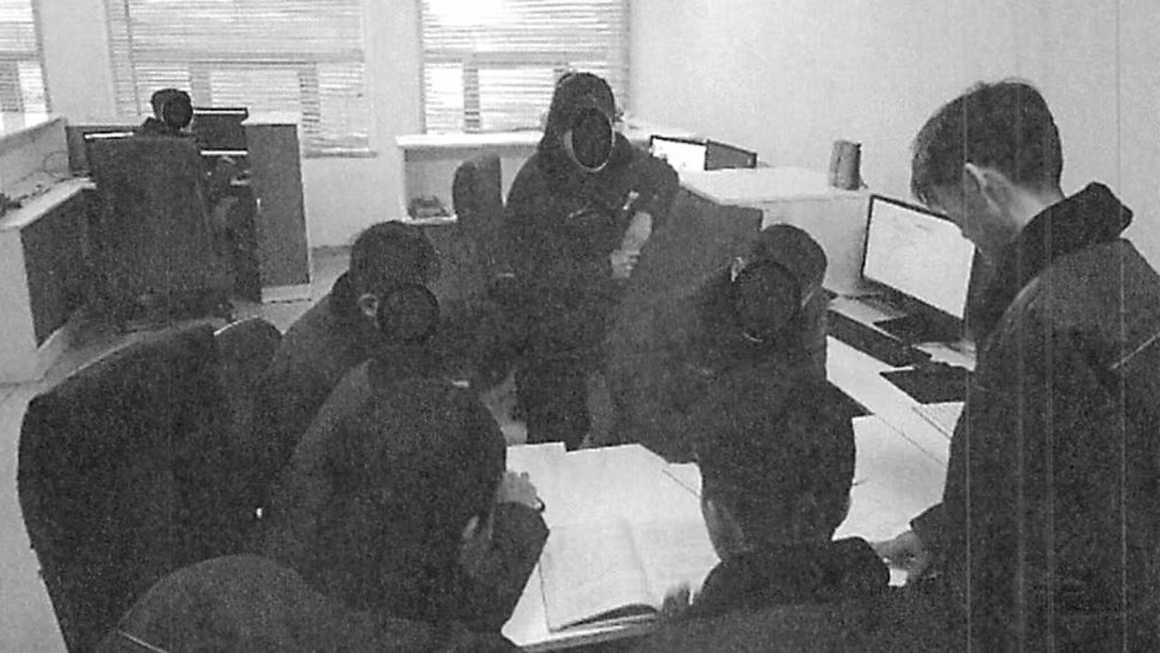


In a significant national security operation, U.S. law enforcement has dismantled a vast network of North Korean operatives who allegedly infiltrated American tech firms to generate revenue for Pyongyang’s weapons development efforts. The Justice Department announced the arrest of a New Jersey man and the execution of coordinated searches across 16 states, targeting “laptop farms” used to deceive U.S. companies into hiring North Korean IT workers. These workers, often aided by accomplices in the U.S., China, and other countries, secured positions at over 100 companies, some of which handle sensitive defense technologies.


I. A Complex and Covert North Korean Operation
1. Hiring North Korean IT Workers Under False Pretenses
According to federal prosecutors, the scheme involved foreign workers posing as U.S. residents to gain employment in American companies. With assistance from domestic collaborators, these workers accessed organization-issued laptops, which were then used from abroad to maintain the illusion that they were operating within the United States.

This deceptive method allowed North Korean nationals to bypass security protocols and collect data from internal systems. In one instance, they infiltrated a California-based defense contractor that specializes in artificial intelligence (AI) for military use, thereby exposing sensitive, export-controlled technology to foreign actors.
2. Financial Theft and Laundering
Beyond data theft, financial crime was also a core component of the scheme. Prosecutors revealed that four North Korean nationals stole over $900,000 in cryptocurrency from two companies—one located in the U.S. and another in Serbia. The stolen digital funds were subsequently laundered through a network of foreign accounts in an effort to obscure their origin and destination.
This illicit revenue is believed to have directly supported North Korea’s military and weapons development programs, a major concern given the regime’s ongoing nuclear ambitions.
II. American Citizens Implicated in the Scheme
1. Domestic Collaborators and Laptop Farms
One of the most concerning elements of this case is the growing involvement of U.S. citizens. The Justice Department cited a New Jersey man who operated what officials described as a “laptop farm,” remotely controlling access to over 100 company laptops. These devices served as remote entry points for foreign workers pretending to be located in the U.S.
Through these setups, North Korean IT professionals were able to gain access to confidential business systems, fooling employers and obtaining proprietary data, which was then allegedly forwarded to agents in North Korea.
2. Previous Prosecutions Linked to Similar Activities
This is not the first time Americans have been linked to North Korean cyber schemes. In the past year alone:
- An Arizona woman was charged with helping North Korean operatives use the identities of 60 U.S. citizens to apply for jobs at 300 U.S. businesses, including a major national television network and a well-known automotive company.
- A Tennessee man was arrested for allegedly assisting North Korean tech workers in posing as U.S. nationals to gain employment at tech firms in both the United States and the United Kingdom.
These incidents reveal a troubling pattern of domestic support that is helping North Korea bypass international sanctions and access lucrative job markets under false identities.
III. Broader Implications of the North Korean Threat
1. The Scope of North Korea’s Overseas Workforce
FBI officials have emphasized that the recently revealed cases represent only a fraction of North Korea’s global efforts to earn foreign currency. Intelligence estimates suggest the regime employs tens of thousands of overseas workers—many in tech and IT roles—whose wages are funneled back to the state, often used to fund missile programs and nuclear development.
These workers typically operate under false identities and can go undetected for months or even years. In some cases, they are able to pass standard hiring interviews and background checks, further complicating detection efforts.
2. Accidental Business Ties to North Korea
A previous CNN investigation uncovered the case of a California-based cryptocurrency entrepreneur who unknowingly hired a North Korean engineer. The business owner, who had no idea he was dealing with a sanctioned individual, was only informed by the FBI after the fact. Such cases highlight the difficulty in identifying and preventing this type of fraud, even for well-intentioned businesses.
3. Hidden Presence in U.S. Creative Industries
Surprisingly, North Korean influence has even reached American entertainment. Independent researchers discovered evidence that North Korean illustrators and animators were involved in producing content for U.S. animation studios. Artwork believed to be linked to North Korea was found on publicly accessible servers associated with the country’s limited internet infrastructure. This kind of infiltration demonstrates how deeply embedded North Korean efforts can become in global industries beyond just tech and finance.
IV. International Cooperation and Ongoing Investigations
1. Fugitive Accomplices Across Asia
The Justice Department has identified multiple foreign nationals who were involved in these schemes. Six Chinese citizens and two individuals from Taiwan have been charged but remain at large. U.S. officials are working closely with international law enforcement partners to locate and arrest these suspects.
2. Strategic Countermeasures
In response to these incidents, U.S. authorities are increasing efforts to educate companies on the risks of remote hiring, especially from unknown or unverifiable sources. Cybersecurity awareness, stricter background checks, and vigilance in IT hiring practices are being promoted to help prevent future breaches.
Government agencies, including the FBI and Department of Justice, have also reiterated the importance of reporting suspicious activities related to unauthorized access or potential identity fraud within organizations.
Conclusion: A Wake-Up Call for Corporate America
The revelation of North Korea’s elaborate and wide-reaching cyber employment scheme is a sobering reminder of how hostile states can exploit technological globalization for strategic gain. Through a complex network of false identities, remote access tools, and both foreign and domestic collaborators, Pyongyang has managed to penetrate American tech firms, steal valuable data, and generate significant funds to bolster its weapons program—all under the radar.
As companies continue to adapt to remote work and global hiring, the need for rigorous vetting, international cooperation, and heightened cybersecurity measures has never been more urgent. The recent arrests and ongoing investigations may have disrupted part of the network, but they also reveal how much more work remains in safeguarding critical national infrastructure from cyber-enabled threats.