






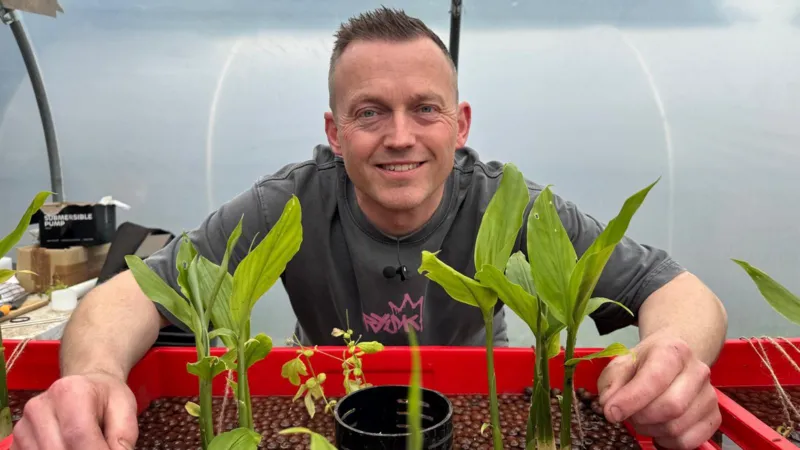


A determined entrepreneur from Grantham is calling on the UK government to rethink its approach to supporting small and medium-sized enterprises (SMEs) after facing years of obstacles in launching what he believes could be a game-changing agricultural venture. Alastair Hawken, the founder of Hawkens Gingerbread, has been striving to establish the country’s first commercial ginger plantation but says bureaucratic hurdles and lack of financial support nearly derailed his efforts. Despite repeated setbacks, he has pressed on, convinced that his initiative could transform the UK spice industry and significantly reduce reliance on imports.


I. A Vision for Sustainable Spice Production
1. The Drive to Grow Ginger Locally
Mr. Hawken, whose gingerbread products currently rely on ginger imported from China, was motivated by environmental and economic factors to explore domestic cultivation. Concerned about the carbon footprint associated with shipping ginger across the globe, he envisioned a more sustainable, UK-based supply chain. Recognizing the climate and potential for growing ginger in Britain, he embarked on a mission to grow two varieties — zingiber mioga and zingiber officinale — under controlled conditions.

This vision, however, was not matched by institutional backing. Hawken applied for a £50,000 grant through the Innovate UK fund to plant a trial crop but was rejected without explanation. “The potential is to totally revolutionize the spice industry, but I can’t tell you the number of times I’ve almost given up,” he remarked.
2. Turning to Community Support
Without official funding, Hawken turned to his local network for help. A neighbor stepped in voluntarily to build a hydroponic system — a soil-free method of growing plants using water enriched with nutrients. Installed in a polytunnel, this system is now successfully cultivating ginger, with the first harvest expected in November.

The project is a testament to grassroots innovation and resilience. Yet Hawken emphasizes that his story highlights the broader challenges faced by many UK entrepreneurs: “The government is fantastic at talking about strategies, but it has to understand there are so many barriers to small and medium-sized businesses in getting funding and support.”
II. Financial Challenges Facing SMEs
1. Lack of Bank Support
In addition to being denied grant funding, Hawken also struggled to secure traditional bank loans — even after landing a substantial order from an American client. With limited options and increasing pressure, he resorted to LinkedIn in a last-ditch attempt to raise funds. His plea gained traction, allowing him to gather £150,000 for raw materials, packaging, and payroll.
This experience echoes the frustrations of many small business owners who feel that financial institutions are failing to recognize their potential. Hawken noted that he even secured a private meeting at the House of Lords in search of answers about the funding gap — only to come away disheartened.
2. Political Acknowledgment but No Immediate Fix
The challenges faced by Hawken were brought to light on BBC’s Politics North programme, where he confronted Labour MP Olivia Blake. In response, Blake acknowledged the struggles and reaffirmed her party’s commitment to increasing research and development funding to £22 billion annually by the end of the current spending review. “I’m hoping a fair whack of that will go to small and medium-sized enterprises,” she stated.
Meanwhile, Wayne Dickson, leader of the Social Democratic Party group on Leeds City Council, said small businesses routinely raise concerns over rising national insurance, business rates, and limited access to capital. “Until that changes, the pressures are still going to be on those small and medium businesses that are the lifeblood of our society,” he said.
III. Government Response and Future Outlook
1. DBT Reaffirms Commitment to SMEs
A spokesperson for the Department for Business and Trade acknowledged that finance remains a major hurdle for SMEs and reiterated the government’s ongoing efforts to support them. “We’re determined to back these businesses as part of our Plan for Change,” the spokesperson said. They highlighted that the Chancellor had recently announced increased support for lenders to better assist small firms in accessing funding.
The government also pledged to unveil a new Small Business Strategy later this year, which is expected to outline more specific measures aimed at supporting entrepreneurship and improving access to capital.
2. A Broader Need for Reform
While these announcements signal potential progress, entrepreneurs like Hawken remain skeptical. Their experiences suggest that high-level strategies and political commitments are often slow to translate into real-world support. For innovative ideas with transformative potential, such as domestic ginger cultivation, the current system continues to present more barriers than bridges.
Hawken’s journey reveals a disconnect between governmental rhetoric and the lived experience of SME owners. It underscores the need for not just more funding, but also greater transparency, faster responses, and a culture shift within funding bodies and financial institutions toward risk-taking and innovation.
Conclusion
Alastair Hawken’s mission to establish the UK’s first commercial ginger plantation illustrates both the immense potential and the substantial roadblocks facing small business innovators. Despite institutional indifference, he persevered with community support and a belief in sustainable, local food production. His story shines a light on systemic issues that continue to hold back many UK entrepreneurs.
As the government promises further action through its upcoming Small Business Strategy, the real test will be whether such reforms can break down entrenched barriers and foster an environment where small enterprises not only survive but thrive. For now, entrepreneurs like Hawken remain hopeful — but cautious.