






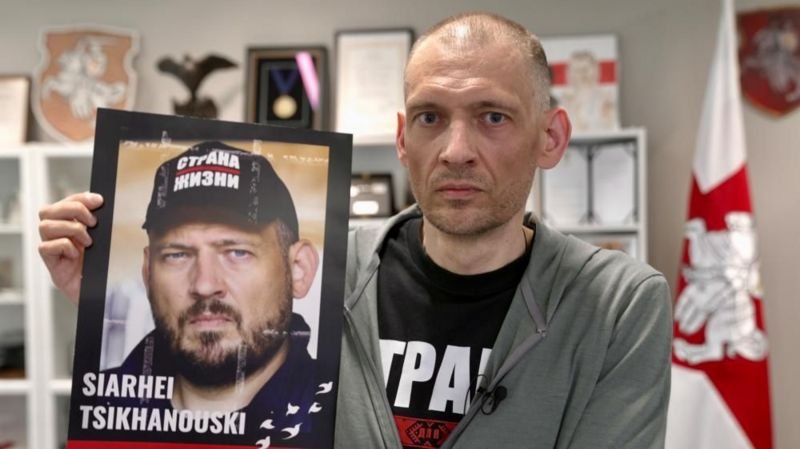


After enduring over five years in solitary confinement within a Belarusian high-security prison, Sergei Tikhanovsky, a once-outspoken critic of President Alexander Lukashenko, has finally been released. The former blogger and political prisoner is now in enforced exile in Lithuania, where he has begun to recount his harrowing experience and reflect on the ongoing political repression in his homeland. His release, part of a rare diplomatic opening between Belarus and the United States, has cast renewed light on the plight of more than a thousand political detainees still languishing in Belarusian prisons.

I. The Price of Dissent in Belarus
1. Arrested for Challenging the Regime
In 2020, Tikhanovsky rose to prominence through his YouTube channel, where he candidly interviewed everyday Belarusians about the struggles they faced under the Lukashenko regime. His attempt to register as a presidential candidate later that year was quickly met with arrest. His slogan—“Stop the Cockroach!”—was a thinly veiled jab at Lukashenko. Sergei’s wife, Svetlana Tikhanovskaya, would later run in his place and become the face of Belarus’s democratic opposition.
2. Solitary Confinement and Punishment
Following his arrest, Tikhanovsky was subjected to relentless mistreatment. He spent nearly the entire duration of his sentence in solitary confinement, enduring constant psychological and physical pressure. “I wasn’t allowed to write, speak, or even see a priest,” he recalled. His conditions were so dire that he lost around 60 kilograms (132 pounds). Kept in a cramped punishment cell with no mattress or proper sanitation, Sergei would wake hourly at night to do exercises just to stay warm and keep his limbs from locking up.
II. The Toll of Injustice and the Strength to Survive
1. A Harrowing Reunion
Upon release, Sergei’s emotions overwhelmed him, especially during his first reunion with his family. His daughter, who was just four years old when he was detained, didn’t recognize him at first. “She eventually threw herself into my arms, and we just held each other for a long time,” he said with tears. The years lost, especially with loved ones, remain a painful wound.
2. Mental Survival Tactics
To endure the isolation, Sergei explained that he had to block thoughts of his family from his mind entirely. “If you allow yourself to dwell on what your family is going through, you won’t make it,” he said. Despite the psychological torment, Sergei’s resilience remained intact. “I might be physically diminished, but my spirit is stronger than ever.”
III. A Diplomatic Breakthrough and Its Costs
1. Unexpected Release via U.S. Diplomacy
Sergei’s release came as a result of an unexpected diplomatic intervention. Keith Kellogg, a U.S. special envoy, traveled to Minsk in an effort to secure the release of American citizens. Surprisingly, Tikhanovsky was included in the outcome of that visit. This move marked a rare diplomatic opening for Lukashenko, who has been isolated from Western powers since violently suppressing mass protests in 2020.
2. Lukashenko’s Strategic Calculations
Sergei speculated that Lukashenko’s decision to free him and 13 other political prisoners was driven by a desire to re-establish limited contact with the West. “That was the price,” Sergei said. “He needed to show that a dialogue was possible with the United States.” However, Sergei emphasized that many prominent detainees like Maria Kolesnikova and Viktor Babaryka were still being held, and countless others remain unaccounted for.
IV. The Moral Dilemma of Bargaining with Dictatorship
1. The Pressure to Confess
In August of the previous year, signs emerged that the regime might consider releasing some political prisoners. Prosecutors began encouraging detainees to write letters requesting pardons from the president. Sergei, however, refused to admit guilt. “I am not a criminal,” he declared. “To confess would be to betray everyone who believed in me.”
2. The Opposition’s Stance on Sanctions
Svetlana Tikhanovskaya, now the de facto leader of the Belarusian opposition, celebrated her husband’s return but remains wary of any softening in Western pressure. “Sanctions should not be lifted until the repression ends,” she warned. While 14 political prisoners were released, at least 28 more were reportedly detained around the same time, underscoring the regime’s continued authoritarian grip.
V. A New Chapter in Exile
1. Reuniting with Family and Freedom
In his first week of freedom, Sergei has been rapidly adjusting to life outside prison. He’s made public appearances, met with politicians, and even reached out to former U.S. President Donald Trump with a personal message of gratitude. But perhaps most importantly, he’s finally had the chance to spend time with his children and catch up on five years of global events missed while in total isolation.
2. Avoiding Political Conflict at Home
Although Sergei was once the more politically active partner, he has no intention of stepping on Svetlana’s toes. “I have no desire to claim her position,” he said. “I only want to see a democratic Belarus.” His focus remains on the bigger picture—freedom for all political prisoners and justice for the people of his country.
Conclusion
Sergei Tikhanovsky’s release marks a moment of bittersweet victory for the Belarusian opposition movement. While his freedom brings hope, it also highlights the deep scars inflicted by years of repression. His survival story is one of unimaginable endurance, but also one of unfinished struggle. With over 1,000 political prisoners still held in Belarus, the road to democracy remains fraught with obstacles. As Sergei reintegrates into the world he was once cut off from, his voice—silenced for over five years—is once again an important weapon in the fight for freedom.