







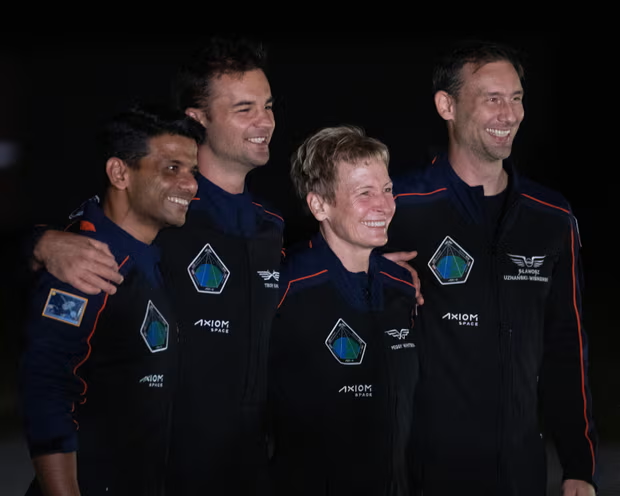


In a landmark event for international space exploration, a SpaceX rocket successfully launched four astronauts from the United States, India, Poland, and Hungary to the International Space Station (ISS) early Wednesday morning. This marks the first time in decades that these countries have sent citizens into space, symbolizing renewed interest and global cooperation in space travel.

I. A Multinational Team Aboard Ax-4
1. Launch and Mission Overview
The Axiom Mission 4 (Ax-4), a privately organized crewed spaceflight, lifted off from NASA’s Kennedy Space Center in Florida at 2:31 a.m. local time. It carried a brand-new Crew Dragon capsule—SpaceX’s fifth and final of its kind—atop the reliable Falcon 9 rocket. The spacecraft is scheduled to dock with the ISS on Thursday, with the crew expected to remain aboard the station for up to two weeks.

2. The Astronauts on Board
Leading the mission is Peggy Whitson, a former NASA astronaut who now represents Axiom Space, the company behind the mission. Joining her are Indian test pilot Shubhanshu Shukla, Polish mission specialist Sławosz Uznański-Wiśniewski, and Hungarian astronaut Tibor Kapu. This moment is particularly significant as it marks the return of these nations to spaceflight since the era of Soviet-led cosmonaut missions.
II. Historical Significance for India, Poland, and Hungary
1. A Long-Awaited Return
For India, the launch is a moment of national pride. Shukla becomes the first Indian astronaut in space since Rakesh Sharma’s Soviet-assisted mission in 1984. His participation is seen as a crucial step toward India’s ambitious Gaganyaan program, which aims to send a homegrown crewed mission into orbit by 2027.

2. National Reactions and Soft Power
Indian Prime Minister Narendra Modi celebrated the achievement, noting that Shukla “carries the hopes and aspirations of 1.4 billion Indians.” Shukla is also expected to hold a video call with Modi from the ISS, a gesture likely to boost domestic enthusiasm and international visibility for India’s space program.
Poland and Hungary, too, celebrated the mission as a symbol of national pride. Polish Prime Minister Donald Tusk shared video footage of himself watching the launch alongside children at the Copernicus Science Centre in Warsaw. He wrote: “Poland has reached for the stars,” expressing pride and hope for future generations of Polish astronauts.
Hungary’s participation, meanwhile, comes at a high cost. The country publicly confirmed it spent $100 million to secure its astronaut’s seat on the mission. India and Poland have not disclosed their contributions.
III. Challenges Before Liftoff
1. Delays and Political Tensions
The Ax-4 mission was originally set for early June but experienced several delays. The launch came amid tensions between SpaceX CEO Elon Musk and former U.S. President Donald Trump, who had previously advised Musk. A public feud between the two led to Trump threatening SpaceX’s federal contracts, while Musk responded by suggesting an early retirement for Crew Dragon—a move that would have severely impacted U.S. space operations.
2. Avoiding a Disruption in Space Cooperation
Despite the tension, Musk walked back his threat, later admitting on social media that he had gone “too far.” The incident served as a reminder of how intertwined SpaceX has become with U.S. space and defense operations, including critical cargo and crew launches for both NASA and the Department of Defense. Most analysts agree that any lasting fallout would be mutually damaging, making a serious rift unlikely for now.
IV. A New Addition to the Crew Dragon Fleet
1. Final Dragon Joins the Fleet
This mission debuts the fifth and final Crew Dragon capsule in the active SpaceX fleet, joining its siblings: Endeavour, Resilience, Endurance, and Freedom. The name of this new capsule will be officially revealed once it reaches orbit. It represents the last in this line of spacecraft before SpaceX transitions to its much larger Starship rocket in the coming decade.
2. Looking Toward the Future
SpaceX plans to gradually phase out the Crew Dragon fleet in the 2030s, replacing them with the more powerful and reusable Starship vehicles. These new rockets are currently under development and are expected to take on the next generation of deep space missions.
V. Scientific Goals and Research Aboard the ISS
1. Experiments to Be Conducted
Ax-4’s crew will carry out around 60 scientific experiments during their two-week stay on the ISS. These include research on how microscopic organisms like tardigrades survive in microgravity, the growth of microalgae, and the sprouting of salad greens in space—key studies for long-term life support systems on future space missions.
2. Axiom’s Broader Vision
Axiom Space is not only facilitating missions like Ax-4 but is also laying the groundwork for future private space stations. These commercial initiatives are intended to replace the aging ISS in the coming decades, offering orbiting research hubs for nations and private companies alike.
Conclusion
Axiom Mission 4 symbolizes a significant step forward in international space collaboration and the growing role of commercial spaceflight. For India, Poland, and Hungary, this mission revives their national presence in space after decades of absence. For SpaceX and Axiom, it is a testament to the increasing influence of private entities in space exploration. Despite political headwinds and technical challenges, the successful launch of Ax-4 opens new doors—not just for the astronauts onboard but for the next generation of global space explorers.








