







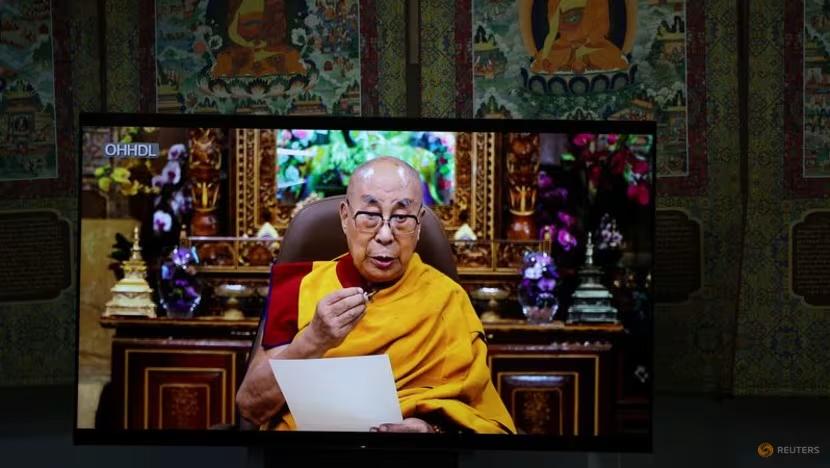

In a notable development that adds a new dimension to the long-standing geopolitical and spiritual tension between India and China, a senior Indian government minister has firmly stated that only the Dalai Lama and the organization he established have the exclusive right to determine his spiritual successor. This comment stands in stark contrast to Beijing’s persistent assertion that it holds authority over the reincarnation process of the Tibetan spiritual leader.

I. The Dalai Lama’s Stand on Reincarnation
Dalai Lama Reaffirms His Authority
Speaking earlier this week, the Dalai Lama reaffirmed his stance that the decision regarding his successor rests solely with him and the Gaden Phodrang Trust, the body overseeing Tibetan Buddhist affairs in exile. He emphasized that any such reincarnation would not be determined by any political regime and even suggested that his next reincarnation may be born outside of China. The Dalai Lama, who fled Tibet in 1959 after a failed uprising against Chinese rule, has long maintained this position, underscoring the spiritual and non-political nature of Tibetan Buddhism’s leadership tradition.
China’s Contrasting Claim
Beijing, however, continues to assert its authority over the succession process. According to the Chinese government, the right to approve the Dalai Lama’s reincarnation dates back to imperial times and remains a legitimate legacy. China’s claim is part of its broader policy of controlling religious practices within its territory, particularly in Tibet, where the Dalai Lama is viewed by Beijing as a separatist figure.
II. India’s Unprecedented Declaration
Kiren Rijiju Voices Support for Dalai Lama
Kiren Rijiju, India’s Minister of Parliamentary and Minority Affairs and a practicing Buddhist himself, made a rare and direct statement on the issue just days before the Dalai Lama’s 90th birthday celebration in Dharamshala, the spiritual leader’s longtime home in northern India. Rijiju categorically stated that “no one has the right to interfere or decide who the successor of His Holiness the Dalai Lama will be,” affirming that the spiritual authority to choose a successor lies only with the Dalai Lama or his recognized institution.

He added that the Dalai Lama’s followers across the world believe in his spiritual autonomy and that respecting his decision on succession is crucial for global Tibetan Buddhist communities.
Chinese Government Reacts
China responded swiftly and strongly to Rijiju’s remarks. During a regular press conference, Foreign Ministry spokesperson Mao Ning warned India not to interfere in what China considers its internal matters. She reiterated Beijing’s position that the 14th Dalai Lama is an anti-China separatist and cautioned India to act with prudence to avoid harming bilateral relations.
China’s warning underscores how sensitive the issue of Tibet remains for Beijing, especially when linked to foreign governments’ public positions.
III. Strategic and Diplomatic Implications
Tibet as a Diplomatic Lever
The presence of the Dalai Lama and the Tibetan government-in-exile in India has long given New Delhi a subtle yet powerful tool in its complex relationship with China. With India hosting tens of thousands of Tibetan exiles, the country provides a haven for Tibetan culture, religion, and political identity.
International relations analysts often note that India’s support for the Tibetan cause, while mostly non-confrontational, gives it diplomatic leverage amid its border tensions and economic rivalry with China.
Context of India-China Relations
Relations between the two Asian giants reached a low point in 2020 after a deadly border clash in the Galwan Valley, which led to military and diplomatic escalations. Although efforts to normalize ties have resumed, including high-level talks and military disengagement in certain border areas, trust remains fragile.
Against this backdrop, India’s open endorsement of the Dalai Lama’s authority could be interpreted as a subtle assertion of its values and a message to Beijing that New Delhi will not be dictated to on matters of spiritual or internal autonomy.
IV. The Cultural and Religious Significance
Dalai Lama’s Influence in India
The Dalai Lama is deeply respected in India, both as a religious figure and as a symbol of peace and compassion. He has lived in India since 1960, and his teachings have influenced millions, regardless of religion. His birthday is widely celebrated by Tibetan communities and Indian Buddhists alike.
Indian officials, including Rijiju, are expected to participate in the upcoming celebration of his 90th birthday, signifying ongoing public and political support for the revered spiritual leader.
Religious Freedom and Autonomy
India’s position also underscores its commitment to religious freedom and spiritual autonomy, particularly in contrast to China’s more controlled approach. By emphasizing that only the Dalai Lama can choose his successor, Indian officials are aligning with the global Tibetan community’s desire to maintain the sanctity of their religious traditions.
Conclusion
India’s affirmation of the Dalai Lama’s exclusive right to determine his successor marks a significant statement in the ongoing dispute over Tibetan leadership. It challenges China’s narrative and highlights India’s support for religious autonomy, even at the risk of provoking diplomatic tensions. As the Dalai Lama nears his 90th birthday, the question of succession becomes increasingly important—not only for Tibetan Buddhists but also for the geopolitical landscape in South Asia. Whether more nations will adopt a similar stance remains to be seen, but India’s position has undoubtedly added weight to the global conversation on Tibetan sovereignty and spiritual rights.








