







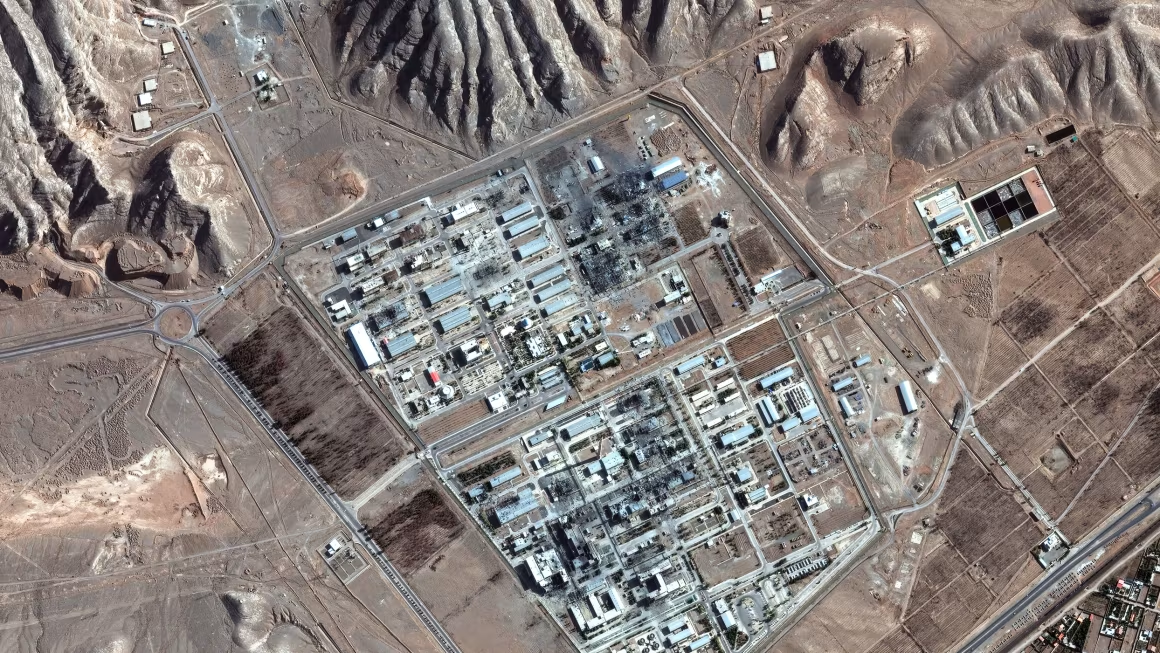
Iranian President Masoud Pezeshkian has formally enacted legislation that suspends the country’s cooperation with the International Atomic Energy Agency (IAEA), a significant move that could obscure any future efforts to revive Iran’s damaged nuclear program. The decision follows recent parliamentary approval of the law, which accuses the UN nuclear watchdog of aiding Israeli attacks on Iranian nuclear sites—a claim the IAEA has firmly rejected.

I. Implementation of the New Law
1. Presidential Directive and Targeted Agencies
President Pezeshkian has instructed the Atomic Energy Organization of Iran, the Supreme National Security Council, and the Ministry of Foreign Affairs to begin executing the new law, according to Iran’s official news agency IRNA. The timing and full extent of the law’s enforcement remain uncertain.

2. Potential Consequences for Monitoring and Transparency
This legislative action could enable Iran to restart aspects of its nuclear program without the oversight or verification mechanisms typically carried out by the IAEA. As a signatory of the Non-Proliferation Treaty (NPT), Iran is obligated to allow such inspections to ensure its program remains peaceful.

II. International Reaction and Diplomatic Fallout
1. IAEA Responds with Caution
A spokesperson for the IAEA stated the agency is aware of the reports and awaiting official communication from Tehran. The agency has not yet received formal notice outlining how or when Iran intends to implement the law.
2. Western Governments Condemn the Decision
The United States strongly criticized Iran’s move, labeling it “unacceptable” and urging immediate cooperation. State Department spokesperson Tammy Bruce emphasized that Iran has “a window of opportunity” to opt for diplomacy and economic growth instead of isolation.

3. European Concerns Over Setback to Diplomacy
Germany also condemned the move, with foreign ministry spokesperson Martin Giese stating it sends a “disastrous signal” and undermines efforts toward a diplomatic resolution. He stressed that working with the IAEA is essential to rebuilding trust.
4. UN Expresses Alarm
UN Secretary-General spokesperson Stephane Dujarric echoed concerns during a press briefing, reiterating Antonio Guterres’ calls for Iran to maintain cooperation with the IAEA to ensure transparency.
III. Recent Escalation and Background to the Law
1. Israeli and U.S. Strikes on Iranian Nuclear Facilities
Tensions escalated last month after Israel launched a large-scale attack targeting Iranian military leaders, nuclear sites, and scientists. In response, the U.S. conducted strikes on nuclear facilities in Natanz, Isfahan, and Fordow. Although the conflict ended in a ceasefire after 12 days, Iran reported extensive damage to its infrastructure.
2. Iran’s Commitment to Enrichment
Despite the attacks, Iranian authorities vowed to continue their uranium enrichment under what they claim is a peaceful program. The IAEA assessed that the U.S. strikes did not completely cripple Iran’s nuclear capabilities and that enrichment activities could resume within months.
3. IAEA Report and Iran’s Anger
Just prior to the Israeli offensive, the IAEA released a report expressing that it could not fully verify the peaceful intent of Iran’s nuclear ambitions and highlighted uranium enrichment at near weapons-grade levels. This led to a formal censure by the IAEA, which drew sharp criticism from Iranian officials, who accused the agency and its Director General, Rafael Grossi, of partiality.
IV. Historical and Religious Context
1. Religious Ruling Against Nuclear Weapons
Iran’s Supreme Leader Ayatollah Ali Khamenei has consistently denied that Iran seeks to develop nuclear weapons, citing Islamic principles that prohibit weapons of mass destruction.
2. Fallout from U.S. Withdrawal from Nuclear Deal
Iran intensified its uranium enrichment following the U.S. withdrawal in 2018 from the Joint Comprehensive Plan of Action (JCPOA)—a landmark nuclear agreement signed under President Obama. President Trump’s exit from the deal has since triggered a steady unraveling of diplomatic and verification mechanisms.
Conclusion
President Pezeshkian’s approval of a law to end cooperation with the IAEA marks a critical turning point in Iran’s nuclear trajectory and international relations. While Iranian officials frame the move as necessary self-defense against foreign interference, global leaders and watchdogs view it as a troubling retreat from transparency and diplomacy. With nuclear tensions again rising, the international community is watching closely to see whether Iran re-engages or isolates itself further.








